Seoul, Washington discuss plan to send envoy to North Korea

President Moon Jae-in, left, delivers his address in Singapore, 13 July 2018, and U.S. President Donald Trump speaks during a press conference in Washington. EPA-Yonhap
By Kim Yoo-chul
The government is discussing with the United States a plan to send a special envoy to North Korea, Cheong Wa Dae officials said Tuesday.
Kim Hyun-chong, deputy chief of the presidential National Security Office (NSO) met with U.S. Deputy National Security Adviser Charles Kupperman at the White House, Tuesday (KST), and discussed ways to break the stalemate in denuclearization talks between the U.S. and the North, including sending the envoy.
Kim and Kupperman also discussed the agenda for next week's summit between President Moon Jae-in and President Donald Trump, the officials said.
“One of the main issues at the Kim-Kupperman meeting was how to define denuclearization and to narrow the differences between the U.S. and North Korea,” one official said requesting anonymity. “It appears they also touched briefly on the possibility of sending a special envoy to North Korea.”
On the way back to his hotel after meetings with U.S. lawmakers, Kim told reporters that his talks with Kupperman were “good,” but didn't elaborate further.
Upon his arrival at the Dulles International Airport, near Washington D.C., March 31, he told reporters his visit was aimed at discussing issues for the upcoming summit.
Kim also met with Senator Dianne Feinstein and Senator Roy Blunt for talks on North Korea.
The official didn't specify who the envoy would be, but Cheong Wa Dae sources said National Intelligence Service chief Suh Hoon may fulfil the role.
The White House said the prospects of renewed nuclear talks between Washington and Pyongyang will be discussed during President Moon's visit.
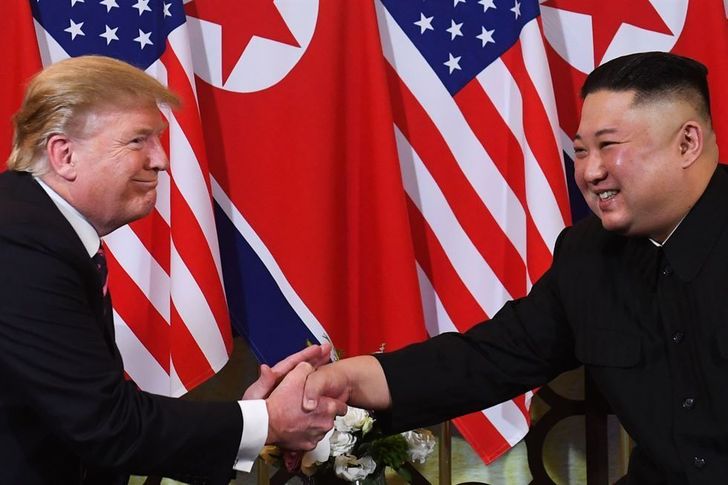
In this file photo taken on Feb. 27, 2019, U.S. President Donald Trump speaks with North Korean leader Kim Jong-un during their summit at the Sofitel Legend Metropole hotel in Hanoi, Vietnam. Yonhap
The presidential official said it was unlikely Kim raised the early resumption of frozen inter-Korean business projects with Kupperman, given the growing calls in Washington and from the U.S. intelligence community to maintain the current sanctions in place on the North.
“The alliance between the United States and the Republic of Korea remains the linchpin of peace and security on the Korean Peninsula and in the region,” according to a White House statement released after the meeting.
The United Nations said last month that food production in the North had fallen to its lowest level in more than a decade because of natural disasters and that the regime's foreign currency, food and oil reserves may not last the year. Given this, another Cheong Wa Dae official said that Kim and Kupperman may have touched on a partial easing of sanctions that directly affect North Korean people's lives.
According to some observers, the Hanoi summit between Trump and North Korean leader Kim Jong-un wasn't a complete failure as it allowed the two sides to better understand each other's core positions. The U.S. wants complete, final and fully-verified denuclearization before any sanctions easing, while the North wants a phased, step-by-step approach to nuclear disarmament.
They said President Moon must shift his role from being a “mediator” to a “facilitator” in order to push for another Washington-Pyongyang summit. U.S. Secretary of State Mike Pompeo said he hoped Trump-Kim would meet again “in the coming months” and make significant headway on ending the North's nuclear program.
“Kim Hyun-chong's focus during his meetings with U.S. officials and politicians was to assure them of the feasibility of top-down diplomacy between the leaders of the Koreas and the United States. He would also have pointed to Moon facilitating an early third North Korea-United States summit,” Koh Yu-hwan, a professor of North Korean studies at Dongguk University in Seoul, said.