'Seoul will discuss fine dust issue with Beijing': Ex-UN chief
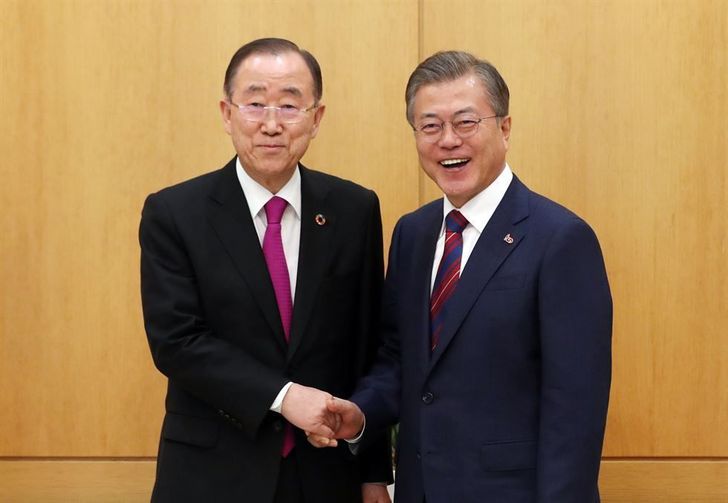
President Moon Jae-in talks with former U.N. Secretary General Ban Ki-moon at Cheong Wa Dae, Thursday. Yonhap
By Kim Yoo-chul
Former U.N. Secretary-General Ban Ki-moon, also chief of a newly established national committee to fight fine dust, said Thursday South Korea will “soon begin” discussions with China for “comprehensive measures” aimed at addressing the worsening air quality.
“South Korea designated the worsening air pollution as a national disaster. Record levels of fine dust have blanketed most of the country. Yes, this is a national disaster. We have to address it by developing relevant talks with countries in Northeast Asia including China,” Ban said in a press conference at Cheong Wa Dae.
President Moon Jae-in thanked the former U.N. chief for his decision to accept an offer to lead the committee upon his visit to the presidential office. The meeting lasted for 40 minutes from 2 p.m., Thursday, according to presidential spokesman Kim Eui-kyeom.
The committee chief asked relevant government agencies to stand together to tackle the air pollution “disaster.” “This is a problem facing China, as well. But I think this challenge fulfils the same purpose and is more manageable via thorough discussions with affected countries,” Ban told reporters.
Representatives from the government, National Assembly and social and civic groups will join the committee. The spokesman said the committee will send its recommendations directly to President Moon.
The idea of holding discussions with China came a few days after Beijing complained about Seoul's recent decision for coordinated efforts with the United States' NASA to jointly take on the issue.
The decision is calling for South Korea and the United States to use satellite observations to find out the exact source of dirty air particles, helping Seoul gain the upper hand in negotiations with China. China is denying claims that it is the main source of fine dust by saying the pollution is a “regional problem.”
“We can't address the issue hastily. It's important to find out the reasons by applying a scientific approach,” according to the committee head Ban.
The National Assembly passed a series of bills recently giving authorities access to emergency funds for measures including the mandatory installation of high-capacity air purifiers in classrooms across the country and encouraging sales of liquefied petroleum gas vehicles. These measures are regarded as “not good enough,” as air pollution has become a key political issue after the concentration of fine dust particles surged to record levels.
South Korean public health experts claim China is responsible for between 50 percent and 70 percent of fine dust pollution in the Seoul area. Experts say the particles from Chinese deserts and factories are carried to the Korean Peninsula by prevailing westerly winds.