Severance founder's philanthropic mindset touches Korean people
By Lee Min-hyung
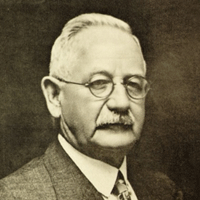
Oliver R. Avison
Oliver R. Avison, the late founder of Yonsei Severance Hospital, is best known for his commitment to the country's medical development in the early to mid-20th century. But his descendants remember him not just for his accomplishments here, but his philanthropic mindset for the Korean people.
Dr. Avison stood at the forefront to promote Western medicine in Seoul by opening the hospital and its education facility, the Severance Union Medical College, in 1904.
Avison arrived in Korean in 1893 and soon felt the need to improve Western-style medical education in Korea.
He thought the nation's first Western medical school, Jejoongwon which opened in 1886, had not served a proper role.
“It was felt that the school did not produce real doctors,” said Katie Black, a great granddaughter of Dr. Avison. She is based in Calgary, Canada, where she is a social worker. Black shared his story gleaned from conversations with her extended family.
Upon arriving in Korea with his wife and children, Avison started negotiations with the royal family, and received permission to reorganize Jejoongwon in 1894, she said.
“It was rebuilt as the Severance Union Medical College in 1904, named after benefactor Louis H. Severance, and its first seven medical school graduates became Korea's first medical doctors in 1908,” she said.
Two years later, however, Japan began its 1910-45 colonial rule on Korea.
At that time, it was not easy for him to run the institution, but Avison did not falter in his goal of promoting the Western medical system across Korea.
The Japanese colonial government prevented him from establishing a Korean university from the time of the March 1 Independence Movement in 1919.
“Dr. Avison was busy trying to establish a Korean university, but the Japanese government objected to the plan,” she said. “It was not until after liberation in 1945 and the reconstruction period following the 1950-53 Korean War that the Severance Union Medical College and Yonhi College were able to be merged as Yonsei University in 1956.”
She also shared another story about the doctor's response to Korean independence activists.
“I have also heard from my family that some independence-minded young people in the time of the struggle for Korea's independence from Japan's colonial activities told Dr. Avison that they want to die for their country,” she said.
Dr. Avison's response was: “Wouldn't it be better to live for your country?”
It was his sense of affection for the Korean people that pushed him to continue expanding his medical footprint here.
“He was very mindful of the hardships of the Korean people,” she said. “His memoirs recount a conversation he had with Japan's first resident general in Korea, Prince Ito, who wanted him and his fellow missionaries to influence the Korean people to be friendly with Japan.”
But Avison explained that he and his colleagues shared the firm position of non-interference in political matters here, but also acknowledged and got Ito to agree that it was quite natural for the missionaries to sympathize with the Korean people in their struggle, she said.
The 55-year-old descendant of the medical missionary also recounted a story on how passionate Avison had been in fulfilling his duties as such.
“The story that was told and retold many times in my family was about how my great grandfather influenced this, beginning with him mobilizing all the diverse missionaries and many local Korean people in the face of a coming cholera epidemic in 1895 ― a time when the disease was poorly understood and deeply dreaded throughout the world,” she said.
“It was the time when Yu Kil-chun, a then-politician and reform activist, called Dr. Avison in and, after consulting, asked him to take full charge of everything related to the prevention and treatment of the epidemic in and around Seoul,” she said.
Avison then ensured no cases of cholera developed within the palace walls, but also convened a group of missionaries in the area to come together as one “cholera-fighting squad.”