Trump cautious about progress in Hanoi summit
By Lee Min-hyung
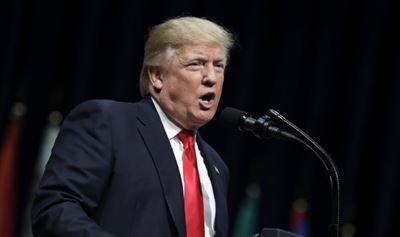
U.S. President Donald Trump
The United States will be in “no rush” to denuclearize North Korea as long as tough sanctions on the regime stay in place, U.S. President Donald Trump said Tuesday (local time).
“I have no pressing time schedule,” Trump told reporters at the White House. “I am in no particular rush. The sanctions are on.”
The remarks came about a week before the beginning of the second landmark summit between Trump and North Korean leader Kim Jong-un, Feb. 27 and 28 in Hanoi, Vietnam.
“As long as there is no testing, I am in no rush. If there is testing, that is another deal. But there has been no testing.”
As the summit approaches, preparations for the pre-summit dialogue are in full swing in the Vietnamese capital city.
On Wednesday afternoon, North Korean nuclear negotiator Kim Hyok-chol, who leads the regime’s working-level pre-summit delegation, arrived in Hanoi for talks with his U.S. counterpart Steve Biegun.
The leaders of each delegation will likely start having talks as early as Thursday to fine-tune the upcoming summit schedule and agenda.
Both sides are expected to focus on drafting a summit agreement which Trump and Kim will sign next week.
Expectations are that details of the agreement will include the U.S.’ corresponding measures in return for the dismantling of the North’s Yongbyon nuclear facilities.
Following the historic Singapore summit last June, the lack of what the regime calls “reciprocal steps” from the U.S. was the key reason their nuclear disarmament talks have stalled.
In May last year, Pyongyang demolished its Punggye-ri nuclear test site to express its firm determination for complete denuclearization of the Korean Peninsula. At that time, the regime invited a group of outside observers for the shutdown event.
The North has since called the move a sincere step to realize its pledge for denuclearization. But with the U.S. showing no signs of taking any reciprocal measures in exchange for such an event, the North started ramping up criticism on the U.S.
Washington, however, remained firm in its determination not to ease any sanctions on the regime until it realizes complete and verifiable denuclearization.
The rare reconciliatory momentum, following the historic Trump-Kim summit, has since shown little sign of progress due to such a lingering difference on the timeline and methods of the North’s denuclearization.
But earlier this year, the two leaders reached a consensus to break the ongoing deadlock in negotiations for denuclearization of the peninsula.
The upcoming second summit between Washington and Pyongyang takes place against that backdrop, with Trump and Kim expected to focus on ending the stalemate and resuming the denuclearization talks during their planned meeting.
To build a long-lasting relationship, both sides are also in advanced talks to build a joint liaison office which critics view will play a key role in normalizing their diplomatic relations.
Robert Gallucci, former top U.S. negotiator on the North Korean nuclear crisis, said the U.S. and the North can sign an agreement on establishing the office during the upcoming summit, according to Radio Free Asia (RFA).
RFA quoted Gallucci as saying that the possible agreement to build the office can be one of the reciprocal steps from the U.S. in exchange for the regime’s denuclearization steps.