Joint military committee to speed up inter-Korean tension easing

A guard post located on the South's side of the border county of Cheorwon, Gangwon Province, is being demolished on Nov. 15 as part of the fulfillment of the inter-Korean military agreement. / Joint Press Corps
Seoul, Pyongyang will fine-tune differences on military exercises, NLL
By Lee Min-hyung
2018 has been a year of peace on the Korean Peninsula, with Seoul and Pyongyang setting a basic framework for reducing inter-Korean tension.
For 2019, the two Koreas will give concrete shape to the framework by discussing taking more detailed steps to further relax the lingering military tension on the peninsula.
Officials say a inter-Korean joint military committee, set to be established in the very near future, will stand at the center to speed up the drive for inter-Korean reconciliation.
The two Koreas have yet to decide when to launch the committee. But as both sides have reached a consensus on its establishment, the committee will start its operation sometime in the first half of the year. It will focus on putting into practice the two Koreas' agreed-upon tension-easing steps.
The committee comes with symbolic significance, as this will mark the first time the two Koreas have launched such an organization after their botched attempt in 1992.
South Korea's Ministry of National Defense said the committee will be headed by vice minister-level officials on each side. Both committee members also plan to hold regular meetings on a quarterly basis to remain consistent with their bilateral pledge for disarmament under the common goal of building a nuclear-free peninsula.
Experts here say the top agenda for discussion will include continuous withdrawal of guard posts in the border area and suspension of joint military exercises between Seoul and Washington.
“The inter-Korean joint military committee will discuss timelines for the withdrawal of all guard posts in the demilitarized zone (DMZ),” said Kim Sang-ki, director of the unification policy division at the Korea Institute for National Unification (KINU).
Seoul and Pyongyang already reached a consensus on the complete withdrawal of guard posts in the DMZ during the latest inter-Korean summit in September in Pyongyang.
As part of a first step toward the move, both sides finished pulling out 11 guard posts on each side in the border region by the end of November.
“Aside from the withdrawal of the posts, the two Koreas will also narrow their differences on the Seoul-Washington regular joint military exercises that take place in the South's territory each year,” the expert said.
The joint military drills have been a decade-long principal bone of contention between Seoul and Pyongyang.
But the two Koreas are expected to clash while negotiating their differences on the military exercises.
Washington is in a position to scale down or suspend the joint drills when Pyongyang takes concrete steps for denuclearization. North Korea, however, wants the South to put a complete end to the joint drills with the U.S. in consideration of its ongoing peace gestures.
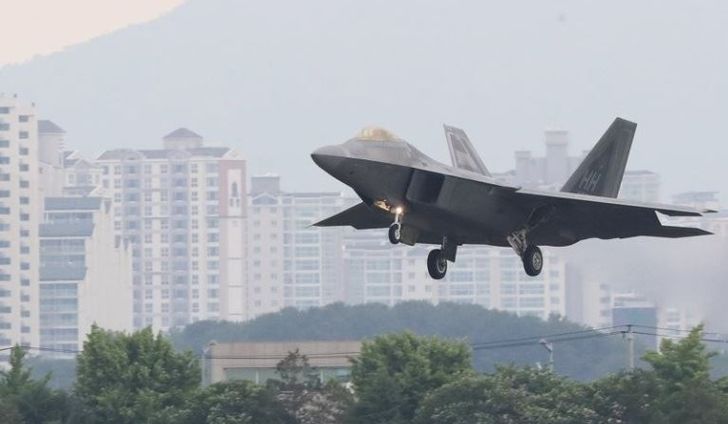
An F-22 Raptor fighter jet arrives at an air base in Gwangju after carrying out the Max Thunder Seoul-Washington joint air drill on May 16. / Yonhap
Kim Yeol-soo, director of the security strategy division at the Korea Institute for Military Affairs, said the possible suspension of the Seoul-Washington joint drills will be determined in line with the North's steps for denuclearization.
“It is tough for us to predict whether Seoul and Pyongyang can reach a consensus on the joint exercises, as it depends on the North's possible actions for peace and denuclearization,” he said. “If North Korea does not take any additional measures for denuclearization, the Seoul-Washington drills will resume and bring the ongoing inter-Korean dialogue momentum back to square one.”
Even before the committee is launched, the North is taking issue with a series of the South's military affairs, such as the increase of its national defense budget this year, so the expert said he remains pessimistic for the two Koreas to settle such big differences in a short period of time even after the launch of the committee.
Debate on NLL will continue
Another critical agenda to be discussed through the joint military committee is the disputed western sea border, officially known here as the Northern Limit Line (NLL).
The NLL issue has been one of the most controversial topics for the two Koreas, with the North refusing to acknowledge the line.
In the April 27 Panmunjeom Declaration, the two Koreas came to terms on establishing a peace zone near the NLL. For this reason, expectations were that leaders from both sides would sign any updated version of agreements on the NLL during their meeting in September.
The two Koreas, however, did not unveil any outstanding updates on the NLL issue during the Pyongyang summit.
“The joint inter-Korean military committee will discuss details on how to set a detailed location for the peace zone near the NLL,” the KINU expert said. But as they are not in an advanced stage of dialogue on the NLL issue, it is expected to take some time for them to settle the agenda, according to him.