Moon urges stronger readiness for peace

President Moon Jae-in salutes the national flag before the start of a briefing on the defense ministry's policies for next year, held at its headquarters in Yongsan, Seoul, Thursday. At left is Defense Minister Jeong Kyeong-doo, and right, Hong Young-pyo, the ruling Democratic Party of Korea floor leader. Yonhap
By Kim Yoo-chul
President Moon Jae-in said Thursday South Korea will maintain a strong military although a potential peace process is underway.
“How to maintain strong troop readiness is a top priority under my watch. We should maintain continuity and keep a strong defense because I believe peace can be achieved when we have a stronger military,” Moon said during a meeting with top generals and commanders.
This was held on the sidelines of the President's participation in a briefing on the Ministry of National Defense's priorities for next year, held at its headquarters in Yongsan, downtown Seoul.
Moon added that his summits with North Korean leader Kim Jong-un this year were momentous in terms of progress in talks regarding the North's denuclearization.
But despite this, Moon asked the ministry to “do more” to gain the trust of the public by pushing forward with military reform.
“What you have to do is move ahead with reform timely to ensure that the military is ready to defend the country from any external threats. The public is watching the ministry and its central role in reform, and it is the people who will evaluate this. I want you to be more transparent with regard to military budget spending,” Moon said.
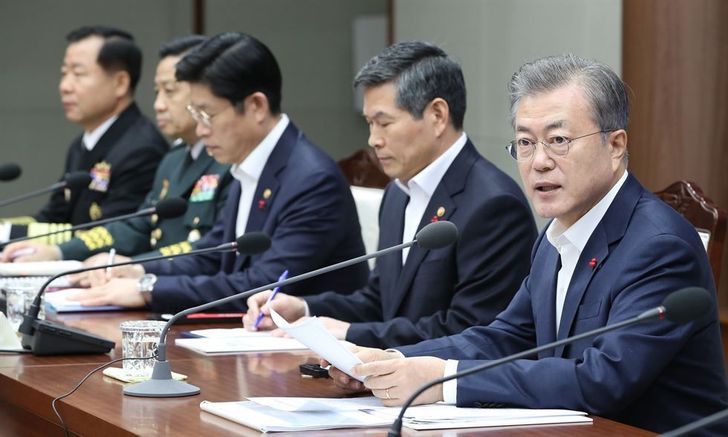
President Moon Jae-in delivers a speech in a meeting with top defense ministry officials and commanders on the ministry's briefing on its top policy objectives for next year, at the ministry's headquarters in Yongsan, downtown Seoul, Thursday. Yonhap
A record 46.7 trillion won will be spent on defense in 2019, up 8.2 percent from this year. In order to enhance military efficiency, the ministry plans to implement a force structure realignment based on advanced technologies such robots, radar-evading fighters and unmanned aerial vehicles (UAVs).
The two Koreas have destroyed a number of their border posts located near the heavily-fortified demilitarized zone (DMZ) as part of an agreed framework to reduce military tension between the sides.
The North and South Korea agreed in September to begin an arms reduction process on their respective sides of the DMZ and the Joint Security Area (JSA) that crosses it.
Washington accepted a request from Seoul to delay annual joint military exercises because measures to ease border tension between the two Koreas were being applied. However, USFK chief Robert Abrams recently said the pause in military exercises could eventually hurt troop readiness. Also, Moon's plans to ease border tension are receiving some negative comments from the South Korean public aged over 50.
Moon said the military alliance between Seoul and Washington will remain strong. “All preparatory processes relating to transforming the DMZ into a peace zone, to push forward the military accord agreed to by the two Koreas, and moves to transfer wartime operational control (OPCON) from the United States should be done in close consultation with Washington.”
The ministry said it will set up an inter-Korean joint military committee in the first half of next year to develop steps after the September military agreement.
Under the ministry's plan, a vice ministerial representative from each side is to lead the committee and a full session will be held once every quarter. The two sides will also set up several subcommittees.
The military authorities will hold discussions next year over the establishment of direct communication channels between their top defense officials, such as defense ministers and chiefs of joint forces.