NK may use summit for sanctions relief

President Moon Jae-in, right, walks toward an airplane to return home after ending his three-day trip to North Korea for a summit with his northern counterpart Kim Jong-un, at Samjiyon Airport on Sept. 20. / Joint Press Corps
By Lee Min-hyung
North Korea will continue seeking sanctions exemptions in exchange for its phased steps for denuclearization by bringing the issue to the table during any future inter-Korean summit, according to experts.
Such a scenario comes at a critical time when Washington and Pyongyang have reached a deadlock in their denuclearization talks, with both sides refusing to make any concessions on the timeline and methods for the North's nuclear disarmament
To make a breakthrough, calls have grown for South Korea to play a bigger role as a mediator between the U.S. and the North.
“What North Korean leader Kim Jong-un wants is sanctions relief from the international community and will likely use the promise of step-by-step denuclearization as a bargaining chip,” Cho Han-bum, a senior researcher of the policy unit at the Korea Institute for National Unification, said.
Denuclearization will, therefore, stand at the center of the dialogue agenda during any future meeting between Moon and Moon, the expert on inter-Korean affairs said.
“As is shown from their previous summit in September, they would likely continue their talks on denuclearization during the meeting,” he said. The chances are that Kim will provide a specific timeline for the shutdown of its Yongbyon nuclear facility on the condition that the U.S. takes reciprocal steps, possibly the lifting of some sanctions, according to Cho.
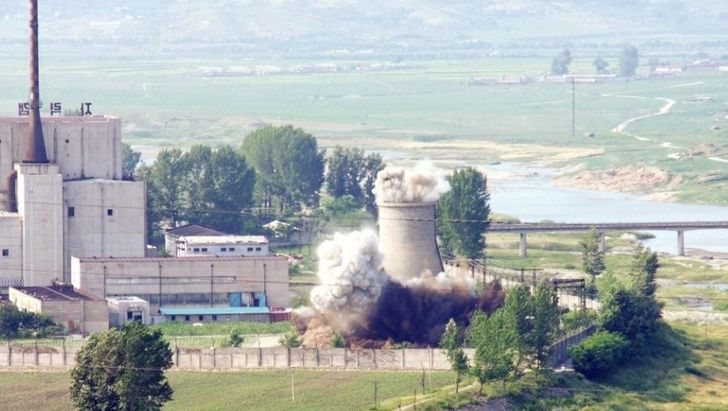
A cooling tower for North Korea's Yongbyon nuclear reactor is demolished on June 27, 2008. The North took the measure to display its willingness for denuclearization. / Yonhap
During the inter-Korean summit in Pyongyang, the North pledged to dismantle the facility if the U.S. took corresponding measures. But the move has yet to be realized, as Washington and Pyongyang have in recent months failed to recover their stalled dialogue momentum.
As part of efforts to resolve the deadlock, U.S. President Donald Trump has in recent weeks expressed his strong willingness to hold a second Washington-Pyongyang summit in the near future.
Last week, U.S. National Security Advisor John Bolton, who is cited as one of the hard-liners on North Korea, also hinted at the possibility of lifting sanctions on the regime.
“What we need to see (from the North) is performance,” Bolton said in an interview with local media. “When we get performance, then we can look at removing the economic sanctions.”
Under the diplomatic atmosphere, Seoul's mediating role is getting more and more important, as the South is the only country able to help narrow the difference between Washington and Pyongyang.
For this reason, Cheong Wa Dae hopes to hold a fourth inter-Korean summit as early as possible. During the last meeting between Moon and Kim, they agreed to hold a fourth summit before the end of the year.
But no talks are underway between the two Koreas over arranging a schedule for the possible Seoul summit this year, even with the year-end deadline approaching.
“There still remains a faint hope that the Seoul summit can take place this year as agreed-upon by the two leaders,” Cho said. “But if it is not held this year, we cannot rule out the possibility that the inter-Korean summit can take place after the second meeting between Trump and Kim next year.”
“This is because the North believes there is nothing to gain if Kim visits the South around this time when the U.S. shows no willingness to ease sanctions against the North,” said the expert.
Cheong Seong-chang, a researcher from the Sejong Institute also shared a similar view.
He said in a recent report that Moon and Kim will likely discuss denuclearization as the key issue at their next meeting.
“During the Pyongyang summit, Kim reiterated his determination to take additional steps toward denuclearization on the condition that the U.S. takes reciprocal measures in line with the June 12 Washington-Pyongyang meeting,” Cheong said.
The expert underlined the need for the North to be more specific on the reciprocal measures from the U.S.
“Kim needs to specify what the North wants from the U.S.,” he said.
On top of that, Pyongyang should provide a specific timeline to realize its pledge to dismantle a missile engine test site at Tongchang-ri as agreed upon with Moon during the Pyongyang summit.
The expert also called for Seoul to play a more active role as a mediator for the Washington-Pyongyang dialogue.
“Kim expressed his hopes to finish denuclearization of the peninsula in a swift manner during the Pyongyang summit,” he said. “Against this backdrop, there is a chance that Kim can bring to the discussion the destruction of nuclear warheads and long-range ballistic missiles during an upcoming meeting with Trump.”
“The South Korean government should actively persuade Kim to make such a deal in the second Washington-Pyongyang summit,” Cheong remarked.
Toward that end, Cheong suggested establishing three-way working-level talks among the two Koreas and the U.S.