'Sanctions relief key for North Korea denuclearization'
.jpg?w=728)
Seoul should continue persuading Washington over Kim Jong-un's pledge for peace
By Lee Min-hyung

Charles Armstrong
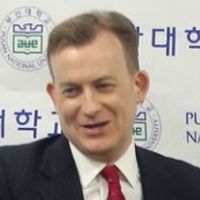
Robert Kelly

Hazel Smith
The United States and international society need to offer interim sanctions relief for North Korea, as such a phased step is essential to keep the regime's dialogue momentum moving forward, according to experts familiar with the inter-Korean affairs.
“Denuclearization and sanctions relief should not be approached in an all-or-nothing way,” Charles Armstrong, professor of Korean Studies at Columbia University, said in a recent interview.
“The two should be approached as a linked process moving forward step-by-step: as North Korea takes steps to dismantle its nuclear and missile programs and open them up to inspections, the international community should begin to ease sanctions,” he said.
Last month, Pyongyang offered to invite international inspectors to check on its Punggye-ri nuclear test site, which the regime said was dismantled in May, in a move to show its strong willingness for denuclearization.
Starting this year, North Korean leader Kim Jong-un has also reaffirmed his strong desire for completely scrapping his nuclear arsenal via multiple diplomatic channels, including summit talks with South Korean President Moon Jae-in.
However, he also called for the international society to take “reciprocal” actions in exchange for his ongoing steps for denuclearization. The reciprocal measures include the easing of heavy economic and political sanctions, even if Kim has not pinpointed them in public appearances.
“Near-term sanctions relief is essential to encourage North Korea to continue its progress toward denuclearization,” the North Korea expert said. Sanctions relief will create a positive feedback loop encouraging further progress in the ongoing denuclearization talks between Washington and Pyongyang, according to him.
Despite Kim's open pledge for denuclearization, chances are slim that he will denuclearize his country completely before the global community takes what he views as “corresponding” steps to guarantee his regime's security and economic development, said the professor.
“Both sides need to take reciprocal action in order to build trust, create a more secure regional environment and encourage North Korea's economic development,” he said. “Such an approach, with complete denuclearization and diplomatic normalization as long-term goals, will enable dialogue to continue and move forward.”
Robert Kelly, a political science professor at Pusan National University, concurred by saying it is tough for the U.S. and North Korea to sign a very specific and big deal over denuclearization under the current diplomatic circumstance.
“Big-bang deals with North Korea are too difficult,” the expert on inter-Korean affairs said.
“There is too much distrust on all sides to fix Korea in one big shot. We should bring North Korea to the table by offering a series of changes in sanctions and other things they want in exchange for things we want, such as inspectors, the destruction of nuclear and missile facilities, human rights improvements and so on.”
He views sanctions relief as a “reward” given to the North in return for its shift in behavior for denuclearization and human rights issues.
“Given that North Korea violated multiple United Nations Security Council resolutions in developing its nuclear and missile programs, the sanctions should not come off until there is verified movement on those issues ― or human rights,” he said.
In particular, the international community should take into serious account the egregious human rights conditions in the North, and its concrete steps for better human rights should also be a bargaining chip for sanctions relief, according to the professor.
“The human rights situation in the North is so bad that we should be willing to trade sanctions relief for human rights improvement as well,” he said.
Seoul's role as mediator
Starting this year, Seoul has played a mediator role in talks between Washington and Pyongyang.
Following two rounds of inter-Korean summits in April and May, the U.S. and North Korea held their first-ever historic summit where both sides reached a broad consensus to join hands to end the decades-long hostility between each other and bring peace to the peninsula.
Despite the landmark meeting between U.S. President Donald Trump and Kim Jong-un, Washington and Pyongyang have since failed to speed up their denuclearization talks.
A series of high-level and working-level dialogues between the two sides have been held to discuss follow-up measures for the June 12 summit in Singapore.
But they have not come to terms with each other after failing to see any progress in timetables for denuclearization.
The Columbia University professor said the primary role for President Moon Jae-in is to continue persuading Trump and ranking U.S. officials that Kim Jong-un is sincere in his pledge for denuclearization.
“The difficult task for the Moon administration is to persuade the U.S. foreign policy establishment, and not just President Trump, that supporting inter-Korean reconciliation is in the U.S. vital national interest and that North Korea is serious about denuclearization,” he said.
Such an idea is contrary to much of the conventional wisdom in Washington, so President Moon needs to keep “forcefully and consistently” making the point to politicians, policy-makers, academic experts and media in the U.S., according to the professor.
President Moon finished his European tour recently where he asked European countries for support on relieving sanctions imposed on the North, as Kim Jong-un is more than willing to fulfill his pledge for peace here.
But opposition parties here have stepped up criticism on Moon for being in a rush for sanctions relief of the regime despite no consensus being drawn over the timeline with Washington. They raised concerns that the posture may create a possible crack in the defense alliance between Seoul and Washington.
“Both the U.S. and South Korea should work in tandem to reach the common goals of peace and denuclearization,” the professor said. “Bilateral U.S.-South Korea dialogue, inter-Korean dialogue and U.S.-North Korea dialogue should lead to U.S.-South Korea-North Korea trilateral talks for peace.”
Hazel Smith, a North Korea expert who serves as professor emeritus at Cranfield University, said the Seoul-Washington defense alliance is “anything other than very healthy.” She said President Moon's North Korea policy is also in the right direction in that it reduces potential risks for the outbreak of war.
“Seoul and Washington more or less agree on objectives, but of course, as different states, have diverse national interests,” she said. “Put simply, if war breaks out, South Koreans will die, be made homeless, become displaced persons and be maimed. The U.S. is not in that position.”
“From the perspective as an outsider, President Moon's policy is a pro-South Korea policy in that it directly represents the interests of all South Koreans in its priority of threat reduction.”