Yongsan Legacy Korean rock legend's rocky start in 1950s Yongsan Garrison
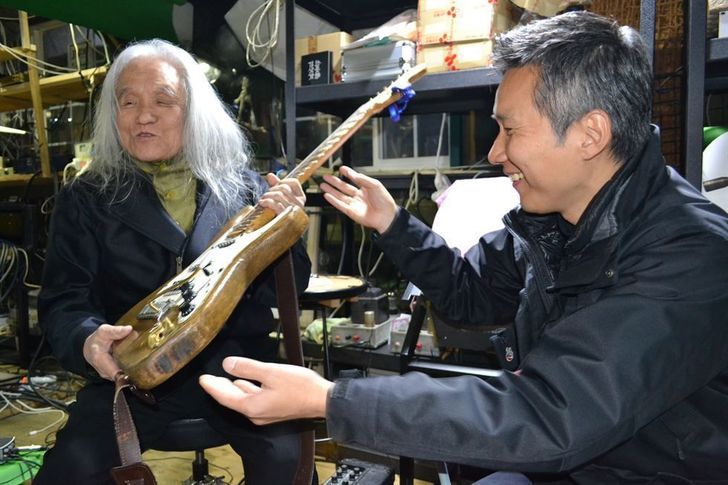
Shin Joong-hyun, left, and Yongsan Legacy co-founder Daniel Oh discuss Shin's "jailbroken" Fender electric guitar wired with parts from a Korean gayageum, which he is using to remaster his own classics. / Courtesy of Yongsan Legacy
By Kyung Lee
Shin Joong-hyun, just 17 years old, stepped foot on U.S. Army Garrison (USAG) Yongsan for the first time in 1955 ― a newly purchased electric guitar strapped across his shoulder which his former coworker at a pharmaceutical factory gifted to him. He'd received the green light to audition for the right to perform American classics at select clubs for the Eighth U.S. Army (EUSA) and other service members frequenting them.
Before Shin could demonstrate his acquired talents confidently in front of a committee inside the Annex I Club, however, a minor mishap occurred just prior to stepping on stage that could sabotage his chances.
“The amplifier wasn't working,” Shin said in a recent interview. “So after giving up on trying to figure out what was going on, I thought it was the end for me.”
He strummed his powerless electric guitar before the judges, after which he gave an infuriated kick to the hibernating amplifier, which screeched to life.
Shin fell short of the top AA-class clearance grade for incoming musicians looking to perform on base. Fortunately, the judges issued him a B-class clearance grade.
Granted a pass to prove he could improve on his disheartening audition, Shin was now tasked with learning how to emulate the popular American genres of the day, primarily rock 'n' roll and its psychedelic deviations.
“There was a vinyl jukebox playing in every club, so my bandmates and I would put some money into the machines to study the scores we liked,” he said. “We would also purchase sheet music sold in the compound to practice with our band.”
Other than sitting in front of jukeboxes, Shin adds that listening to American beats on Vagabond FM _ a once-nomadic radio station broadcast by American Forces Korea Network (AFKN) _ played a major role in helping him adapt to the music U.S. service members craved from back home.
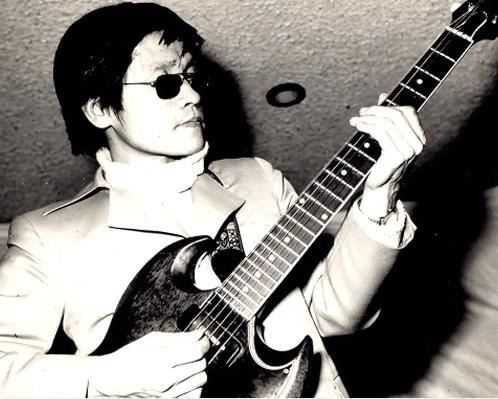
Shin Joong-hyun from May 2005 / Korea Times file
Having a clearance grade also offered privileges for the bands, allowing them to rehearse in places like the Annex I Club, a wide brick structure that Shin has called home from 1955 to this day.
Shin says Annex I fulfilled its function as a multipurpose sanctuary where he and his band could rest, practice, audition, and perform with various compositions they had selected to their liking.
“We would usually play rock 'n' roll until one day Park Soon-hwan (Jackie Park) walked into the dressing room and asked me for a spot in the band,” he said.
Famously known for covering classic titles like “The House of the Rising Sun” and Sam Cooke's “A Change is Gonna Come” in the later years of his career, Park's audition that evening infused Shin's group with a little more soul.
An African-American GI, Shin recalls, who happened to be standing at the club entrance, heard Park's Otis Redding-like vocals, then left the building only to return accompanied by his fellow soldiers.
“Hey man, you got some soul! Give me five!” one soldier yelled towards Park.
Having long been credited for his powerful voice, Park would prove his exceptional singing talents in the 1959 Spring Variety Show and in Shin's later compositions such as “Spring Rain” produced in 1970.
Contrary to the positive reception Park had received that evening, Shin was often met with heckles from the crowd that rattled his spirits while he strummed his chords aimlessly behind his bandleader.
“Hey, shorty! Play the guitar!” some privates would yell at Shin.
Noting that he was the youngest and shortest guitarist who was still unfamiliar with the charisma of American rock, Shin was teased to the point he didn't want to be remembered as the “adorable musician handling an oversized guitar.”
“That line kept following me until I asked one of the club managers for some vinyl from the jukebox,” he said. “And after listening to and practicing the solo for Guitar Boogie Shuffle all night, I put in a request for him to distribute sheet music to our band to perform the following evening.”
It was at the Siberian Club located in front of Yongsan Station at the time ― an EUSA-affiliated club appropriated for U.S. intelligence officers in attendance ― where Shin played his first-ever solo sitting behind the band leader, his head bowed in concentration.
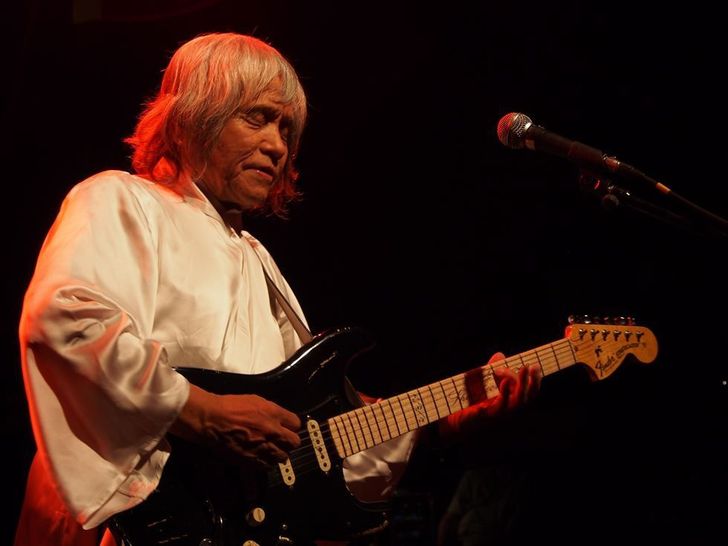
Shin Joong-hyun performs during an America tour in November 2012. / Korea Times file
“I don't really remember how I performed the solo,” he said. “During my strums, I was afraid I'd be ridiculed by my older bandmates for having played it.”
That is, until the contrabassist kicked the leg of Shin's chair, telling him to stand up and face the standing hurrahs from a rapt audience.
“A week after, a visiting club manager heard about my solo and offered me to play at his venue for a monthly raise of 10,000 won from the 3,000 won I was getting at the time,” he said. “I told my current boss I was quitting for that raise but then I decided to stay after he countered that offer with 12,000 won.”
Owing much of his sprouting stardom to his many gig opportunities on Yongsan Garrison ― namely its many clubs including Annex I ― Shin also credits his early development to the Jang Chung Dong Recording Studio located in Huam-dong, just north of the base.
Declaring it the very first studio of its kind in postwar Korea for a community of musicians practicing their own compositions, he recalls recording his solo there in 1958 with only a microphone stand, a few instruments and a military-issued sound recorder shared among other musicians.
Now 80 and recording in his own properly equipped home studio set up in the basement of his Yongin residence, Shin plans to remaster each song he performed in Yongsan and other U.S. bases in Korea.
“When playing each song, I can remember when and where I was writing my music,” he said. “My songs are like a mental record of my life and career in Yongsan.”
His new prize instrument is a Fender electric guitar that has been fused manually with elements of a gayageum, a Korean string instrument, to localize its vibrato capabilities.
“Perhaps Fender can make a modified guitar like the one I have, so the bands of today can pave a new generation of rock here in Korea,” Shin said.
Shin Joong-hyun's versatile career as a musician spans more than five decades since the Korean War, performing at clubs on U.S. military bases in Korea, including USAG Yongsan, which later helped introduce the gradual emergence of popular American genres to the listening Korean public already immersed in trot. Shin has also sought and cultivated talented musicians through the EUSA such as the Pearl Sisters. Long having established a formidable discography that includes his membership in the first Korean rock band Add 4, Shin has also been honored as the sixth recipient of the Fender Custom Shop Tribute Series “Shin Joong-hyun Tribute Stratocaster” as well as an electric dance music (EDM) version of his song, “Beauty,” played in the opening ceremony of the PyeongChang Winter Olympics.