Moon's mentor vows to overcome USKI fiasco
By Kim Rahn
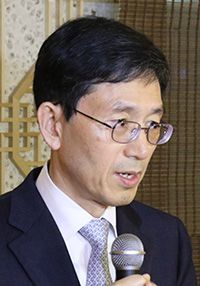
Seong Kyoung-ryung
The Moon Jae-in administration is determined to expand cooperation with U.S. experts about Korean Peninsula issues, despite a recent controversy over the government cutting funds for the U.S.-Korea Institute (USKI), Seong Kyoung-ryung, chairman of the National Research Council for Economics, Humanities and Social Sciences (NRC), said Wednesday.
Seong, who is widely considered as Moon's economic mentor, also said he will help mend relations with the Johns Hopkins School of Advanced International Studies (SAIS), which has the USKI under its wing.
Seong's remark came a day after the USKI announced it would close next month due to the funding cut from the Korean government, which has provided 2.1 billion won ($1.87 million) annually through the Korea Institute for International Economic Policy (KIEP).
The government said earlier this month it would stop the funding, citing problems of the USKI with transparency in accounting and selecting visiting scholars and interns. The NRC oversees state-run research institutes including the KIEP.
“If the KIEP and the USKI had discussed such problems and come up with agreements step by step, this situation (of conflict and the institute's closure) would not have happened,” Seong, who was appointed in February, said in a media briefing in Seoul.
“Our intention was not to sever ties with the USKI and Korea experts in the U.S., but to maintain and improve them. For better relations, we are contemplating all possible measures, including my visiting the U.S., by listening to relevant experts and mobilizing all U.S. channels of the NRC-governed 26 state institutes,” he said.
Seong expressed hopes to continue cooperation with the SAIS, adding it would be possible to expand cooperation for its Korea studies and Korean language programs.
He said the conflict stemmed from a different understanding about the funding between the two parties.
“The Korean government recognized the funding as a subsidy, while the USKI recognized it as a donation,” he said.
In government subsidy programs in Korea, an organization receiving it should submit very detailed reports about accounting, with receipts attached even for lodging, transportation and meals. But in case of a donation, the recipient does not need to do so.
Seong said he believes the different understanding made the USKI officials think the Korean government was meddling in its affairs when it asked the institute to submit detailed accounting reports, make clear its selection process of visiting scholars and set regulations about the institute head's terms and qualifications.
“When the KIEP demanded improvement of such systems, the USKI officials said it was a violation of academic freedom,” Seong said. “If they recognized the funding as a donation, their reaction is understandable.”
He said when the USKI was founded in 2006, the two sides did not make detailed agreements about the extent the USKI needs to report its accounting and other issues to the KIEP. “It is regrettable that the two parties have failed to talk about their different recognitions or try to come to an agreement.”
But Seong denied the USKI claim that the government's demands violated its academic freedom. “We have never raised an issue about the content of scholarly research.”
He also denied the government's alleged demand to replace USKI director Jae H. Ku, adding as far as he knows, there was no demand about a specific person's job.
Regarding USKI Chairman Robert Gallucci and Joel Wit, founder of 38 North, a USKI-affiliated website specializing in North Korea affairs, Seong said the government recognizes their contribution to Korean Peninsula issues. “We hope to have a chance to express to them our sincerity and to build a stronger and healthier cooperative relationship.”
He also expressed personal hope to continue cooperation with 38 North.
In the meantime, Wit said in a statement that the website would continue despite the USKI's closure.
Mentioning the KIEP's ending of funding for the USKI, Wit said that it was a very unfortunate development given the institute's history.
“Founded by Don Oberdorfer, a well-known Washington Post correspondent and long-time Korea watcher, chairmen of the institute have included Ambassadors Stephen Bosworth and Robert L. Gallucci, both former U.S. government officials who played key roles in shaping U.S. policy toward North Korea,” he said.
“Without commenting on the current controversy, I would like to assure our readers that 38 North will continue its operations despite the demise of USKI.”
It is said the website is receiving funding from other organizations.