Opposition party sends protest letter to Gallup
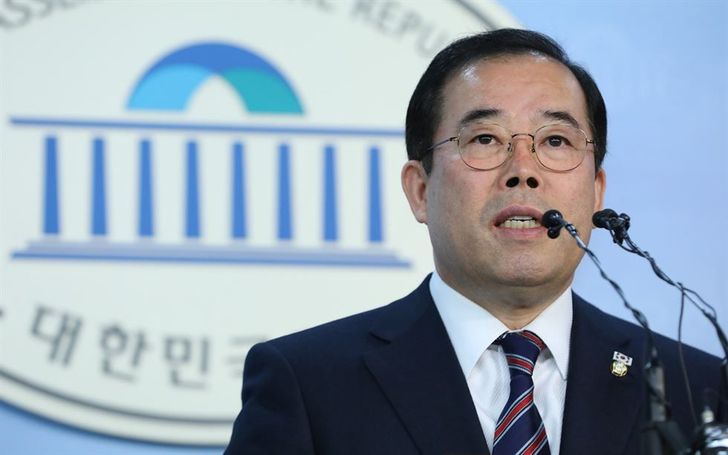
Rep. Park Sung-joong, PR chairman of the conservative Liberty Korea Party, criticizes Gallup Korea at a press conference, Tuesday.
By Choi Ha-young
The largest conservative opposition Liberty Korea Party (LKP) has sent a letter to U.S. consulting firm Gallup to protest what it called Gallup Korea’s “biased” opinion polls.
But Gallup Korea is not a subsidiary of Gallup, and has no business ties with the U.S. firm. Gallup Korea is a member of Gallup International, based in Switzerland since 1979. The U.S. firm withdrew from the association in 1993.
Company officials said the LKP is fully aware of this but is using the U.S. firm for a malicious campaign against Gallup Korea.
Rep. Park Sung-joong, LKP’s PR chief, said: “I think Gallup could have some leverage on Gallup Korea, since the latter has used Gallup’s reputation for its business.”
In the protest letter, the LKP claimed Gallup Korea uses biased methods for its surveys, unlike other pollsters. For example, the LKP gained a 12 percent popularity rating in Gallup Korea’s survey issued March 8. In a poll released by Realmeter on the same day, the LKP received 18.6 percent support.
The LKP claimed Gallup Korea discriminated against parties by arranging their names according to the Korean alphabet, not in order of Assembly seats.
“The order of names of parties may affect respondents choices for the survey and it can be favorable to a certain party and unfavorable to others,” Park said in the letter.
The party also took issue with the pollster’s survey methods, claiming it intentionally uses biased questions.
But Gallup Korea said it conducts surveys in consultation with the National Election Commission. “Such conspiracies have been raised always, since we began the survey service in 1987,” said Jung Ji-yeon, director of Gallup Korea. “If our surveys are really biased, the LKP could file a lawsuit rather than appeal to the public.”
According to experts, such gaps between polling agencies originate from differing survey methods. Gallup Korea hires interviewers who are charged with asking questions via phone, while other pollsters usually use an automated response system (ARS).
Experts view conservatives, a political minority amid the overwhelming popularity of liberal President Moon Jae-in, as being less likely to reveal their political inclinations in phone interviews, as shown in the term “shy conservatives.” However, they are less burdened in revealing their orientation using the ARS.
But Jung backed the company’s methodology. “In ARS, respondents without strong loyalty to certain parties easily skip polls. On the other hand, by doing interviews, our interviewers can persuade swing voters’ participation,” she said.
“It is more accurate to say Gallup Korea’s polls represent more nonpartisan citizens compared to other agencies. Without such benefits, the company has no reason to adopt the method which is more burdensome and expensive.”