Adieu turbulent 2017
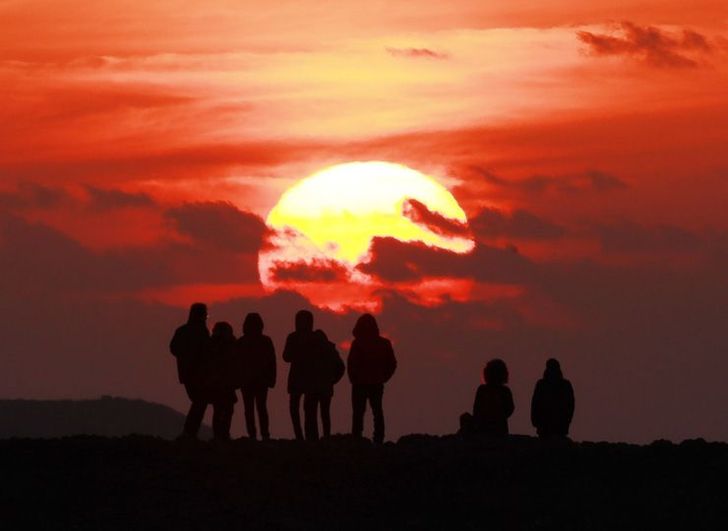
A group of people watch the sunset on Anmyeon Island in Taean County, South Chungcheong Province, Friday, bidding farewell to 2017. / Yonhap
By Jung Min-ho
The year of 2017 will be remembered for its many shocks and thrills.
The nation’s president was impeached and ousted for the first time in its democratic history. A new leader was elected two month later. North Korea claimed the completion of its nuclear arsenal.
Outside the Korean Peninsula, political upheavals, wars and terrorism created the potential for a fundamental change in the world order.
Here, the year began with candlelight. Almost every weekend, crowds thronged the streets with candlelit vigils. In one voice, they demanded the Constitutional Court remove Park Geun-hye from the presidency over a massive corruption scandal involving her friend Choi Soon-sil.
On March 11, the court upheld the National Assembly’s impeachment motion, making her the nation’s first president to be ousted peacefully by the court. It was a moment of triumph for the common people who rose up against those in power who had forgotten who holds the power in a democracy.
The ruling immediately triggered the race for the next president. Moon Jae-in, the son of North Korean refugees and a former human rights lawyer, came to power on promises of a fairer and more just society. During his May 10 inauguration, Moon promised to do everything he could for peace on the Korean Peninsula.
The task was never going to be easy. Donald Trump, sworn in as U.S. president the same year, already vowed to shake up U.S. foreign policy ― a signal of profound changes to the very nature of its relationship with South Korea, for the first time since the end of the Korean War.
At the same time, under the strong leadership of Xi Jinping, China flexed its political muscle to pressure South Korea over the deployment of a U.S. anti-missile system here.
China’s economic retaliation over the Terminal High Altitude Area Defense (THAAD) deployment was one of the most complicated issues the Moon government and Korean firms had to deal with throughout the year.
The biggest national security crisis came on Sept. 9, when North Korea conducted its sixth nuclear test. The regime later claimed it had successfully tested a hydrogen bomb small enough to be fitted in an intercontinental ballistic missile that can strike anywhere in the United States mainland.
The test, which allegedly achieved the very thing Trump warned not to, escalated tension in the region. Just a month ago, Trump threatened North Korea would meet with “fire and fury” if it continued to develop nuclear weapons capable of striking America.
It was also a year of many unusual natural phenomena around the world, and here was no exception. A magnitude 5.4 earthquake hit Korea’s southeastern city of Pohang on Nov. 15, sending shockwaves throughout the country.
It was the second most powerful tremor felt in Korea in the whole time it has been collecting seismic records since 1978. Smaller quakes continued to hit the area, which brought about calls for more government investments into earthquake-resistant technologies.
The beginning of the countdown for the PyeongChang Olympics was one of the most exciting events of the year for Koreans. On Nov. 1, the Olympic flame was lit, precisely 100 days ahead of the opening ceremony for Korea’s first-ever Winter Games.
Few Koreans believe 2018 will be any easier; North Korea now possesses nuclear weapons that may not be able to strike the United States but have no problems reaching here; Trump will intensify the pressure on North Korea and China’s THAAD retaliation is still in place.
But there is room for hope, as Koreans have successfully coped with many difficulties over this tumultuous year, and they will begin their new year with the Olympic torch instead of candles this time.