LKP ends audit boycott after taking flak
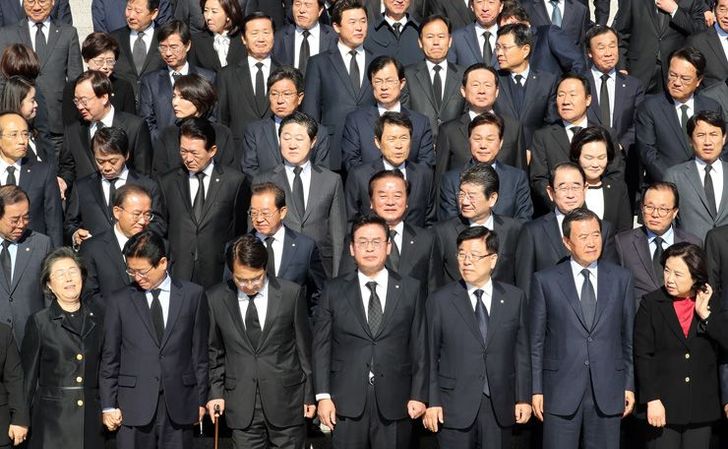
Lawmakers of the conservative opposition Liberty Korea Party (LKP), wearing black suits and ties, hold a rally at the National Assembly, Monday, to protest what they claim is the liberal government’s intervention in the operation of public broadcasters. They claimed public broadcasters are already “dead,” but according to surveys, a majority of Koreans back government-led reform of the broadcasters, which are still managed by people appointed under the previous Park Geun-hye administration. / Yonhap
By Kim Rahn
The main opposition Liberty Korea Party (LKP) returned to the National Assembly audit of government agencies Monday, four days after it decided to boycott the inspection to protest the government’s alleged “attempt to control media.”
Other parties denounced the LKP’s flip-flopping decision, saying the boycott lacked a proper reason and failed to achieve anything, only impeding Assembly sessions.
After a general meeting of party members, LKP floor leader Chung Woo-taik said the party decided to return to the audit. “The boycott was a minimum protest as an opposition party against the government’s plot to control broadcasters,” he said.
The party announced the boycott Thursday after the state broadcasting authority, the Korea Communications Commission (KCC), filled two vacant seats of the nine-member board of the Foundation for Broadcast Culture (FBC) with “pro-government” figures. The two seats had been previously taken by figures recommended by the former ruling party now named the LKP, and they resigned amid growing criticism of the FBC’s failure to maintain political neutrality.
Despite ending the boycott, Chung said the party would continue protesting. LKP lawmakers began wearing black suits and ties as if they were at a funeral, to symbolize “public broadcasters who are dying due to the Moon Jae-in administration’s control.” They also put signs reading “Stop media control that infringes on democracy” on their laptops at the audit sessions.
But the four-day boycott has drawn neither public support nor any feasible achievement. The audit ends Tuesday, so the LKP lawmakers’ absence did not have much impact on the audit sessions. The party will also face public criticism if it continues to snub future Assembly sessions and events including President Moon’s national address slated for Nov. 1 and U.S. President Donald Trump’s speech on Nov. 8.
Other parties welcomed the LKP’s return to the audit, but criticized it for its “habitual boycott.”
“The retraction of the boycott was a reasonable and natural decision,” Rep. Kang Hoon-sik, a spokesman of the ruling Democratic Party of Korea (DPK), said in a statement. “The decision proved the LKP’s boycott was an unreasonable one just aimed at political strife.”
The minor liberal People’s Party also said the people may see the LKP as “a party of habitual boycott.”
The minor conservative Bareun Party said the people are not interested in the LKP’s decision to boycott the audit and its later decision to withdraw the boycott, saying the LKP is in “a league of their own.”
“The LKP is the major opposition party with more than 100 seats, but it gets pathetic without self-reflection and reform,” said Park Jeong-ha, a spokesman of the Bareun Party. “The audit has two days left and the LKP has wasted time. It says it did this and it did that during the boycott, but I can’t see anything it achieved.”
A public opinion poll also showed the cause of the LKP’s boycott — to protest the Moon government’s “media control attempt” — did not gain much public sympathy.
In a poll conducted Friday on 500 adults by Realmeter, 55.6 percent of the respondents said the KCC’s appointment of two new directors at the FBC was a good step to “normalize public broadcasters,” while 26.8 percent said it was the Moon administration’s attempt to control the media.