Moon unveils five-year policy roadmap
Planning committee presents 100 tasks for construction of new Korea
By Kim Rahn
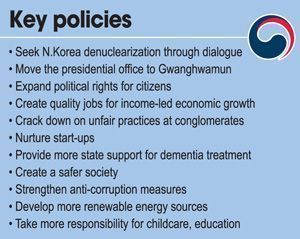
The Moon Jae-in administration unveiled its policy roadmap for his five-year presidency Wednesday.
With a state management philosophy of “The People’s country, just the Republic of Korea,” the new government’s policies will be carried out based on the principles of reflecting citizens’ opinions in state affairs, and providing a just and fair economic and social system, according to the presidential advisory committee.
The State Affairs Planning Advisory Committee, the de facto transition team for the Moon administration which was inaugurated without a transition period, presented 100 tasks under five main policy goals, each dedicated to political reform, a fair economic system, expanded welfare, balanced regional development and peace on the Korean Peninsula.
Moon said the new government will succeed the spirit of the candlelit protests that removed former President Park Geun-hye from power over a massive corruption scandal.
“We’ll make a people’s country where citizens are treated as owners, and make a just Republic of Korea where all privileges, unfairness, discrimination and disparity are eradicated,” the President said at the committee’s presentation of the agenda.
He said changes have already begun ― presidential orders to abolish state-authored history textbooks and reduce fine dust, the restarting of trans-government anti-corruption meetings, a minimum wage hike toward 10,000 won ($8.91) per hour by 2020, the operating of a job creation committee and measures to improve inter-Korean relations.
“The roadmap announced today will be a blueprint and compass toward a new Korea,” Moon said. “Each ministry and agency in charge will develop and confirm the agenda and carry out its tasks. At the end of every year, I’ll check on how they are proceeding and report this to the public.”
Kim Jin-pyo, head of the committee, said the Moon administration will reflect people’s opinions in state affairs, expand their participation in politics, provide equal opportunities and guarantee fair systems.
“The Sewol ferry tragedy in 2014 and the candlelit protests in 2016 showed why a country should exist and how its power should be exercised, bringing in a new spirit of the times,” Kim said.
Starting May 22 for 54 days, the committee collected public opinions online and offline from 165,000 people and reflected many of them in the policy agenda.
Fight against corruption
Under the roadmap, the government will seek transparency in state affairs and social systems by setting up an independent anti-corruption body by 2018, cracking down on conglomerates’ unfair business practices and eradicating corruption in the defense industry.
It will seek dialogue with North Korea for its denuclearization, and law revisions to expand citizens’ political rights. The administration will also focus on creating quality jobs and nurturing startups, providing more welfare such as support for dementia treatment and childcare, improving disaster management systems and developing more renewable energy sources.
Through 2018, the government plans to first carry out policies that do not require legislation, as well as seeking the National Assembly’s cooperation to establish laws for bigger projects.
With outcomes of the policies coming gradually, it expects most of the plans will be in the finalizing stages around 2021.
The roadmap, however, faces hurdles: budget shortages and parliamentary resistance.
The committee expects the five-year agenda will cost 178 trillion won, adding the government can secure the money through increasing tax revenue to 83 trillion won and decreasing expenditure to 95 trillion won.
But it is to be seen whether the government can collect as much money as planned.
Also, many of the policies will require new laws or revisions, and they may be unattainable if the government fails to get the opposition parties’ cooperation as the ruling party does not hold an absolute majority.