President calls for bipartisan support for job creation
.jpg?w=728)
President Moon Jae-in calls for the passage of the supplementary budget bill during his first speech to the National Assembly, Seoul, Monday. / Korea Times photo by Koh Young-kwon
President pleads for passage of supplementary budget
By Kim Rahn
President Moon Jae-in called for bipartisan passage of an 11.2-trillion-won ($9.95 billion) supplementary budget bill drawn up for the creation of jobs for young people in a speech to the National Assembly, Monday.
This is the first time that a president has given a parliamentary speech regarding an extra budget.
His visit to the Assembly comes as his reform measures and personnel affairs face a deadlock just a month after the start of the new government mainly due to protests from the opposition-dominated parliament. The government submitted the budget bill Wednesday, hoping for its passage during the Assembly’s June session.
“I seek the Assembly’s cooperation so the government can carry out jobs creation and support measures immediately starting in the latter half of this year,” Moon said. “If we leave the unemployment situation as it is, it may grow to a disaster-level economic crisis.”
The bill is focused on creating jobs and reflects common pledges offered by most candidates during the presidential campaign, he said.
“It prioritizes creating jobs for young adults, especially in the public sector.”
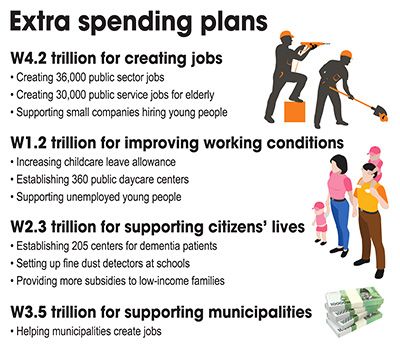
The government aims to increase the number of civil service jobs _ including firefighters, police officers, social workers and positions at daycare centers and welfare centers for dementia patients _ by 36,000.
“Through these jobs, we can resolve youth unemployment and improve social services at the same time,” Moon said.
He added that the government will also provide subsidies to small companies that hire young workers, and offer 300,000 won per month to young adults for up to three months to pay for their expenses in seeking employment.
The extra budget is additionally aimed at helping mothers continue to work through more support for childbirth and childcare.
“Women quitting their jobs due to childcare are losses to the state, their families and to the women themselves,” Moon said, pledging to expand childcare leave allowances, create 360 public daycare centers and hire 5,000 staff for them.
He said fine dust has become a big headache for parents, adding that the budget will enable all elementary schools to have detectors.
To deal with Korea’s aging society, Moon said the extra budget will help create 30,000 jobs for senior citizens in public services.
As part of the plans to expand state support for dementia patients, the government will set up 205 centers nationwide. The budget will also be used to expand basic living allowances to an additional 41,000 underprivileged households.
Some 3.5 trillion won was earmarked for municipalities to help them create jobs for regional needs.
“I ask for your active cooperation so the supplementary budget bill can be passed as soon as possible so as to produce the expected outcome,” Moon said.
During his speech, he used a presentation tool, the first president to do so.
Right before Moon’s speech, two minor opposition parties _ the People’s Party and the Bareun Party _ agreed to deliberate on the extra budget bill along with the ruling Democratic Party of Korea (DPK), according to DPK spokesman Kang Hoon-sik.
The agreement came during a meeting between Assembly Speaker Chung Sye-kyun and the party floor leaders. The main opposition Liberty Korea Party (LKP) did not participate in the meeting.
The opposition parties had previously refused to do this, saying job creation was not a valid reason to draft a supplementary budget. According to the National Finance Act, an extra budget can be drafted in the cases of natural disaster, economic depression, mass unemployment, changes in inter-Korean relations, major changes in domestic and foreign political and economic conditions, and an increase in national spending caused by the enactment of laws.
“The three parties decided to proceed with the budget bill review, and the ruling party promised to respect the conditions of the extra budget stated by the act,” Kang said.
The LKP, however, refused to participate. It has been boycotting any bipartisan meetings offered by Cheong Wa Dae to protest the appointment of Prime Minister Lee Nak-yon.