62 percent of people support foreign minister nominee
By Yi Whan-woo
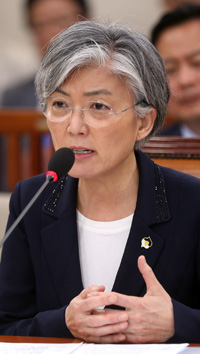
Kang Kyung-wha
More than twice as many people support the appointment of Kang Kyung-wha, a former U.N. official, as foreign minister than oppose it, according to a survey released Monday.
In a Realmeter poll conducted Friday, 62.1 percent of respondents said they support Kang’s appointment, while 30.4 percent said they were against it.
Among the 62.1 percent, 32.4 percent were “very supportive of” Kang’s nomination and the remaining 29.7 percent were “generally supportive.”
The survey of 505 adults nationwide had a 4.4 percent margin of error.
The finding comes as Kang struggles to win the approval of the National Assembly as the country’s top diplomat.
Three opposition parties — Liberty Korea Party (LKP), People’s Party and Bareun Party — have claimed that Kang is not qualified to serve in the job.
They have cited that Kang failed two of the five ethical criteria specified by President Moon Jae-in in selecting top-ranking officials.
A total of 82.2 percent of LKP supporters opposed Kang as the foreign minister-designate, as did 59.4 percent of Bareun Party supporters and 52.7 percent of People’s Party supporters.
Meanwhile, 84.2 percent of the ruling Democratic Party of Korea (DPK) supporters and 66.9 percent of the far-left Justice Party supporters welcome Kang’s nomination.
In each of the country’s major regions, more than half of the people support Kang as the foreign minister-designate.
Gwangju and Jeolla provinces combined have 73.5 percent support, Gyeonggi Province and Incheon combined have 69.1 percent, Daejeon, Sejong and Chungcheong provinces combined have 63 percent, Busan, Ulsan and South Gyeonsang Province combined with 58.4 percent, Seoul with 57.7 percent and Daegu and North Gyeongsang Province combined with 55.3 percent.
By age groups, those aged between 20 and 59 were mainly supportive of Kang’s appointment.
A total of 77.3 percent of those in their 40s responded favorably, while 75.7 percent in their 30s, 64.4 percent of those in their 20s, 55.4 percent of those in their 50s answered the same.
Among those who are aged 60 or older, 42.8 percent of them said “yes” to Kang’s designation but the other 48.9 percent said “no.”
Some 78.7 percent of the survey takers who identified themselves as progressives support Kang’s appointment, while 57.3 percent of the moderates and 41.6 percent of the conservatives responded the same.
The President can push ahead and officially name Kang as foreign minister, despite a possible objection from the multiparty-National Assembly.
A total of 78.2 percent of the DPK supporters said Moon should not listen to such an objection and name Kang for the job in his efforts to speed up handling state affairs.
Among the Justice Party fans, 66.1 percent of them said such a measure can be accepted.
But 85.6 percent of the LKP supporters, 59.3 percent of the People’s Party supporters and 51.5 percent of the Bareun Party supporters said Moon should respect the National Assembly’s possible decision against Kang regardless of circumstances.
Moon picked Kang as the foreign minister nominee on May 21 after she served as the senior adviser on policy for U.N. Secretary-General Antonio Guterres.
She has been under fire for using a false address to register her eldest daughter for school.
Her two daughters also paid gift tax for a house, which they bought in 2014 with Kang’s money, only two days after their mother was tapped as the foreign minister.
Moon’s five ethical criteria are aimed at screening whether nominees for top-ranking government jobs are involved in corrupt practices, such as the use of fake residential addresses and real estate speculation.