Gyeonggi committee to investigate dangers of fine dust
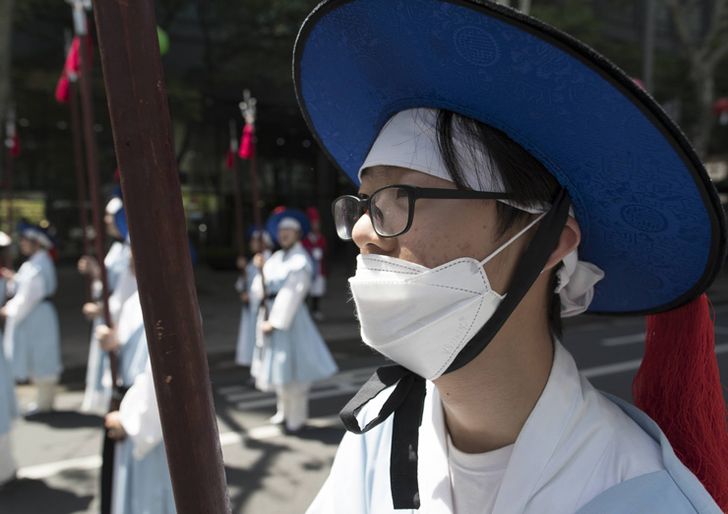
A man wears a mask to keep out the fine dust as he walks from Gwanghwamun Square to Sejongdaero intersection in central Seoul during the annual street parade celebrating the Royal Ancestral Memorial Rite of Joseon, also known as Jongmyodaeje, on May 7. / Korea Times file
By Ko Dong-hwan
.jpg)
Rep. Lee Eun-joo
Gyeonggi Province is set to form a special committee to investigate the harm that the unprecedented fine-dust-driven air pollution causes to the health of vulnerable people.
A decision on whether to set up the committee ― which Rep. Lee Eun-joo of the Minjoo Party of Korea proposed on Thursday ― will be decided during the Gyeonggi Province Assembly’s plenary meeting period from June 13 until 27.
The committee will investigate how the cancer-inducing particles have affected children, youth, students and the elderly.
The committee, once approved, will have up to 20 members and have one year to investigate and report on its findings.
“We will propose solutions in terms of policies and financial capacity so that fine dusts’ harm to the vulnerable social group can be minimized and their quality of life is improved,” Rep. Lee said.
The province this year had 16 alerts for fine dust (PM10, 10 micrograms or lighter) and 20 on ultrafine dust (PM2.5, 2.5 micrograms or lighter) from January to March.
The combined alerts have already surpassed those of last year ― 25 for fine dusts and six for ultrafine dust. A fine dust alert is activated when an average of 150 micrograms per cubic meter persists for two hours or longer. For ultrafine dust the density is 90 microgram per cubic meter for the same duration.
Fine dust is a nationwide problem. From January until May, the nation had only six “good” days with the fine dust level below 30 micrograms per cubic meter. From 30 to 80 is “normal,” 81 to 150 is “bad” and 151 or above is “very bad,” according to the Ministry of Environment.
The number of good days has fallen each year ― 82 days in 2014, 72 in 2015, and 54 last year.
The government’s monitoring of the situation has intensified along with the rising pollution.
With the Ministry of Environment Wonju branch, Gangwon Province launched a special investigation from April 20 to May 31 of 57 business and construction sites most at risk of producing fine dust.
The investigation focused on whether the subjects had taken measures to reduce fine dust, such as covering structures being built with dirt layers or cleansing construction machines off dust and dirt.
The investigation found 15 infringements. They included construction sites not keeping dust down (nine) those with inadequate facilities to do so (three) and those that illegally stored toxic wastes (three).
The companies were reported to police and/or fined.