PHOTOS How Korea's democracy grows: 1987 Vs 2017

In this combined photo taken in front of Shinsegae Department Store in downtown Seoul, on June 10, 1987 and Wednesday, respectively, cars and buses, left, are running, while the protesters, right, take to the streets to fight the authoritarian military regime of the time. / Korea Times file
Nation to remember historical milestone of democracy movement alongside April 19 in 1960, May 18 in 1980 and 2017 candlelit rally in Gwanghwamun
By Lee Kyung-min
The candlelit rallies at Gwanghwamun Square in central Seoul marked a significant historical chapter in Korean history.
The ouster of former President Park Geun-hye meant a victory against what the people considered a corrupt and authoritarian government.
The protests were most distinctive in their diversity in age and gender, in a country that has long been suffering from internal strife, whether it be generational, class or other socially divisive issues.
The months-long struggle will be remembered as another significant grassroots democratic movement in the modern history of Korea.
This year marks the 30th anniversary of the pro-democracy movement June 10, 1987, against the then authoritarian regime of President Chun Doo-hwan.
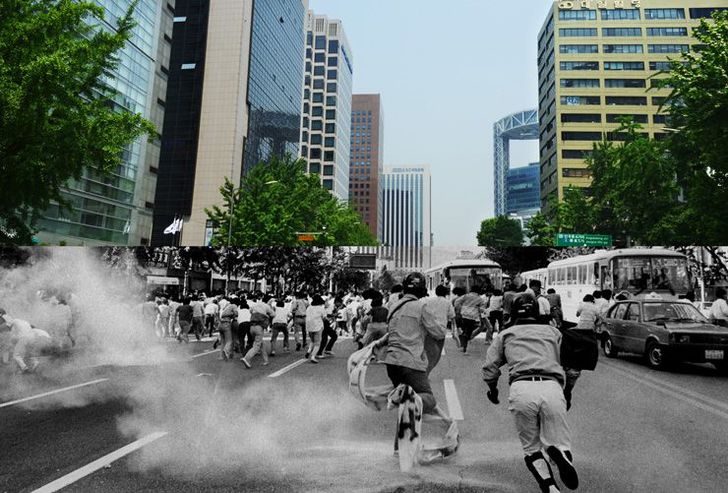
In this combined photo taken in front of Euljiro, downtown Seoul, on June 10, 1987, and Wednesday, respectively, the lower part of the photo shows military officers running towards protesters, while the upper part of the photo shows modern buildings in the area. / Korea Times file
The June 10 movement was triggered by the torture death of a Seoul National University student, Park Jong-chul, in January 1987.
He died after he was taken in for questioning on the whereabouts of his friends, information police suspected Park withheld in the interrogation room in Namyeong-dong, Seoul.
While police initially denied the torture allegations saying Park died after an officer pushed a desk which hit him; an autopsy determined he was severely waterboarded and electrocuted.
Public outrage over his death continued for more than two months, until it was suppressed by the April 13 measures ordered by then President Chun, who claimed he was protecting the Constitution by refusing public calls to adopt a direct presidential vote.
Amid the outrage, a group of Catholic priests, who had a source, held a mass on May 18 and told their congregation about the allegations that a number of ranking officials were involved in the torture death of Park, as well as the attempts to cover up.
The expose set off a firestorm nationwide prompting the public to organize massive protests from June 10.
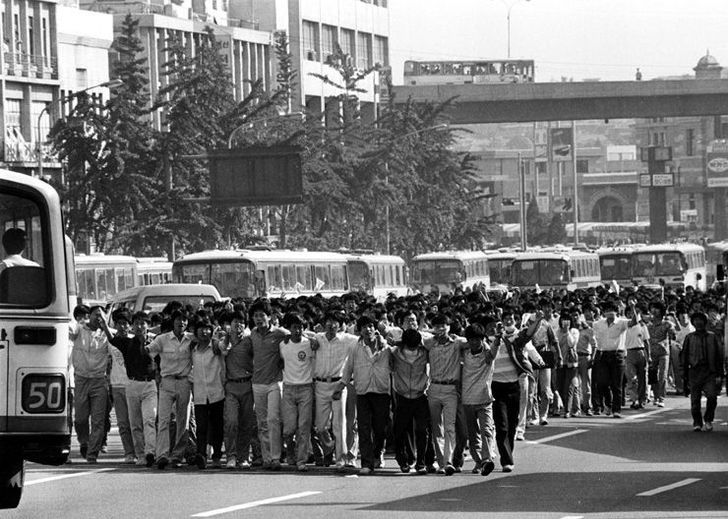
Hundreds of students stand with their arms around each others’ shoulders demanding democratic reforms. / Korea Times file
The outrage swelled after a Yonsei University student Lee Han-yeol fell unconscious after being hit by a tear gas canister, fired by riot police. He died a month later.
The protests grew both in size and intensity, with office workers in their 30s and 40s also taking to the streets to demand the government halt its violent crackdown, abandon its harsh military rule and usher in a democratic system.
Chun finally yielded to the people’s demand for democracy, promising to revise the Constitution to end military rule and elect a new president in a popular vote.
His friend, Roh Tae-woo, also a retired Army general, announced the measures.
.jpg?w=728)
In this combined photo taken in front of Yonsei University in Sinchon, western Soul, on June 10, 1987, and Wednesday, respectively, student protesters, right, retreat onto the school campus away from charging military officers, while contemporary students, left, walk to class. / Korea Times file
Roh issued a statement on June 29, declaring the adoption of direct voting in electing a president. He was elected president in February 1988, beating the so-called Three Kims _ Kim Dae-jung, Kim Young-sam and Kim Jong-pil.
His election was seen as a setback to the pro-democracy movement as it virtually prolonged Chun’s military rule.