Hearings focus on nominee for foreign minister
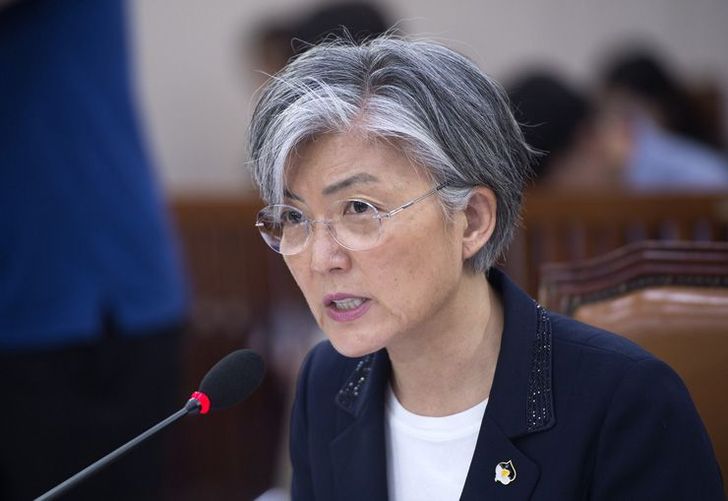
Kang Kyung-wha, the foreign minister nominee, answers a question during a confirmation hearing at the National Assembly, Wednesday. / Korea Times photo by Shim Hyun-chul
Kang rejects alleged tax evasion, real estate speculation
By Kim Hyo-jin
The National Assembly held confirmation hearings Wednesday for President Moon Jae-in’s nominees for finance and foreign ministers, and Constitutional Court president.
The opposition parties focused on alleged irregularities with the nominees, using the hearings as an opportunity to attack the Moon administration.
The main opposition Liberty Korea Party (LKP) went so far as to call on President Moon to withdraw his nominations, or for the nominees themselves to step down voluntarily, saying it would otherwise boycott Assembly sessions.
“The government will face a serious backlash if Moon pushes ahead with the appointment of such disqualified figures,” LKP floor leader Chung Woo-taik said during a party meeting. “They might have to brace for a fierce battle against us in dealing with reform plans and the budget bill.”
The ruling Democratic Party of Korea (DPK) remained highly defensive, denouncing the opposition parties for playing what it called “hostage politics.” It said there was no need to reconsider the nominations as the nominees had no critical flaws.
“They are just obsessed with playing the role of the opposition bloc. They aim to drag down at least one nominee, and their opposition based on such obvious intent will only prompt a public backlash,” a party official said.
Attack on FM nominee
The opposition particularly took aim at Foreign Minister-designate Kang Kyung-wha, who has been involved in a series of allegations on her child’s false address registration, belated gift tax payments and real estate speculation.
On the allegations of tax evasion and real estate speculation, Kang actively defended herself, saying they were “groundless accusations.”
Opposition lawmakers earlier accused her of having sought to evade tax by reporting the sale price of her mother’s house — under her name — as lower than the real market value when it was being refurbished. “I had no idea as the construction firm reported this to the authorities,” she said.
Kang claimed her husband’s purchase of forested land on Geoje Island was simply for his post-retirement life, without any intention of speculating on real estate.
“I had little knowledge of my husband’s management of his assets. I’m sorry but that was caused by a lack of communications between me and my husband,” she said.
But she admitted registering a false address and apologized for the ethical lapse, saying, “It was an inappropriate decision as a public servant. I’d like to tell the people and politicians here that I’m deeply sorry.”
Kang said she would review the current government’s rule of limiting figures whose children have dual citizenship from assuming the top post at diplomatic missions overseas.
“It is not right to deprive them of a chance to serve the country due to their children’s nationality,” she said.
Kang has been questioned over her qualification to be the country’s top diplomat because her daughter acquired U.S. citizenship in 2002. Amid growing controversy, her daughter decided to regain her Korean citizenship.
Kang agreed with the President on the deployment of a Terminal High Altitude Area Defense battery here, saying it needed parliamentary approval to prevent a public backlash.
Meanwhile, opposition politicians also grilled Kim Yi-su, the Constitutional Court president nominee, over his political orientation, taking issue with his earlier opposition to the disbanding of the minor United Progressive Party.
When asked whether he felt any political burden for taking the minority view, Kim dismissed this saying his opinion was given within the outlines of the Constitution. He added that despite his view against the disbandment, he consented to the court’s final decision.
Kim was also dogged over his favorable rulings in the 1980s on the government’s bloody suppression of the pro-democracy movement in Gwangju. He appeared apologetic, saying, “It was a painful chapter in my life. I couldn’t overcome the limitations of the law. I’m sorry for those who have been troubled with my past rulings.”
Kim Dong-yeon, the deputy prime minister and finance minister nominee, faced a comparatively easy hearing as allegations made were not grave as for the others.
The appointment of minister nominees does not require parliamentary consent while that for the Constitutional Court president does. Disapproval from the opposition could delay the operations of Moon’s new Cabinet and undermine his administration.
The presidential office hinted that it will hold onto Moon’s picks despite the opposition’s attacks. “Not a single nominee can be dropped,” a presidential official said, adding more efforts will be undertaken to persuade the opposition.
Chief presidential secretary for political affairs Jun Byung-hun called the leaders of opposition parties to ask for their support, and visited the Assembly later in the day to watch the hearings.