Major hurdles lie ahead for candidates
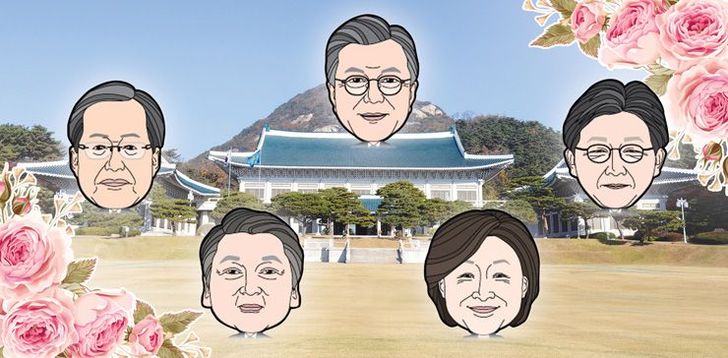
With just a week left before the presidential election, the candidates are taking their last gasp to overcome weaknesses pointed out by their critics. They are, clockwise from top, Moon Jae-in of the Democratic Party of Korea, Yoo Seong-min of the Bareun Party, Sim Sang-jung of the Justice Party, Ahn Cheol-soo of the People’s Party and Hong Joon-pyo of the Liberty Korea Party. / Graphic by Cho Sang-won
By Jun Ji-hye
Each candidate in the May 9 presidential election has been making great efforts to woo voters since their campaign began on April 17.
But there are still some serious hurdles for them to overcome in order to emerge a victor next Tuesday.
According to his critics, presidential election front-runner Moon Jae-in’s greatest weakness is his “unstable” view on national security and North Korea.
Conservative forces have attacked the liberal candidate of the Democratic Party of Korea, saying he is unqualified to defend the nation against North Korean threats, with some far-right opponents even labeling him as a “North Korean sympathizer.”
The attack against Moon has especially centered on whether the Roh Moo-hyun administration, in which Moon served as presidential chief of staff, asked the North’s opinion before it abstained from a U.N. vote against the Pyongyang regime on human rights in 2007.
Former Foreign Minister Song Min-soon claimed so, fanning the flames of criticism of Moon, saying that if elected, Moon will not take a firm enough stance in dealing with the North, which continues to pursue its nuclear ambitions.
Moon has rebutted the claim, saying the Roh government only notified the North after making its abstention decision independently. Moon’s camp filed a complaint against Song for defamation, saying his claim was untrue and violated election laws.
But despite Moon’s explanation, his rivals, especially from the conservative parties, have continued to use to attack him on this issue.
Moon has also faced another controversy after he avoided giving a straight answer to a question from conservative candidate Yoo Seong-min of the Bareun Party about whether or not the North is South Korea’s main enemy.
Moon said defining one’s main enemy is the job of the Ministry of National Defense, not the president’s, saying the president is a person who needs to resolve inter-Korean relations. The conservatives criticized Moon for not calling the North the main enemy, again questioning his capability to firmly respond to the North’s military provocations.
The defense ministry deleted the expression “the main enemy” in reference to North Korea from the 2004 Defense White Paper owing to concerns over possible diplomatic friction with neighboring countries; experts said calling the North the main enemy could mean there are other enemies, which could include neighbors such as China, the North’s traditional ally and the South’s No. 1 trading partner.
Due to the sensitivity of the phrase, former conservative Presidents Lee Myung-bak and Park Geun-hye did not call Pyongyang the main enemy, either; nevertheless, the issue is still being used to downplay Moon.
To overcome the controversy, in recent tours and speeches, Moon has been focusing on promoting his ability to maintain the country’s strong national security. On Wednesday, he observed a South Korea-United States large-scale joint live-fire exercise at the Seungjin Army Training Center in Pocheon, Gyeonggi Province, and then vowed the following day to develop the nation’s own nuclear submarines, if elected.
He also warned that another nuclear test by the North will worsen already strained inter-Korean relations.
“I strongly warn that the North’s sixth nuclear test will only deepen its isolation and throw the regime into difficulties,” he said.
Ahn Cheol-soo of the People’s Party, a runner-up in the presidential race, appears to have become more popular among centrist and conservative voters than Moon. But he is still regarded less influential because some of his supporters are not hard-core fans, but rather support him because of their “anyone but Moon” sentiment that aims to keep Moon out of Cheong Wa Dae.
Those voters can leave Ahn as soon as they find a better candidate who can beat Moon. Ahn should prove himself as a formidable rival against Moon to grab them, but he has already failed to distinguish himself during nationally televised debates, only experiencing a continuous decline in popularity in opinion polls.
Ahn needs the support of centrists and conservatives to have any chance of winning, but his efforts to get this support has also faced difficulties owing to the very liberal policy direction of his party, which is dominated by political figures from the so-called Honam region, including the party chairman Rep. Park Jie-won. The Honam region encompasses liberal forces’ traditional stronghold of North and South Jeolla Provinces and Gwangju.
More importantly, Ahn has been bombarded with questions about whether he will adopt the Sunshine Policy, which emphasized inter-Korean economic cooperation and is pursued by his party. The policy was initiated by the late President Kim Dae-jung government, in which Rep. Park served as a presidential chief of staff. But there is an obvious contrast between the policy and Ahn’s conservative view on national security.
During the TV debates, Ahn was attacked by conservative candidates when he answered: “There were merits and demerits in the Sunshine Policy.” Then, he raised his voice, saying, “Why is it so important whether or not I adopt the policy initiated 20 years ago?”
Mindful of the controversy, Rep. Park vowed not to take any nominative positions if Ahn elected.
Hong Joon-pyo of the conservative Liberty Korea Party probably has been the most controversial candidate owing to his autobiographical essay, published in 2005, in which he wrote about his involvement in an attempted rape while in college. In that essay, Hong confessed that he provided a sexual stimulant used to breed farm pigs to his friend, who wanted to sleep with a coed.
Before this controversy, the former South Gyeongsang governor also drew fire for saying “How can I wash dishes? Men have their own jobs, and women have theirs.”
Hong offered an apology for his sexist remarks and involvement in an attempted rape during the TV debates, but he still faces calls from women’s rights groups to withdraw his candidacy.
Sim Sang-jung of the progressive Justice Party has been assessed as the most impressive candidate during the TV debates, during which she made some notable remarks that pushed other candidates into a corner. Thanks to her great performance, she has enjoyed an increase in her popularity, albeit her support remains in the low single digits.
Yoo Seong-min of the conservative Bareun Party has also been suffering from low single-digit support, which has led his party members to urge him to withdraw his candidacy and unite with Ahn. This lack of support from his own party members is his greatest weakness.
Even after the presidential election, Sim and Yoo could suffer from financial problems, as only candidates that gain over 15 percent of votes will be fully reimbursed for their campaign expenses by a national subsidy, according to the National Election Commission. For those with over 10 percent of votes, only half of their expenses will be reimbursed. Those who earn less than 10 percent get nothing back.