Presidential hopefuls happy to be laughing stocks
.jpg?w=728)
South Chungcheong Province Governor An Hee-jung, a presidential contender from the main opposition Democratic Party of Korea (DPK), lifts up comedian Yang Se-hyung while answering his questions during online entertainment show “Shorterview,” Jan. 19. / Yonhap
Presidential hopefuls appear on entertainment programs to show their human side
By Kim Rahn
Seriousness is no longer a virtue for politicians.
Nowadays it is easy to see presidential contenders appear on entertainment and talk shows, willing to face embarrassing situations and often making themselves a laughing stock. And they tend to opt for such TV programs rather than news or current affairs ones, because in the former, the politicians can show their so-called human side and be more relatable to voters, especially to younger generations.
While presidential candidates used to focus on street campaigns and face-to-face meetings with voters, they have realized TV broadcast and online media can be more effective ways to promote their names to the public.
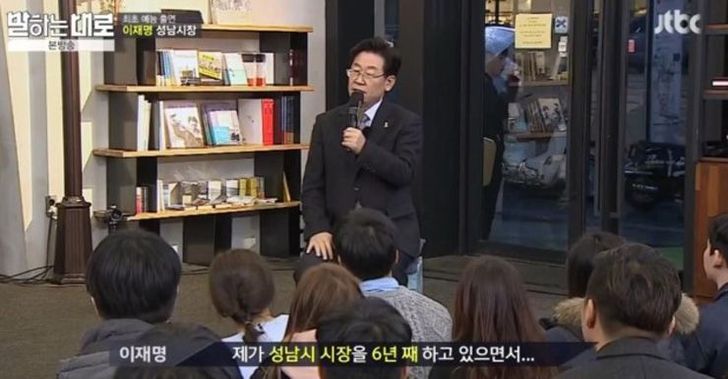
Seongnam Mayor Lee Jae-myung talks about democracy during “As You Say,” a talk show filmed on the street, Jan. 4. / Captured from internet
Ladder for public popularity
It was in the 2012 presidential election when politicians began to appear on entertainment shows, and this strategy was a hit.
In January of 2012, President Park Geun-hye, then the interim leader of the ruling Grand National Party, the predecessor of the current Liberty Korea Party, appeared on the SBS talk show “Healing Camp.” A week after, Moon Jae-in, another potential presidential contender from the main opposition Democratic United Party, the predecessor of the current Democratic Party of Korea (DPK), also made an appearance on the program.
Park and Moon were the big potential candidates from the conservative and liberal blocs, respectively, so the show garnered much attention. The viewership of the Park episode was 12.2 percent and that of the Moon episode, 10.5 percent, almost double that of the episode with actress Choi Ji-woo at 5.9 percent.
Earlier, in 2009, years before he entered the political arena, Ahn Cheol-soo appeared on MBC’s “Knee-Drop Guru.” There he told his life story, achievements as a professor and entrepreneur and personal conviction. The sensation surrounding Ahn prompted political parties to invite him into their circle. Today, Ahn is a presidential contender from the minor opposition People’s Party.
Now back to 2017. The increased appearance of politicians on TV entertainment shows and online media is largely attributable to the greater public attention to politics, following the massive corruption scandal involving President Park and her confidant Choi Soon-sil. As the presidential election may take place in the first half of this year, media outlets have been focusing on presidential hopefuls ― not only current affairs programs but also entertainment shows that seek “fresh” guests.
JTBC’s “Battle of Tongues,” better known as “Ssulzun,” is representative sought-after political talk show for politicians. Moon, Seongnam Mayor Lee Jae-myung and Rep. Yoo Seong-min of the Bareun Party have appeared in recent episodes, engaging in discussions with former health minister Rhyu Si-min and lawyer-turned-poet Jun Won-tchak as well as with comedian-turned-TV personality Kim Gura.
Mayor Lee and South Chungcheong Province Governor An Hee-jung both appeared on JTBC’s street talk show “As You Say” and online talk show “Shorterview” hosted by comedian Yang Se-hyung. Both Lee’s and An’s Shorterview episodes have garnered nearly 1 million views on YouTube.
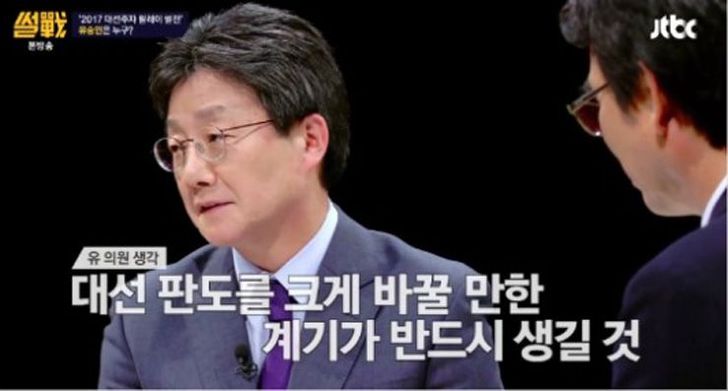
Rep. Yoo Seong-min of the Bareun Party speaks of his presidential ambitions on “Ssulzun,” Feb. 2. / Captured from internet
Funny, human image
In the shows, presidential contenders have a chance to present their pledges without being attacked by rivals, but also a chance to show their human side by telling their school and family life or participating in the shows’ games.
For example, in Ssulzun, Moon talked about how he met his wife. He also joked that he gets lucky the second time around, saying he succeeded in his second attempts at college applications and the state bar exam, and perhaps he might get lucky in his second attempt at the presidency.
In a Shorterview episode, An gamely answered host Yang’s questions and got to show his funny side while lifting Yang up with his arms and while cramming food in his mouth. Lee, also in Shorterview, made public his mayoral office and then exchanged seats with Yang, showing his preference for a democratic rather than hierarchical leadership style.
However, a politician’s appearance in an entertainment program does not always produce the desired results and is not viewed positively by everyone.
For instance, if they fail to answer the panelists’ questions properly or provide false information, they could face criticism immediately. Moreover, appearing on such programs could turn voters’ focus away from the presidential contenders’ policy pledges to their image, which may turn off the older generations, who believe politicians need to be serious. Politicians who appear in entertainment programs can also be criticized for idling around, especially in a time of political turmoil.
Kim Hyung-joon a professor of politics at Myongji University, said, “(As emcees of entertainment programs are non-experts in politics), they cannot verify the truth of or correct information provided by the politicians. Also, focusing on their human side could glorify their life story and achievements.”
A 25-year-old office worker in Seoul, who refused to be named, also said, “The entertainment programs can blur the contenders’ weaknesses. The politicians can raise their public awareness without presenting their policy pledges.”
People’s Party vice spokesman Kim Se-hwan recently denounced An’s frequent appearance in entertainment shows as farms in the Chungcheong region are grappling with the avian influenza and foot-and-mouth disease.
“This is not the time to laugh and chat in entertainment programs. This is the time to wear a combat uniform and dash to the field to help the South Chungcheong Province farmers who are struggling to survive,” he said in a statement.
An himself acknowledged the difficulty in balancing between a fun image and an effective political message.
“While providing laughs on the one hand, politicians also want to include their message in those laughs on the other hand,” he said in a pre-show interview with “Shorterview” producers. “It’s like a cocktail that requires a balanced mixture ratio. But in Korean culture, we don’t have any precedent for the right ratio of humor, wit, fun, seriousness and message and to what extent that mixture can be accepted.”