Fearing stalkers and violent exes, Korean women are hiring their own bodyguards
Summary
A 29-year-old woman in North Jeolla Province hired a bodyguard in mid-October to protect her from her former boyfriend, who appeared at her apartment complex during the four-day assignment. Demand for private security has risen amid killings and other violence involving current or former partners, while the cost puts extended protection beyond many victims’ means. Police also provide bodyguards to some high-risk victims, but access is difficult and the standard protection period was shortened this year. Experts called for stronger measures to restrict high-risk perpetrators.
Key Facts
- The former boyfriend had served six months in prison for fraud-related offenses, including taking out loans in the woman’s name.
- Private security companies typically charge about 250,000 won for eight hours of protection, while round-the-clock coverage can cost about 500,000 won per day.
- The number of people receiving police-supported private security rose from 98 in 2023 to 156 in 2024 and 421 last year.
- During police-supported security operations last year, 14 offenders who violated orders prohibiting them from approaching victims were arrested.
- The police requested a 2.7 billion won budget for the program next year, but the government’s budget proposal allocated 2.45 billion won, unchanged from this year.

gettyimagesbank
After a series of women in Korea were killed after experiencing stalking, assault and threats from former partners or husbands, some potential victims are turning to private bodyguards to protect themselves.
They are paying substantial sums out of pocket amid concerns that public protection measures, including emergency smartwatches and restraining orders, may not be enough to keep an attacker away. The government also provides private security services to some crime victims, but funding has failed to keep pace with rapidly growing demand.
A 29-year-old woman living in North Jeolla Province, identified only as A, hired a bodyguard for four days in mid-October because her former boyfriend, identified as B, was about to be released from prison.
B had served six months in prison for fraud-related offenses, including taking out loans in A's name.
Her fears soon became reality.
On the second day of the security assignment, B showed up at A's apartment complex. The bodyguard stopped him, warned him not to return and sent him away.
"When my ex-boyfriend showed up, I was so scared that I cried," A told the Hankook Ilbo on Monday. "If I hadn't hired a bodyguard separately, I really could have been in danger."

Kim Sung-woo, a suspect in the killing of his mother-in-law and abduction of his wife, is transferred to the prosecution from Songpa Police Station in Seoul, Oct. 20. Kim is accused of fatally stabbing his mother-in-law, who was in her 50s, and abducting his wife in a vehicle after going to his in-laws' home in Songpa District at around 5:38 a.m., Oct. 11. Yonhap
Demand for private security has surged following a series of high-profile crimes, including a case in Seoul's Songpa District involving the killing of a mother-in-law and the abduction of a wife, as well as a string of killings involving current or former romantic partners in Jeju, Gongju in South Chungcheong Province and Daejeon.
Lee, 28, head of security company Ellie Company, said inquiries related to dating violence soared immediately after the Songpa case.
"Particularly after the Songpa case, inquiries about protection related to dating violence increased four- to fivefold," Lee said.
Choi Gyu-sang, 39, head of security company Jikim, has seen a similar trend.
"The number of people using private security services has roughly tripled from last year," Choi said. "As the types of crimes requiring personal protection have diversified to include stalking, dating violence and sex crimes, demand for security services is increasing every year."
But hiring a bodyguard comes at a steep price.
According to private security companies, rates vary depending on the level of danger and the number of hours required, but typically cost around 250,000 won ($175) for eight hours a day. Around-the-clock protection involving separate day and night shifts can push the daily cost to about 500,000 won.
Even at 250,000 won per day, two weeks of protection costs about 3.5 million won, while a month can cost roughly 7.5 million won.
A representative of security company Team Kim Company said most ordinary people cannot afford extended protection.
"Ordinary citizens tend to use a bodyguard for about a day when they expect a specific threat rather than signing a long-term contract," the representative said. "Most victims are in their 20s and 30s, and it would be difficult for them to afford security costs that exceed a month's salary."
A university student surnamed Na, who became terrified after a man repeatedly knocked on the door of her home late at night, also considered hiring private security but ultimately gave up because of the cost.
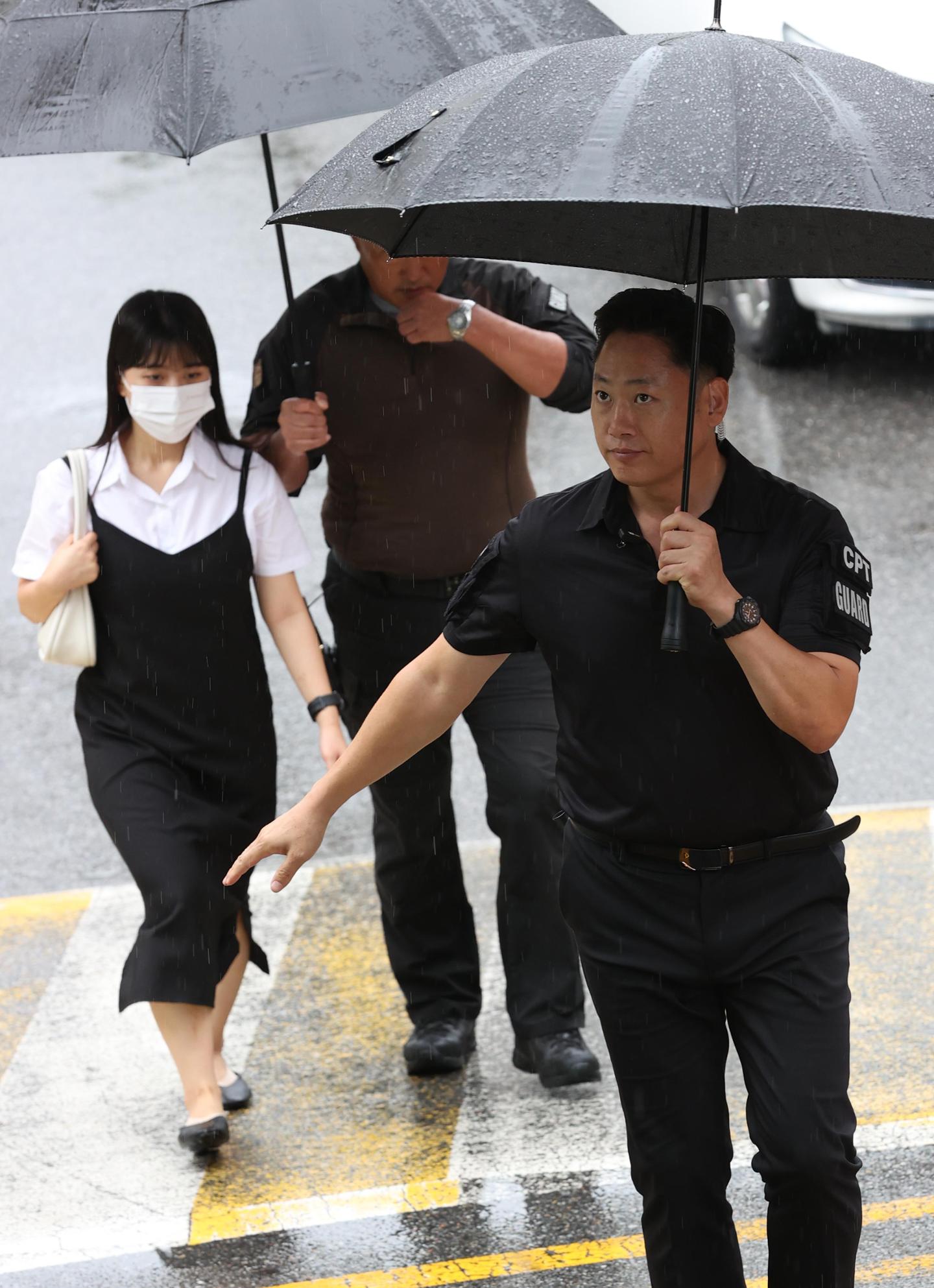
A bodyguard and a Seoul city official demonstrate a private security service provided to high-risk stalking victims. Yonhap
Police also provide private bodyguards to victims considered at high risk.
When authorities determine that a victim could face a serious threat — for example, after an offender is released from prison or a court rejects an arrest warrant — the victim can undergo a screening process to qualify for protection. Those selected are assigned two professional bodyguards for 10 hours a day.
The number of people receiving such police-supported private security has risen sharply, from 98 in 2023 to 156 in 2024 and 421 last year.
Last year, 14 offenders who violated orders prohibiting them from approaching victims were arrested during such security operations.
Yet qualifying for government-supported private protection remains difficult, particularly when victims already face hurdles in obtaining court-approved restraining orders.
The duration of the program has also been shortened this year. The standard protection period was reduced from 14 days to seven, while the maximum period was cut from 28 days to 21.
"Following a research project, we shortened the standard support period while increasing the number of times it can be extended," a Korean National Police Agency official said. "Additional extensions are also possible if the danger has not been resolved."
Funding, however, is set to remain unchanged next year.
According to data the National Police Agency submitted to the office of Rep. Lee Hae-sik of the Democratic Party of Korea, police requested that next year's budget for the program be increased to 2.7 billion won to reflect rising costs, including bodyguard wages. The government's budget proposal instead allocated 2.45 billion won, the same amount as this year.
Experts say neither privately hired nor publicly funded bodyguards and patrols can protect victims indefinitely, making stronger measures to control perpetrators essential.
Han Min-kyung, a professor of public administration at the Korean National Police University, said a more fundamental solution is needed.
"It is difficult for the state to provide security to every victim, so we need to consider a fundamental solution," Han said.
Lee Soo-jung, a professor of criminal psychology at Kyonggi University, said some perpetrators retreat when restrictions are strengthened only to approach their victims again once those measures are relaxed.
"Protection measures should be applied differently according to victims' levels of risk," Lee said. "Measures restricting access also need to be strengthened, including electronic monitoring of high-risk perpetrators."
This article from the Hankook Ilbo, the sister publication of The Korea Times, was translated by a generative AI system and edited by The Korea Times.
Explore More
- Q.
- Q.
- Q.