Court says Korea must allow birth registration for foreign children born in country
Summary
The Constitutional Court ruled on Thursday that Korea’s lack of a legal framework for registering the births of foreign children born in the country is unconstitutional. It unanimously sided with a Vietnamese father and his child, saying the state must ensure birth registration regardless of nationality or immigration status. The court said undocumented children whose births are not officially recorded are more vulnerable to abuse, abandonment and crime. It held that the legislature has a duty to create the needed legal framework.
Key Facts
- The child in the case was born in Korea in 2019 after the parents, both Vietnamese nationals, had overstayed their authorized residence and become undocumented.
- The father initially entered Korea on a nonprofessional employment visa and married the child’s mother in 2016.
- Because the Act on Registration of Family Relations covers births and other family matters only for Korean nationals, the child could not be registered under Korean law and was instead registered under Vietnamese law.
- The court said the right to be registered immediately after birth is a fundamental prerequisite for realizing general personality rights.
- The court said the National Assembly must establish a specific legal framework so births can be registered under Korean law regardless of nationality or immigration status.
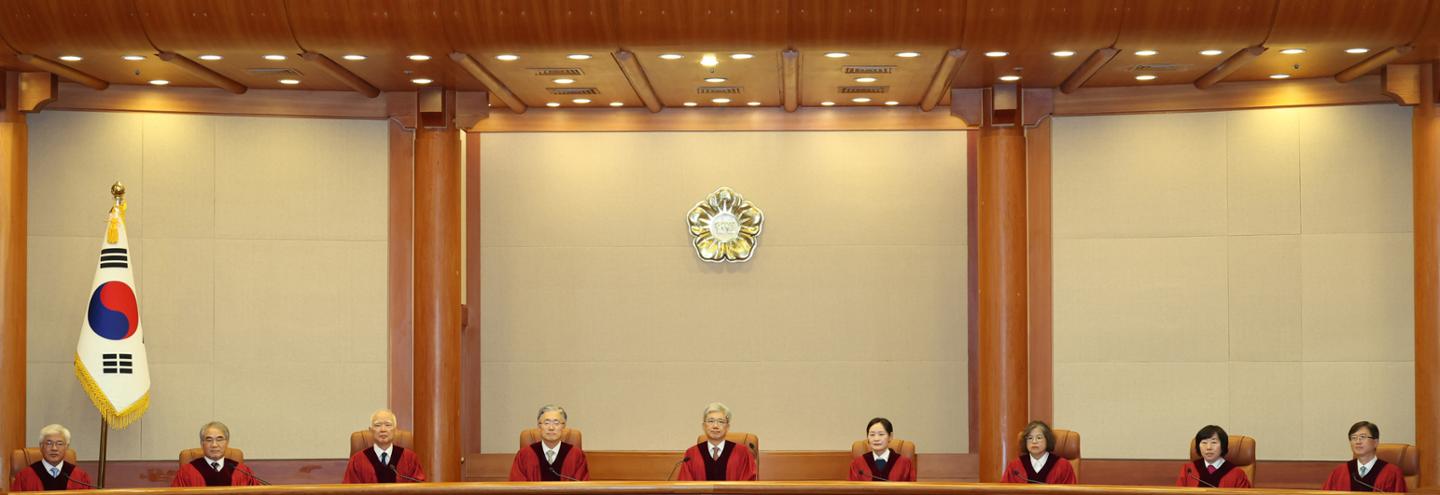
Constitutional Court President Kim Sang-hwan, center, and other justices sit in the courtroom at the Constitutional Court in Jongno District, Seoul, on Thursday, ahead of rulings on constitutional complaints. Yonhap
The Constitutional Court on Thursday ruled as unconstitutional the absence of a legal framework allowing foreign children born in Korea to have their births registered under Korean law.
The court unanimously ruled in favor of a Vietnamese national, identified only as A, and his child, who filed a constitutional complaint arguing that the legislature's failure to establish a system for registering the births of foreign nationals born in Korea violated their constitutional rights.
A legislative omission refers to a situation in which the legislature fails to enact a law despite a constitutional obligation to do so in order to protect fundamental rights.
A entered Korea under a nonprofessional employment visa and married B, also a Vietnamese national, in 2016. The couple later overstayed their authorized period of residence and became undocumented.
When their child was born in Korea in 2019, they were unable to register the birth under Korean law because the country's Act on Registration of Family Relations provides for the registration of births and other family matters only for Korean nationals.
A eventually registered the child's birth under Vietnamese law. He then filed a constitutional complaint, arguing that the legislative omission infringed fundamental rights, to which the Constitutional Court agreed.
"The right to be registered immediately after birth is the right to have the state record and manage basic information concerning a child's birth at the earliest possible time after birth when the child can receive protection," the court said.
"It is a fundamental prerequisite for realizing general personality rights, and there is no reason for its protection to differ depending on whether the child is a Korean or foreign national," it said.
The court also pointed to the risks faced by children whose existence is not officially documented.
"If a child born in Korea is excluded from registration for any reason and his or her existence cannot be verified on paper, the child is relatively more vulnerable to abuse or abandonment and is more likely to become a target of crime because the child's identity is not documented," the court said.
"Children cannot choose where or in which country they are born, or who their parents are, so having the country with jurisdiction officially record their existence immediately after birth is a minimum safeguard," it said.
The court said the state therefore has a legislative obligation to establish the specific legal framework needed to ensure that births can be registered under Korean law regardless of nationality or immigration status.
This article from the Hankook Ilbo, the sister publication of The Korea Times, was translated by a generative AI system and edited by The Korea Times.
Explore More
- Q.
- Q.
- Q.