Female rehabilitation center closure raises concerns over support for drug addicts

Getty Images Bank
Single drug rehab facility for women shut down
By Jung Da-hyun
Baek Seung-un, a 27-year-old who had been seeking to overcome drug addiction at “Saebit-teo,” a drug addiction rehabilitation center (DARC), found herself devastated when the nation's first and only drug addiction center exclusively for women was closed last month ― just one month after its opening ― due to financial difficulties.
“As the center had helped me stay away from drugs a lot, the closure of Saebit-teo gave me huge concerns over a possible relapse if I deal with addiction at home,” Baek told The Korea Times.
Following the shutdown, she had to move to another DARC also located in Gyeonggi, where she is now staying and receiving treatment alongside 13 male addicts.
After the closure, a fellow addict from the now-defunct women's only facility was sent back to prison for using drugs again.
“No matter how well I get along with men, there is a psychological burden on me … I hope more rehab centers for female addicts will be established,” she added.
As Baek said, the closure of Saebit-teo has left female drug addicts without a vital support system for their recovery.
Nestled in a townhouse in Namyangju, Gyeonggi Province, Saebit-teo had offered treatment and residence exclusively for women in need of help for recovery purposes. Until the closure of the center, four women grappling with drug addiction had been staying there.
Before the opening of Saebit-teo, female addicts had limited options available in their fight against drug addiction. Unlike male addicts, they could only attend the daily routine cure program at Gyeonggi DARC without the option of residence.
The necessity for a rehabilitation center for women has come to the fore, with the number of female drug-related arrests on the rise. According to a report by the Supreme Prosecutors' Office, the number of female drug-related arrests surged from 1,398 in May 2022 to 1,885 in May of this year.
In that respect, Lim Sang-hyeon, the chief of the Gyeonggi DARC, decided to establish Saebit-teo and it opened, June 8.
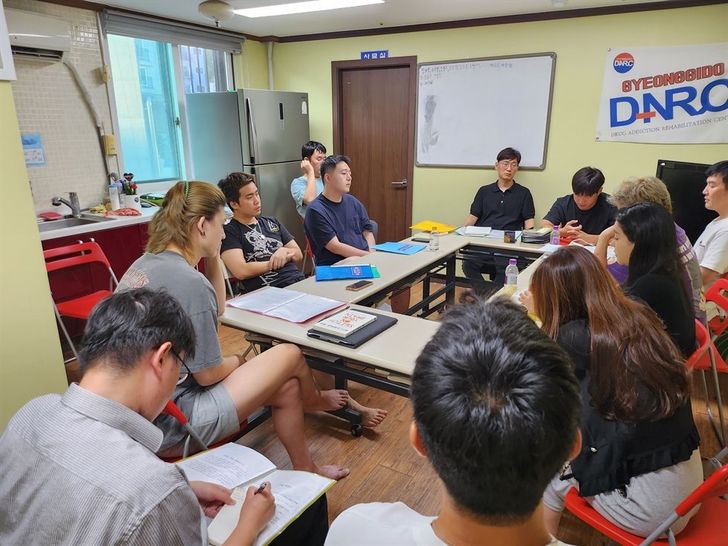
Patients participate in a recovery session at Gyeonggi Drug Addiction Rehabilitation Center (DARC) in Namyangju, Gyeonggi Province in this undated photo. Courtesy of Gyeonggi DARC
However, the operation of Saebit-teo stopped abruptly last month after Namyangju City accused the center of failing to submit relevant documents, which meant that it was an unlicensed facility.
In the wake of the accusation, operating both the Gyeonggi DARC and Saebit-teo was unfeasible for Lim, and so he decided to close the latter.
However, Lim is also under pressure to find a new place to host Gyeonggi DARC ― by Aug. 24 ― because the city government ordered Gyeonggi DARC to leave its jurisdiction as well.
Despite accepting responsibility regarding the licensing issue, Lim believes that finding a new place within such a short period is a daunting task. He worries it may lead to the closure of the rehabilitation center and subsequent addiction relapses.

Participants of the Gyeonggi DARC community enjoy the beach. Courtesy of Gyeonggi DARC
"Without proper support for their rehabilitation, I feared that they may resume using drugs,” he said.
In addition, the imprisonment once more of a former Saebit-teo member following the facility's shutdown sheds light on the importance of rehabilitation centers.
Experts as well as Lim are expressing concerns over possible relapses.
Cho Sung-nam, chief director of the National Forensic Hospital, criticized the social stance on addiction in Korea, emphasizing the need to systematize rehabilitation centers, like Gyeonggi DARC and Saebit-teo, with government support.
He also emphasized the importance of those who have overcome addiction, like Lim, in helping addicts recover with their own firsthand experiences.
“People who have recovered from addiction are also a hope for addicts who struggle to quit drugs,” he said.
The scope and implications of effective drug addiction treatment extend to the broader social sphere and affect society.
“Untreated addiction increases the risk of recidivism, leading to potential traffic accidents, sexual offenses and other crimes,” said Lee Beom-jin, a professor at the College of Pharmacy at Ajou University.
Lim remains resolute in seeking alternatives, striving to secure a new space for addicts seeking recovery. However, the uncertainty has led to anxiety among residents in Gyeonggi DARC, prompting some to leave and others to fear the possibility of relapses should they return home.