Stabbing in Sillim raises calls for countermeasures

Police officers escort a man surnamed Cho, center, who is alleged to have gone on a stabbing rampage near Sillim Station in southern Seoul killing one man and injuring three others, Friday, into the Seoul Central District Court, Sunday. Yonhap
By Ko Dong-hwan
In the wake of a stabbing rampage, in which a 33-year-old man killed one man and injured three others, Friday, there are growing calls for the country's criminal justice system to explore countermeasures for such crimes.
So far, authorities and the public have defined crimes against random victims as motiveless killings by psychopaths and, as such, held individual perpetrators solely responsible for the crime. But many claim that such categorization should be replaced with more systemic management by authorities so that potential killers can be preemptively monitored and prevented from committing any mass assaults.
Experts said that each case of “social terror” should not be simply seen as an adrenalin-driven random act by an individual with psychosis, but instead as a dangerous social phenomenon, a symptom of broader social problems. In other words, the argument approaches such crimes as the responsibility of collective communities rather than the sole problem of a delusional individual.
For now, experts say the country's criminal justice system should be overhauled to verify whether at-risk ex-convicts are being monitored to ensure they do not reoffend.
Prof. Kwak Keum-joo from Seoul National University's Department of Psychology said there are certain indices that correlate to a higher probability of committing random killings, such as self-isolation from communities or being jobless and suffering from economic difficulties. She said the government should monitor such individuals regardless of their criminal records by focusing on traits that are detected through such indices and maintain communication so that they can become aware of their problems.
“To prevent further motiveless crimes, we should pay more attention to those in more vulnerable situations than others, like children who are being constantly abused or those living alone and suffering from economic hardships,” Kwak told The Korea Times. “We should start keeping track of them by communicating with such individuals. We should build up data and use it as a guide to monitor people who might resort to such crimes.”
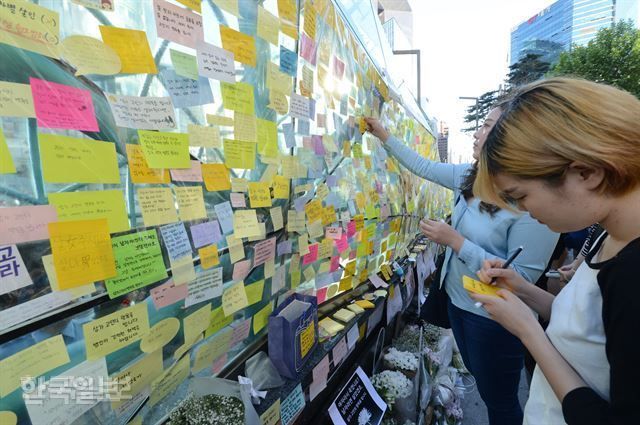
People write messages of condolence on post-it notes and place them on a wall in Gangnam Station in southern Seoul, May 18, 2016, for a woman who was killed in a knife attack by a stranger. Korea Times file
Systems of approach, unique to such crimes, are still emerging in Korea. The national police force developed the official term, “crimes with abnormal motives,” and accordingly launched a dedicated task force. That was 18 months ago. Up until then, the police force had not actually addressed the concept to define and categorize the series of crimes as distinct from any other type of crime.
Another problem with the criminal justice system's approach to random killings is that crimes are jointly handled by the country's prosecutors, the Ministry of Health and Welfare and the Ministry of Gender Equality and Family ― lacking the focus of a singular investigative force.
That problem led to the police forming the task force. Upon the task force's launch, the police had said they would separately manage high-risk ex-convicts with an online data archive called Korea Information System of Criminal Justice Services.
But as of this month, no notable accomplishment from that new screening measure has been released, according to the experts.
Hastening calls for a more systemic approach to managing high-risk ex-convicts come as the recent stabbing demonstrated, yet again, that such crimes have no pre-determined targets but instead victimize random people and, as such, anyone can be a target.
The Sillim-dong killer, identified by the surname Cho, 33, assailed victims in a shop-concentrated alley in Seoul's southern district of Gwanak District. All victims were males in their 20s and 30s. Cho told police after being captured minutes after the crime that he regretted his unsatisfactory life and wanted to make others “unhappy” as well. The remark extends from his past where he had been sent to a juvenile correctional facility 14 times and was charged with physical violence three times.
The Seoul Central District Court on Sunday issued an arrest warrant for Cho for charges including murder. The police said they will refer him to the prosecution after conducting a psychological assessment of him.