Justice minister, South Jeolla governor agree to expand migrant labor workers

South Jeolla Governor Kim Yung-rok, left, and Justice Minister Han Dong-hoon shake hands at the province's headquarters in Muan County, Tuesday. Yonhap
By Ko Dong-hwan
The Ministry of Justice and the South Jeolla Provincial Government have agreed to strengthen the province's migrant worker pool by amending the country's visa policies.
Justice Minister Han Dong-hoon said Tuesday that he understands the labor shortage issue plaguing the region and pledged to collaborate with the provincial government to attract a greater number of foreign workers.
The minister's remark came during a meeting between Minister Han and South Jeolla Governor Kim Yung-rok at the provincial government office in Muan County. Governor Kim requested the minister to upgrade the country's current visa policies to attract more migrant workers to the province.
Governor Kim emphasized the urgent need for a new central immigration agency to mobilize a foreign workforce, given the province's growing manufacturing sectors and insufficient local manpower, and proposed a specialized visa system providing visa-related incentives to appeal to more foreigners.
“When water flows in, ships should get moving by busily pulling oars,” Minister Han said during the meeting with Governor Kim. “But in South Jeolla, the water is flowing in but there's no one behind the oars.”
Previously on Monday, the minister visited the province's local shipbuilder Hyundai Samho Heavy Industries in Yeongam County and saw that the company needed more migrant workers. Particularly welders due to a pipeline of mounting orders before deadlines. He also acknowledged the province doesn't have enough of a productive population and was having a hard time attracting companies to invest, which would lead to a boost in the local economies.
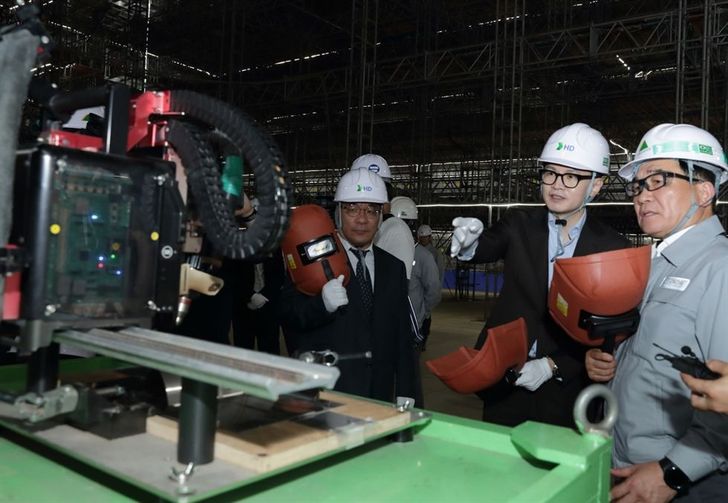
Justice Minister Han Dong-hoon, second from right, is shown around a factory of Hyundai Samho Heavy Industries in Yeongam, South Jeolla Province, Monday. Courtesy of Ministry of Justice
“After the governor visited the ministry last August and shared difficulties in recruiting a workforce, we adjusted our immigration policies to attract more foreigners,” the minister said during his latest meeting with the governor. The adjustment includes introducing a visa-free entry system to Muan International Airport and broadening legal pathways for foreigners so as to secure a stronger workforce for the province's shipbuilding industry and seasonal occupations in agricultural and fishery industries.
The minister emphasized his commitment to work closely with the governor, recognizing the shared responsibility of the central and local governments, as well as the ruling and opposition parties, to work in citizens' best interests.
The minister's two-day visit to South Jeolla came after the ministry last month announced it will ease requirements for E-7 skilled workers visas that guarantee long-term employment and will also increase the quota for work permits. The move was the ministry's response to calls by local industries and local governments for the need to ease visa requirements for foreign technicians amid a deepening labor shortage.
Under the current rules, foreign employees with E-9 unskilled worker permits who have worked legally in Korea for five years can apply for the E-7 visa. The ministry said this requirement will now be reduced to four years.
In the same vein, the ministry introduced a region-specific visa policy as a one-year trial last October. Launched in 28 local jurisdictions across the nation with particularly diminishing populations including the six counties of Yeongam, Haenam, Gangjin, Jangheung, Goheung and Boseong in South Jeolla, the policy conditionally offers the F-2 long-term residence visa to foreigners and F-4 oversea Koreans visa to those with Korean ethnicity.
The ministry last January also simplified application documents for migrants interested in seasonal occupations in the country's agricultural and fishery sectors. As of last June, those who were granted E-8 seasonal workers permits accounted for over 40,000 foreigners across 132 local jurisdictions ― with over 7,500 of those in South Jeolla Province.