'Symposium established Korea as leading legislative country'

Government Legislation Minister Lee Kang-seop / Courtesy of Ministry of Government Legislation
Ministry of Government Legislation to hold 9th symposium with Asian legal experts
By Kang Seung-woo
The Ministry of Government Legislation has been hosting the Asian Legislative Experts Symposium (ALES) every year since 2013, promoting cooperation among Asian countries through the exchanges of legal information as well as the development and advancement of legislative systems in the region.
Under the theme of “Legislative Administration of Each Asian Country and Cooperation Measures,” the ninth annual symposium is scheduled to take place Oct. 27, both online and offline, with a limited number of in-person participants due to COVID-19-induced social distancing guidelines.
Despite the difficulties caused by the pandemic, Government Legislation Minister Lee Kang-seop believes this year's ALES will help enhance mutual understanding between countries and discover specific fields of legislative exchanges and cooperative projects by sharing exemplary practices and the administrative status of Korea's legislative development.
“Lately, many Asian countries increasingly have interest in Korea's legislative experience that has been pivotal to the nation's growth,” Lee said in a recent written interview with The Korea Times.
“In order for the government's New Southern and New Northern policies to have practical effects in target countries, an approach based on a clear understanding of each country's legal system is important. In that sense, this year's conference is expected to be of great help.”
The minister said Korea has benefited from the eight-year run of the symposium.
“As the ALES has been held every year and exchanges and cooperation on the legal framework of legislation have been expanded, a large number of countries have asked us to share our legislative know-how and sought legislative cooperation, which has established Korea as a leading country in legislative systems in Asia,” Lee said.
“In addition, we have systematically continued exchanges and cooperation in the field of legislative systems by signing memoranda of understanding and business agreements with various countries using the conference as an opportunity.”
According to the ministry, those countries include Vietnam, Myanmar, Laos, Kazakhstan and Uzbekistan.
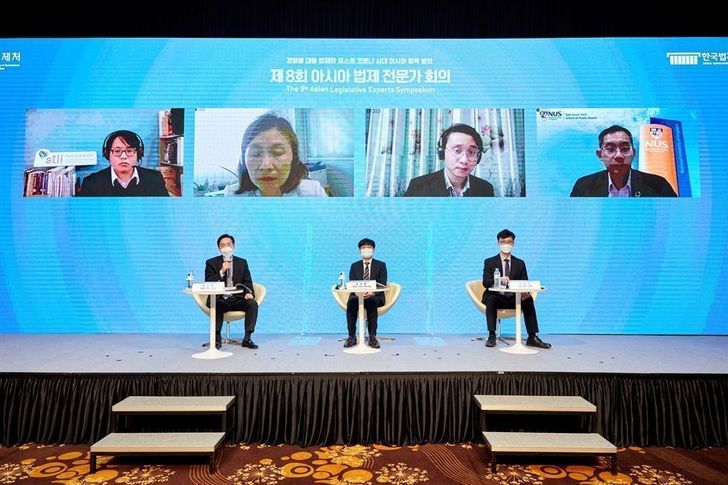
Legal experts from Korea attend the eighth Asian Legislative Experts Symposium at a hotel in Seoul while those from other Asian countries participate online, in this Nov. 25, 2020 photo. Courtesy of Ministry of Government Legislation
The theme of the symposium was selected in consideration of participating countries' common interests, Lee said.
So far, the ALES has covered ASEAN transportation systems, smart city development and IT laws, among others, and last year's symposium focused on legislative efforts on COVID-19 response.
“Last year, many countries were interested in Korea's legislative system that supported the nation's successful response to COVID-19, so we discussed ways to improve each country's legislative system on this topic,” he said.
For the second straight year, the ALES will have a small number of in-person participants at the venue due to the difficulties of inviting speakers from abroad amid the prolonged pandemic.
“The ALES is a forum where legal experts from various countries can share information, but it is most regrettable that they cannot gather in one place to exchange opinions without formality due to the coronavirus,” the minister said.
However, Lee said the online format also had positive attributes that benefit the symposium.
“As evidenced by the fact that last year's symposium drew a total of 1,300 domestic and foreign participants, the virtual forum allowed a large number of people to overcome the space restrictions and attend the event,” he said.
“In addition, it was livestreamed through YouTube, so we could monitor participants' responses on a real-time basis.”
The minister added: “I think this kind of change is very meaningful in that it can raise public interest in legislative systems and allow us to directly listen to the opinions of various interested parties.”
In the wake of the pandemic, the importance of international solidarity is taking on a new significance to jointly overcome global issues, and in that respect, the minister stressed that legislative exchanges and cooperation were indispensable.
“Laws are an essential tool for realizing practical policy changes in administrative, economic, and socio-cultural aspects. Therefore, studying laws and systems of other countries that are successfully coping with similar problems is very important to address problems effectively,” he said.
“Common global issues such as the coronavirus and climate change cannot be resolved independently, so international cooperation needs to be backed up.”
In this process, legislative exchanges and cooperation are significant in enhancing international solidarity to resolve global problems by seeking more effective policy directions and sharing information on laws that implement them, he noted.
The ministry has inked some 30 business agreements with 16 Asian countries, leading the development of legislative administration in the region and building the foundation for domestic and international legislative networks and cooperation.
In addition, it provides a service translating into Korean foreign legal information shared through exchanges with legal institutions in each country for the public and local companies.
“It supports Korean people and companies overseas, while allowing other countries to easily consult Korea's legal information,” Lee said.
In May 2018, Korea helped Myanmar launch an online government system on legal information, which allows people in the Southeast Asian country to search for legal information using computers and mobile applications.
“As of October this year, some 1.39 million people in Myanmar have used the database system,” Lee said.
Also, Indonesia is seeking to establish a “unitary legislative organization” like the Ministry of Government Legislation here, in order to address excessive regulations on business activities and conflicts between laws that it believes hinder national development.
“To this end, the Southeast Asian country has held five seminars with the ministry on five occasions to share Korea's legislative experience and know-how,” he said.
“In the future, we will continue to share Korea's expertise and experience with other Asian countries.”