Trial of ex-justice minister's wife again shows ethical lapses of Moon administration
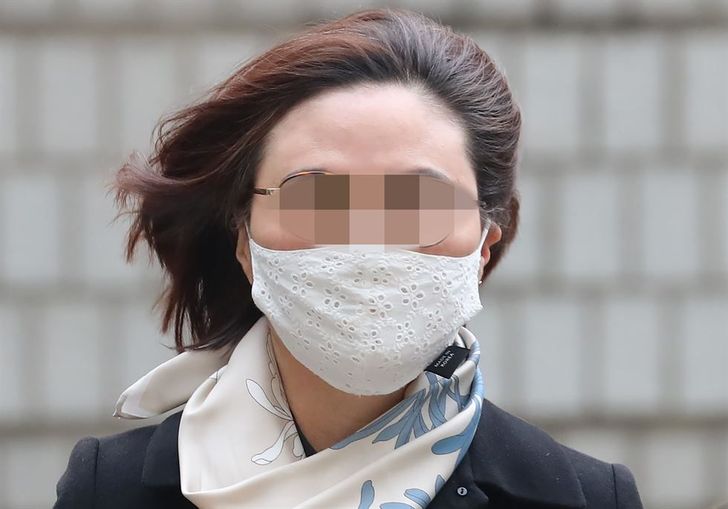
Chung Kyung-shim, a professor at Dongyang University and wife of former Justice Minister Cho Kuk, arrives at the Seoul Central District Court in Seocho-gu, Seoul, Wednesday. Chung was detained after being sentenced to four years in prison and fined with 500 million won ($453,992) for forging her daughter's academic records. Yonhap
By Jung Da-min
The prison term handed down to the wife of former Justice Minister Cho Kuk, announced after her conviction for multiple criminal acts, is an unfavorable factor for President Moon Jae-in and the ruling party which defended Cho.
The court decision adds to criticism of the Moon government for its ethical lapses, as a number of high-ranking officials have also been embroiled in influence-peddling scandals. The controversy surrounding Cho, in particular, has been so far the biggest considering he was trusted by the President to lead prosecutorial reform and the prosecution's investigation into corruption allegations surrounding him brought about the months-long conflict between the ruling bloc and Prosecutor General Yoon Seok-youl.
The Seoul Central District Court gave a four-year prison term to Cho's wife, Chung Kyung-shim, a professor at Dongyang University, for forging academic documents to bolster her daughter's medical school application, such as an award certificate from the head of Dongyang University and an internship certificate from Seoul National University's (SNU) Center for Public Interests and Human Rights Law. It said Chung also forged other internship certificates from several medical-related research centers affiliated with a prominent university or organizations and of a hotel.
The court said the former minister was also involved in many of the forgery activities, playing a main role in creating the fake internship certificate from the SNU center.
Regarding the other charges against Chung of financial wrongdoing, the court dismissed some while recognizing others, including insider trading using an account under a borrowed name and attempting to destroy evidence. The court ordered the immediate detention of Chung after announcing the verdict, citing the possibility of her destroying evidence.
The snowballing corruption scandals surrounding Cho and his family have long troubled President Moon, who pushed ahead with the appointment of Cho to the position of justice minister in September 2019 even though the prosecution had begun investigating the allegations.
Yoon, who was appointed by Moon in July 2019, has led investigations into sensitive cases in which prominent figures of the ruling bloc have been involved, including the case of Cho. These have led to conflicts between the ruling camp and Yoon. Justice Minister Choo Mi-ae, who succeeded Cho, has been active in pushing ahead with Moon's prosecutorial reform, labelling Yoon as a figure who needs to be dealt with.
Following the months-long conflict, Choo in late November ordered the suspension of Yoon from duty, demanding he be disciplined over alleged interference in sensitive investigations, claiming Yoon had failed remain politically neutral. Yoon has protested Choo's order by filing an injunction request to suspend both it and the disciplinary actions against him.
But the court ruling that found Cho's family guilty of corruption has proven the investigation led by Yoon was legitimate, and this verdict is likely to further put the Moon administration into a corner.
“It is widely believed that the investigation into the Cho family was the main cause of Choo's order for disciplinary action against Yoon, although it was not included in the official causes of her order,” said Cha Jae-won, a professor of special affairs at the Catholic University of Pusan. “The court ruling has weakened Choo's claim that the investigation was politically motivated.”