Warrant denial raises 'double standard' issue
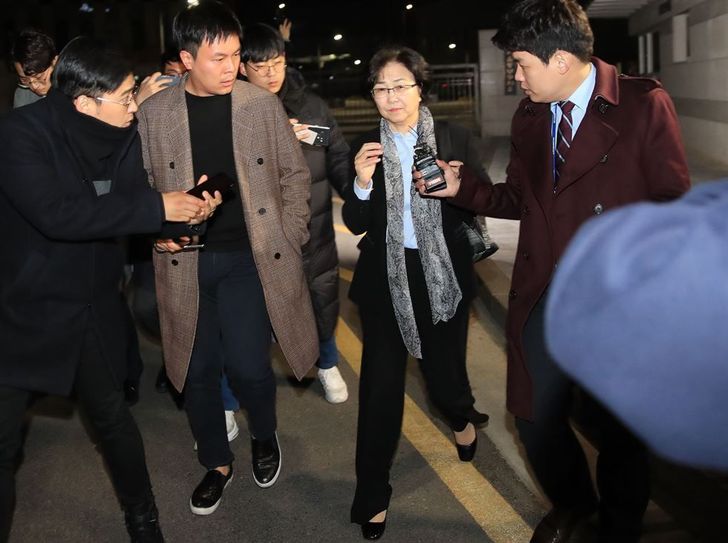
Former Environment Minister Kim Eun-kyung leaves Seoul Dongbu Detention Center, early Tuesday morning, after a court turned down the prosecution's request for an arrest warrant for Kim. / Yonhap
By Lee Suh-yoon
Controversy is rising over a local court's rejection of a request for an arrest warrant for former Environment Minister Kim Eun-kyung, as in its ruling it seemed to defend Cheong Wa Dae's interference with the selection of senior officials for ministry-affiliated organizations.
It also seemed to imply that there was “a need” to kick out officials appointed by the former Park Geun-hye administration, as if they were a part of “deep-rooted evil” to be eradicated by the new Moon Jae-in administration.
The Seoul Eastern District Court turned down the prosecution's request Tuesday for an arrest warrant for Kim, who has been charged with abuse of power.
It was suspected that the Kim-led ministry forced 24 senior officials at its eight affiliated organizations appointed by the previous Park administration to step down, so the posts could be filled with people loyal to the current Moon Jae-in government. The ministry allegedly inspected some of the officials to uncover individual wrongdoing or business-related mistakes, eventually forcing a standing auditor at the Korea Environment Corp. to quit.
It was alleged that the ministry did not create the “blacklist” of the officials but Cheong Wa Dae pulled the strings.
The court said there was no risk of flight or evidence-destroying from Kim. The court further said, in an unusually long statement, that Kim's charges were debatable under circumstances that called for “the normalization of state affairs.”
“Regarding the allegations of forcing mass resignations and carrying out targeted inspections, we must take into account the fact that there was a problem of lax management and discipline at public institutions due to a lack of proper supervision while the nation was facing the massive corruption scandal involving Park's aide Choi Soon-sil and Park's impeachment,” said Park Jung-gil, the judge who reviewed the arrest warrant request.
“The new administration had reason to review resignation plans of officials in order to normalize operations at public institutions, and some of the inspected officials were actually found to have conducted wrongdoing. So there is room for debate, and Kim's right of defense must be ensured in this case.”
With regard to filling the posts with people close to the Moon administration, the court added “there was a long-held custom” of the President or Cheong Wa Dae directly nominating candidates. According to the prosecution, the ministry cancelled entire hiring processes when a Cheong Wa Dae-favored candidate was dropped, and leaked interview documents to certain applicants beforehand.
The court's stance on Kim is likely to affect future rulings about the allegations when prosecutors seek indictment without physical detention. It may raise criticism of “double standards” in juxtaposition with ongoing trials over another “blacklist” and power abuse cases involving Park's former aides.
The issue is sensitive as President Moon, who came to power in May 2017 after the “candlelight revolution” against the corrupt Park regime, has pledged to be different from his predecessor, with anti-corruption as a top priority of his political agenda.
Opposition parties instantly lashed out at the court decision. In a press statement on Tuesday, the Party for Democracy and Peace called on the court to conduct a “strict and impartial trial” on Kim to prevent public criticism of implementing double standards.
The main opposition Liberty Korea Party (LKP) also said Cheong Wa Dae's pressure had forced the court to drop the warrant request.
“It is regretful that different yardsticks were applied for the similar cases that took place respectively in the former administration and the current,” LKP floor leader Rep. Na Kyung-won said at a party meeting at the National Assembly.
Na said the court's account for the rejection implied Cheong Wa Dae's involvement in the selection of officials at the organizations, calling for a more thorough investigation.
After the court decision on Tuesday, Cheong Wa Dae said it “respected the court decision.”
“We hope the court will now clarify to what extent the minster can legally exercise personnel inspection rights,” presidential spokesman Kim Eui-kyum said in a text message sent out to local reporters on Tuesday. “We will also work to make the appointment procedures of public institution heads more transparent.”