Former political star jailed in #MeToo case

An Hee-jung, former governor of South Chongcheong Province, is taken into custody at the Seoul High Court in southern Seoul, Friday, after being sentenced to 3.5 years in jail for raping and sexually harassing his personal secretary. Korea Times photo by Seo Jae-hoon
By Lee Suh-yoon
A former governor of South Chungcheong Province was sentenced to three and a half years in prison in his appeals trial, Friday, after being found guilty of repeatedly raping and sexually harassing his former secretary.
In a landmark victory for the country's ongoing #MeToo movement, the guilty verdict overturned a lower court's ruling that acquitted him last year due to insufficient evidence.
Handing down the verdict saying he was guilty on nine counts of the 10 charges, the Seoul High Court ruled that his former secretary Kim Ji-eun's testimony was credible and consistent enough to be accepted as evidence this time.
“The victim's accounts are consistent, detailed and specific to the extent where it could not come from anything but direct experience,” said Hong Dong-ki, the presiding judge.
“The victim also gave no sign of any romantic interest in An, who was married, 20 years her senior and also her boss. This was not a normal consensual relationship.”
An was taken into custody immediately.
Kim expressed relief at the ruling.
“It's finally time to say goodbye to the days of being burned at the stake like a witch,” Kim wrote in a letter sent to the media, referring to the doubts and accusations she faced after going public. “I'm glad I can live in a separate world from An now.”
An's sexual abuse case came to light last March after Kim gave a TV interview, saying he repeatedly raped and sexually harassed her. Right after the accusations, An made a “vague” apology to Kim and the public on social media, claiming everything was “his fault,” and stepping down from the governorship.
However, the 53-year-old changed his stance later and said everything took place “under consent” after the prosecution indicted him the following month.
The scandal gripped the nation given that An was such a high-profile politician.
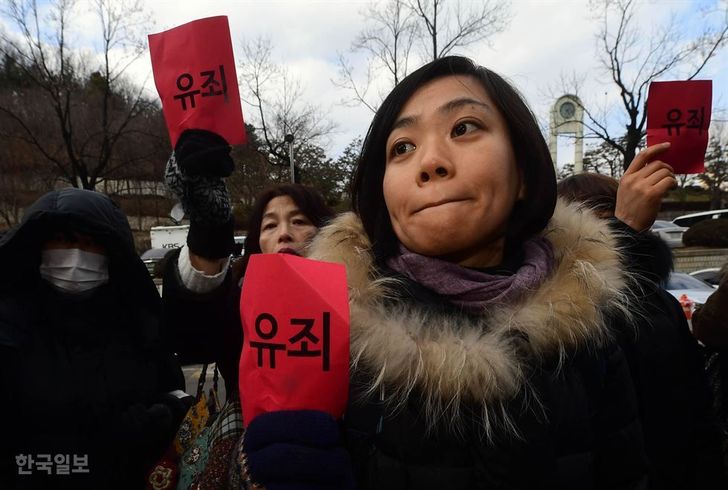
#MeToo activists outside Seoul High Court hold up red cards reading “guilty,” Friday. / Korea Times photo by Seo Jae-hoon
He was seen as a potential hopeful in the next presidential election in 2022 and had closely competed with President Moon Jae-in in the primary for presidential candidacy of the Democratic Party of Korea in 2017.
After the verdict was read out, #MeToo activists, who stayed out of the courtroom holding up red cards reading “guilty,” broke out into teary hugs and applauded.
The Friday ruling “apparently” gives a landmark court victory to the country's ongoing #MeToo movement.
In the first ruling in August, the Seoul Western District Court handed An a non-guilty verdict on the grounds of insufficient evidence and that Kim had enough “physical leeway” to resist or avoid the governor's advances during these repeated incidents.
That ruling dealt a crushing blow to #MeToo activists, who criticized the ruling for turning a blind eye to how occupational authority of superiors makes the use of overt physical coercion unnecessary in workplace rape.
According to the law on “sexual intercourse by abuse of occupational authority” ― which prosecutors charged An with ― those who use their “authority” to have sexual intercourse with someone under their supervision in an employer-employee relationship can be given up to five years in jail. In some past verdicts, even socioeconomic status was recognized as one type of such “authority” capable of non-physical coercion. Though this law was not applied actively to An's case in August, it was on Friday.
“An was a standing governor who was capable of firing or penalizing the victim, who as An's personal secretary was in a position where she had to obey his orders from a close range,” the court said in the verdict. “Being An's contact person to others, she was well aware that her perpetrator was considered the next presidential candidate.”
In the ruling, the court also dismissed claims by An's side that Kim did not “fit the image of a victim” in her continued service and “friendly attitude” to An.
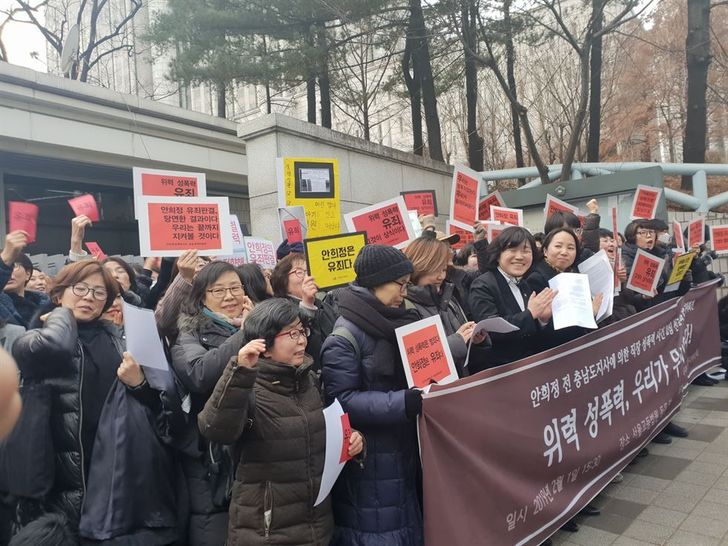
#MeToo activists celebrate the court verdict over Ahn Hee-jung in front of the Seoul High Court's east gate, Friday. / Korea Times photo by Lee Suh-yoon
“The victim said she was afraid she would be fired, just a month after she just landed the job,” judge Hong said, dismissing An's lawyers' claims that a victim of sexual violence “could not possibly” look for the governor's favorite foods or use friendly emoticons in her text messages to him. “These actions were an essential part of the job as personal secretary, not done out of amicable or intimate feelings towards the governor.”
#MeToo activists welcomed the court's active use of the law criminalizing sexual coercion through occupational authority.
“A dead clause in our legal system finally came alive as justice today. We can no longer permit a society where a governor, director or coach can demand their secretary, actor or athlete to offer up their bodies for sex after a long day. That needs to be called exploitation, oppression and authority-based sexual violence now,” Kwon Kim Hyun-young, a women's rights scholar and activist, said after the ruling.
“In the minds of citizens and working women, An was already guilty. This ruling went closer to that common sense.”
This is not the first court victory for a high-profile #MeToo case. Just last Wednesday, senior prosecutor Ahn Tae-guen was sentenced to two years behind bars for sexually harassing a junior prosecutor, and later disadvantaging her in job postings after she tried to expose him.
Politicians, prosecutors, priests, theater directors, professors and even a poet who was listed for the Nobel Prize ― men at the top tiers of Korean society ― fell in succession during the height of the country's #MeToo movement last year. The movement opened a floodgate of harrowing stories of habitual sexual abuse of Korean women, which have continued in a steady stream into 2019 with the recent #MeToo claims by female athletes.
Women's rights groups heralded the ruling as a new chapter for the #MeToo movement in Korea, in a high-spirited press conference held in front of the court gates after the ruling.
“Through #MeToo, our society now stands at a crossroad of change,” they said. “The women who took part in this movement will not allow things to go back to the way they were in the past.”