Dispute rekindled over disclosure of suspect's personal info
By Kang Seung-woo
The police's decision to disclose the personal information of a suspect in a recent atrocious murder is reigniting a years-long debate over how to balance the rights of the accused with the people's right to know.
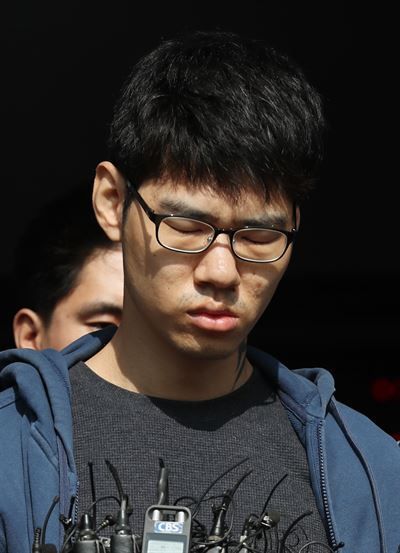
Kim Seong-soo is escorted out of the Yangchoen Police Station in Seoul, Monday. / Yonhap
In the aftermath of a brutal crime, the public often demands the investigative authorities disclose the suspect's name and face, while rights activists claim such a move undermines the principle of “innocent until proven guilty.”
This comes after the Seoul Metropolitan Police Agency revealed a murder suspect's face and age, Monday, after holding a meeting to discuss the issue.
Kim Seong-soo, 29, is suspected of stabbing a 21-year-old part-time worker dozens of times to death in an internet cafe in western Seoul, Oct. 14. Officers did not cover his face with a cap or a mask when he was taken out of the police station.
According to the Act on Special Cases concerning Punishment of Specific Violent Crimes, a suspect's name, face, age and other personal details can be disclosed if police have sufficient grounds to believe the suspect has committed the crime, and when disclosing such information is necessary for the public interest to guarantee the people's right to know and prevent other similar crimes.
The regulation was made in April 2010 in the wake of serial murder case by Kang Ho-sun, who was sentenced to death in 2010 for killing 10 women.
The recent case with Kim has sparked public anger and demand for heavy punishment, as he pled for leniency citing an unstable mental condition, which is believed to have mainly affected the police decision to disclose his identity to the public.
However, eight years after the revised act on disclosing information of a suspect, there are still those for and against the decision.
Those who agree with it believe people have the right to know about criminals and they have to be socially punished through disclosure.
“Criminals who take innocent lives need to be treated as nonpersons by making their identities known,” said Yu Jin-hee, a 35-year-old office worker.
“Plus, it will potentially help prevent violent crimes.”
However, opponents claim the disclosure of suspects' private details goes against the presumption of innocent until proven guilty ― a fundamental principle of common law.
“Legal decisions and punishment for those who commit crimes must be made only through trials. The police disclosure of Kim's face and name is like an investigative agency without the decision-making right violating a basic legal right,” a judicial official said.
“It is not an issue that can be easily handled based on public opinion.”
Kim is currently undergoing a psychiatric evaluation at the National Forensic Psychiatry Hospital in Gongju, South Chungcheong Province, which is expected to take a month.