Koreans' patience with bullies running out
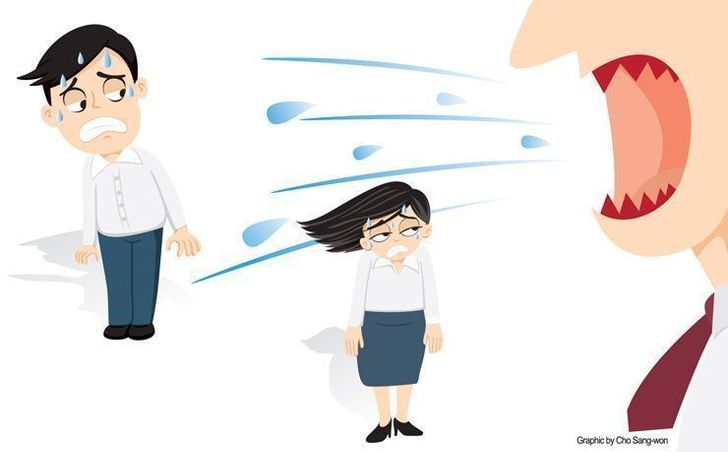
More people stand up against 'gapjil'
By Kang Hyun-kyung
Human rights activist Oh Chang-ik encountered an awkward moment during his visit to the National Assembly on Feb. 22 for a seminar about reforming the law enforcement agencies. When he dropped by the restroom during a break that afternoon, an assistant of then Deputy Police Commissioner Kim Gui-chan was there waiting for his boss with toilet paper in his hand.
Soon, Oh figured out what was going on. As Kim came out of the toilet and washed his hands, his assistant handed him tissues from the roll. His assistant was there to help his boss dry out his wet hands. Kim, who appeared to take his assistant’s help for granted, took the toilet paper and used it to dry his hands.
Oh was in disbelief at what he saw. After returning to the seminar room, Oh asked Jang Sin-joong, a retired senior superintendent, if it’s common for a senior-level police official like Kim to have their assistant attend to them even in the restroom.
“It’s a shame such a trash-like outdated practice is still festering in the police organization,” Jang answered. “I was frustrated because I thought it disappeared a long time ago.”
What Oh saw in the National Assembly restroom is the tip of the iceberg. Jang said having a full-time personal assistant is one of the perks given to high-ranking police officials. Such excessive perks spoil officials and some wittingly or unwittingly boss their aides around, which Koreans now call “gapjil.”
Jang, the founder of the web-based watchdog Human Rights Center for Police Officers, posted the fresh gapjil case on Facebook. It went viral and caused a public uproar against the high-ranking police official.
Kim was replaced in a reshuffle in July, two months after Moon Jae-in was elected President.
Korean society’s patience with bullies is wearing thin.
Gapjil (an act of the party, gap) is initially derived from a two-party contract. The party who has the right to enforce terms of a contract, such as a landlord in a housing contract, is usually called “gap,” whereas the other party subject to follow the rules set by the gap is “eul.”
Gap is an analogy used mainly in a negative manner to refer to people with power who misuse their influence when interacting with others.
So when people portray someone as gap, this usually means the person is greedy, self-serving and abuses their power at the expense of the weaker. There are no established norms or guidelines that can be used to identify whether a certain act by someone constitutes gapjil or not.
In general, however, there’s a widely accepted criterion, albeit still vague, to determine gapjil — if you were in the same circumstances, would you feel insulted? If so, you are the victim of gapjil.
Lee Jang-han, the tyrannical, foul-mouthed president of the pharmaceutical company Chong Kun Dang who came under criticism earlier this year after his mistreatment of his driver was made public, and four-star general Park Chan-ju who abused soldiers serving at his official residence are two well-known gapjil examples.
Soldiers who served at Park’s official residence reportedly were treated as if they were slaves and had to wear electronic bracelets that vibrated whenever “their masters” called on them to run errands. One of the soldiers testified Gen. Park had received several fruit boxes as gifts from his acquaintances and the fruit soon went bad because there are only two people in the household who ate them — Park and his wife. “When the fruit went bad, his wife yelled at us and blamed us for our failure to keep the fruit fresh,” the anonymous soldier said. He said he even saw Park’s wife hurl a rotten apple at one of the soldiers.
Earlier this month, the general was arrested after some of the allegations were found to be true and the investigation concluded he violated the law.
Psychiatrist Choi Myong-ki said bullying or gapjil is an outdated way of expressing one’s authority.
“People boss others around for various reasons,” he said. “Tyrannical leaders do so in order to make sure they are in charge, so they expect their subordinates to recognize their authority and follow their directions without resistance. If the bullies feel their subordinates’ reactions or recognition are insufficient, they take the offensive.”
Choi said bossing someone around also occurs outside organizations between, for example, a female VIP client of a luxury shopping mall and a staffer selling certain products there. The client, who is upset for some reason, is hard on the staffer and explodes with anger because she fails to control her anger. “In this case, what triggers gapjil is the client’s impatience,” he said.
According to the psychiatrist, bullies, cutthroat bosses and demanding clients have in common that they don’t know they are being excessive. “They do the same as they did in the past because their demanding behavior was accepted then. But their attitude backfires and gets them in trouble today because society has changed a lot. People they interact with are no longer tolerant of bullies or of dysfunctional social hierarchy.”
Some experts say gapjil culture shows the transformation of Korean society in a retroactive way.
Emanuel Pastreich, professor of Kyung Hee University and director of The Asia Institute in Seoul, said gapjil culture was born from radical competition encouraged in Korean society.
“Korean society is oddly even more dominated by social hierarchy today and in odd places,” he said. “We are looking at something profoundly different from Confucian hierarchy which is based on ethical principles.”
Pastreich describes gapjil as a sign of retroactive society in that Confucian hierarchy, which affected the Korean way of thinking, is based on mutual respect and responsibility but such obligations for the haves or those who are in powerful positions are lost in social hierarchy.
The abuse of power by some people in power has been there for several decades. The slave labor of soldiers at the military commander’s official residence is one example. According to former police official Jang, Korean men in their 40s or 50s who finished their military service are all too familiar with such abusive practices facing soldiers serving at the official residences of the top brass.
Why does their bullying, which was taken for granted for decades, belatedly draw the ire of the public now?
Kim Jin-sook, a partner at the Seoul-based law firm Barun Law, said a generational change is one reason behind Korean society’s growing impatience with bullies or ignorant superrich people who mistreat their workers. “The older generation didn’t confront abusive practices because they took them as part of life and something they had to endure,” she said. “But for the younger people who were raised in relatively affluent days and educated about equal treatment and human rights, the dysfunctional social practices are not acceptable, so they confront them.”
Kim said social media empowers ordinary citizens, who once were considered weak, to become influencers who can make their voices heard.
“In an era of individual media, social media users are independent journalists and they make the most of internet technology to spread the word and influence society to correct the wrongs,” she said.