Foreign workers vulnerable under work permit system
By Lee Kyung-min
Nepalese worker’s suicide sparks call for law revision
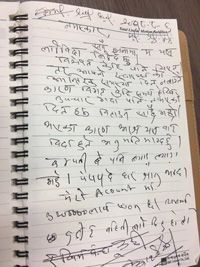
The handwritten note found next to the body of Keshav Shrestha. Courtesy of Sunita Bandey
A regulation banning foreign workers from seeking new jobs without their current employer’s approval has drawn growing criticism, following the suicide of a migrant worker whose requests for such permission were repeatedly denied.
Many Korean employers have abused the Employment Permit System, under which migrant workers have had to endure habitual verbal and physical abuses as they are tethered to the companies they work for. The system has deprived non-professional foreign workers of their right to seek new employment.
A Nepalese man, Keshav Shrestha, 27, was found dead in a dormitory at a bearing manufacturing factory in Chungju, North Chungcheong Province, at 4 a.m., Aug 7. A roommate of Shrestha found his body with a note next to it.
The note read: “I was under enormous stress at work. I was not allowed to leave the workplace to find new work at a different factory, nor was I permitted to go back to Nepal for medical treatment. I have 3.2 million won ($2,800) in my bank account. Please send it to my wife and my sister back in my home country.”
“Shrestha came to Korea in February last year. He had worked less than 18 months, less than half the time allowed for a migrant worker, which is four years and 10 months,” said Sunita Bandey, a Nepalese woman who helps migrant workers in Korea from her country.
Foreign workers can stay here on E-9 visas for three years and have their visas extended by one year and ten months.
Most immigrant workers want to stay here as long as possible to earn money. But the Nepalese man committed suicide with more than two years left before his visa expired.
According to Bandey, the man could not handle the work schedule _ a 12-hour day shift for two weeks followed by a 12-hour night shift for the following two weeks.
He had to be at work from 8 a.m. to 8 p.m. for two weeks, and then from 8 p.m. to 8 a.m. the following two weeks.
“He told many of his friends he could not sleep at night for the first few days of the week after the night shift began. He had this sleeplessness for days which made it impossible to do anything _ let alone work,” she said.
He asked the employer on multiple occasions to approve his requests to seek a new employer where he could work during the daytime and sleep at night, or go back home to rest, but the employer rejected his requests.
Shrestha took sleeping pills and sought treatment at numerous hospitals, but his condition did not improve.
Meanwhile, Shrestha is one of many migrant workers vulnerable to the abuses of employers who feel “entitled” to treat them any way they want under the current regulation.
The work permit system that allows such substantial discretion of employers was implemented with two objectives.
First, foreigners are allowed to work only to the extent that they do not infringe on local workers’ right to work. Allowing foreigners to choose workplaces would end up increasing demands for higher pay and better working conditions, which would threaten local workers in the job market, according to government officials. The government also sought to prevent those workers from staying here permanently.
Bandey said she has heard abuse claims from countless men and women which involved being hit in the head, slapped or punched in the face or kicked as well as being yelled at on many farms and in factories.
Bandey said, “If a Korean employer does the same thing to Korean workers, wouldn’t it be a major crime? Not to mention the workers quitting the job would be sure to happen? Why should migrant workers be punished just because they are foreigners?”
Udaya Rai, head of the Migrant Workers’ Union, visited the factory, Tuesday, to find out if the employer had banned Shrestha from seeking immediate medical attention when needed, had refused to accept his requests or whether any other abusive practices took place.
“Korean people can quit and find a new job whenever they want without needing the approval from their current employer,” he said. “Why are foreigners not allowed to do so?”