'Black budget' controversy resurfaces
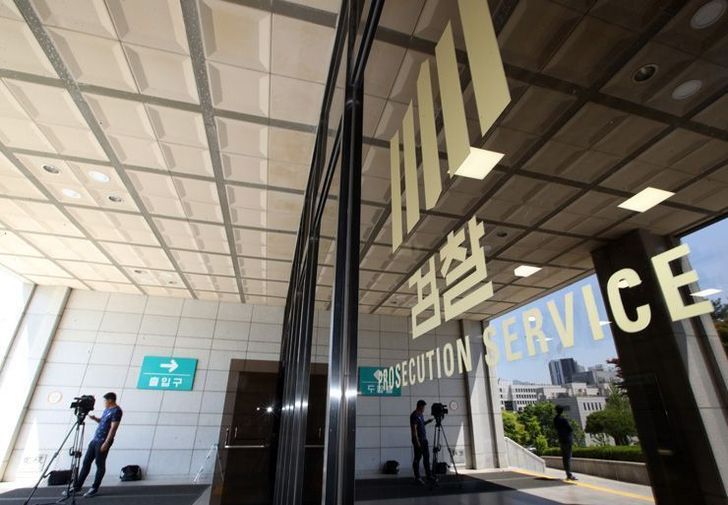
Bribery allegations involving senior prosecutors have renewed controversy over "special activity budgets," also known as "black budgets." / Yonhap
Gov’t urged to minimize secret expenses
By Jung Min-ho
It is the money that cannot be traced. Once given, no one asks about it, and no one needs to explain why and how it was spent.
“Special activity budgets,” also known as “black budgets,” are given to ministries and other government agencies for classified operations. But there are plenty of examples where the money often turns into the root of corruption or simply a waste of taxpayers’ money.
The latest case came into the spotlight this week when it was revealed that Ahn Tae-geun, a former deputy minister for criminal affairs, and Lee Young-ryeol, former head of the Seoul Central District Prosecutors’ Office, exchanged suspicious money envelopes over dinner last month.
Four days after the end of the Choi Soon-sil scandal investigation, Lee, who led the probe for the prosecution, met Ahn, a friend of one of the key suspects in the scandal, at a restaurant in southern Seoul. There, the two gave envelopes containing cash to each other’s staffs.
They said the money came from the justice ministry’s special activity budget of 28.7 billion won ($25.5 million), which has now come under scrutiny by the ministry and the Supreme Prosecutors’ Office.
But the legality aside, many people are questioning the need for secret expenses and urging the government to minimize them.
According to the Korea Taxpayers’ Association, 886.9 billion won was given to 18 ministries and other government agencies in 2016 as special activity budgets. The National Intelligence Service took the biggest share with 486 billion won, followed by the defense ministry (178.3 billion won), the National Police Agency (129.8 billion won) and the justice ministry.
A prosecutor general is known to use much of the justice ministry’s portion, which sparked controversy over the past few years.
In 2009, former prosecutor general Kim Joon-kyu was criticized after it was disclosed he handed out money envelopes containing 500,000 won each to eight journalists. He caused trouble again after giving out 98 million won to high-ranking prosecutors two years after that.
Citing security reasons, the prosecution has never disclosed how it spends its black budget. But it is no secret that top-ranking prosecutors often use the money as a means of boosting and strengthening their authority.
Black budgets are the root of many problems, which is the last thing taxpayers want to pay for, said the Citizens Coalition for Economic Justice, a civic group.
“Special activity budgets have to be minimized. The government needs to make the system more transparent so that taxpayers’ money is not wasted,” the CCEJ said.
Over many years, many civic groups have asked Cheong Wa Dae and the National Assembly to resolve the issue.
But former presidents and lawmakers, who also enjoyed the perks for themselves, have not been active in responding to the requests.
Hong Joon-pyo, a former lawmaker who ran in the presidential election this year, admitted to giving some of the National Assembly’s black budget to his wife in 2008 when he was serving as chair of the House Steering Committee. Another former lawmaker, Shin Gye-ryoon, said he also spent part of the money to pay for his son’s education abroad.
Yet things may be about to change. As he ordered an inspection of Ahn and Lee, Wednesday, President Moon Jae-in told his secretaries that Cheong Wa Dae should set an example by reducing its black budget.