Precocious puberty myths: Why milk and eggs aren’t to blame
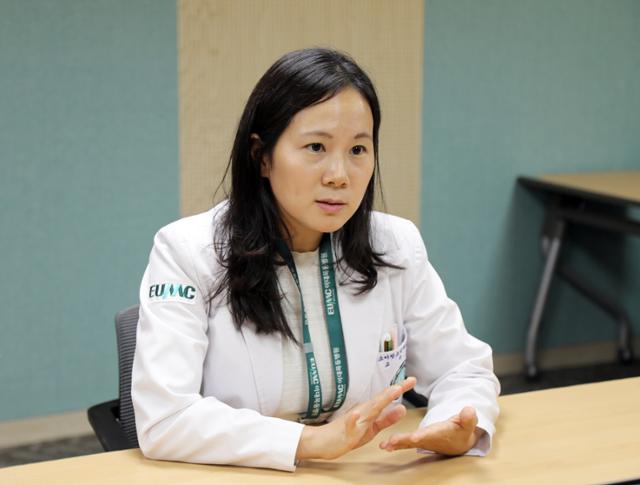
Choi Jung-eun, pediatrics professor at Ewha Womans University Mokdong Hospital / Courtesy of Ewha Womans University Mokdong Hospital
Parents worried about precocious puberty in their children sometimes avoid giving them milk, eggs or blueberries, believing these foods trigger early puberty. Some even remove the chalaza, the string-like structure near the yolk, before cooking eggs, thinking it causes the condition.
However, Choi Jung-eun, a pediatrician at Ewha Womans University Mokdong Hospital, said such fears are unfounded. “These are all myths,” she said, adding that milk, eggs, chalazae and blueberries “do not have a significant impact on precocious puberty.”
In an interview at the hospital in Yangcheon District, southwestern Seoul, on Aug. 4, Choi said the best way to prevent the condition is to give children a balanced diet. She advised parents to reduce high-calorie instant and frozen foods, encourage regular exercise and keep obesity in check.
‘Balanced diet is key’
“Eating a lot of foods like milk, eggs or soy milk alone is unlikely to bring on precocious puberty,” she said. “The most important thing is to eat a variety of foods. But I do recommend avoiding instant or frozen foods when possible because they tend to be high in calories, fat and sugar, increasing the risk of obesity, and they may expose children to environmental hormones during processing.”
On whether vitamin D deficiency or exposure to electromagnetic waves increases the risk, she said: “Some studies show a link between vitamin D and precocious puberty, others don’t, so it’s hard to draw a clear conclusion. Excessive smartphone or TV use doesn’t directly cause it either, although such habits can raise obesity risk, which in turn could indirectly contribute.”
Cases rising sharply
According to the Health Insurance Review and Assessment Service, the number of children and adolescents diagnosed with precocious puberty jumped about 72 percent from 109,000 in 2019 to 187,000 in 2023. Choi attributed the increase to rising rates of childhood obesity and metabolic syndrome around the COVID-19 pandemic, along with higher consumption of high-calorie processed foods and greater exposure to environmental hormones.
Early signs and diagnosis
Girls are considered to have precocious puberty if breast development or pubic hair appears before age 8, while boys are diagnosed if testicular volume exceeds 4 milliliters or pubic hair appears before age 9. Armpit hair and voice changes occur later in puberty and are not diagnostic signs, Choi explained, and boys’ facial hair is influenced by adrenal hormones rather than sex hormones.
The condition is 5 to 10 times more common in girls. While there is often no specific underlying cause identified for girls, boys often develop it due to brain tumors or other central nervous system issues. Because testicular size is hard for parents to assess, boys are often only brought in for assessment after the condition has progressed.
For boys diagnosed with precocious puberty, brain MRI scans are recommended and covered by insurance due to the higher risk of neurological causes. However, rising obesity in boys has also led to more cases of idiopathic (cause unknown) precocious puberty.
Why early treatment matters
If puberty starts too soon, growth spurt occurs earlier, shortening the overall growth period and potentially resulting in shorter adult height. Girls may also experience earlier menstruation, which can cause psychological stress, and some studies suggest a higher risk of Type 2 diabetes or breast and ovarian diseases.
Treatment is most effective when started early, before bone age exceeds 12 in girls and 13 in boys. “For girls, it’s best to check for symptoms around their second-grade birthday, and for boys, around their third-grade birthday,” she said.
Treatment methods and limits
The standard treatment involves regular injections to suppress the release of gonadotropin-releasing hormone, which triggers sex hormone production. Injections can be given every 4, 12 or 24 weeks, with equal effectiveness, but consistency is critical.
Girls can receive treatment until age 11 years and 11 months, and boys until age 12 years and 11 months, after which insurance coverage stops and the health benefits diminish. Prolonged suppression during normal puberty may lead to lower bone density and harm bone health.
This article from the Hankook Ilbo, the sister publication of The Korea Times, is translated by a generative AI system and edited by The Korea Times.