Korea to downgrade COVID-19's infection level to lowest Aug. 31

A medical worker carries out COVID-19 testing at a local public health center in Daegu, Wednesday. Yonhap
By Jun Ji-hye
Health authorities have decided to downgrade the COVID-19 infection classification level to the lowest, Class 4, from the current Class 2 on Aug. 31, as the virus situation has stabilized, Korea Disease Control and Prevention Agency (KDCA) Commissioner Jee Young-mee said Wednesday.
The decision means that the government will manage the infectious disease like seasonal flu, lift nearly all antivirus curbs and stop counting the number of daily new cases that have continued for the past three years and seven months.
Instead, the government will shift its focus to protecting high-risk groups of people such as the elderly.
“We have decided to manage COVID-19 within the general healthcare system, as the risk of the disease has decreased to the flu level for healthy people,” Jee said during a government meeting.
“In addition, we have secured sufficient medical capabilities to cope with the disease.”
Jee noted that the number of daily new virus cases, which has resurged since the fourth week of June, now shows signs of a reduction.
According to the KDCA's latest data, the daily average for new infections for the week beginning Aug. 15 stood at 40,355, down by 17.7 percent from 49,012 tallied the previous week. The weekly death toll has also decreased by 11 percent to 130 from 146.
“The country is expected to experience the resurgence again once or twice in the future, but most countries around the world have already stopped counting the number of daily new cases and are managing the disease within the general healthcare system,” Jee said.
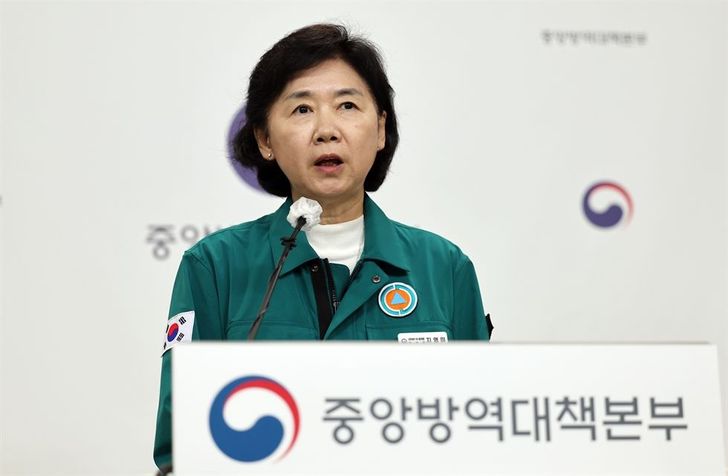
Korea Disease Control and Prevention Agency (KDCA) Commissioner Jee Young-mee speaks during a media briefing at the KDCA building in Osong, North Chungcheong Province, Wednesday. Yonhap
Korea has a four-tier classification system dealing with infectious diseases.
The lowest Class 4 diseases include influenza and hand, foot and mouth disease.
Class 2 ― COVID-19's current level ― includes tuberculosis, measles and cholera. Patients infected with these diseases are isolated by the health authorities.
COVID-19 was classified as Class 1 in January 2020 when the country reported its first case. Then, it was downgraded to Class 2 on April 25 last year.
With counting of the number of daily new cases discontinued, the KDCA will monitor the virus situation on a weekly basis.
Jee stressed that protecting high-risk groups of people such as young children, the elderly and patients with compromised immune systems will still be important, even after the disease's classification is downgraded to the lowest level.
In this respect, the government will maintain COVID-19's national crisis level at the current “alert” in a four-tier system. The four levels are: attention, caution, alert and serious. The disease had been classified at the top level ― “serious” ― since February 2020, before being lowered to the current level on June 1.
“We will maintain indoor mask rules at general hospitals and other high-risk places such as nursing facilities for the elderly for the time being,” Jee said.
“We will also maintain part of state supports for medical costs, so people infected with COVID-19 can be diagnosed and treated promptly.”
She said the government will also continue to offer vaccines and medicine for free for the time being to minimize medical expense burdens on the public.