No. of malaria patients tops 500, already exceeding last year's total
By Jun Ji-hye
The number of malaria patients has already surpassed 500 this year, raising concerns as the figure already exceeded last year's total at 420.
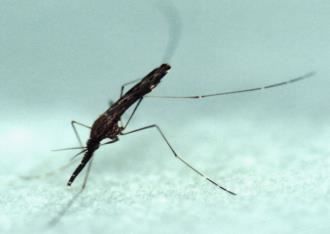
Anopheles mosquito which can transmit malaria / Courtesy of Korea Disease Control and Prevention Agency
Malaria is a serious and sometimes fatal mosquito-borne disease resulting in high fever, shaking chills and flu-like symptoms.
According to the latest data offered by the Korea Disease Control and Prevention Agency (KDCA), the number of malaria patients reported here since Jan. 1 stood at 509 as of Tuesday.
At this rate, the number could reach 700 at the end of the year, health authorities said, urging citizens to heighten their safety measures against the disease.
The last time when the number of malaria patients exceeded 700 was 2011.
The figure exceeded 600 only three times in 2014, 2015 and 2016.
Following the outbreak of the COVID-19 pandemic, the number stayed comparatively low at 385 in 2020, 294 in 2021 and 420 in 2022, apparently because many people stayed indoors due to concerns of infection.
The KDCA issued a malaria alert across the country on Aug. 3 after identifying plasmodium parasites in Paju, Gyeonggi Province, for the first time this year.
“We advise people to refrain from outdoor activities at night when mosquitos are more active,” a KDCA official said. “People are also advised to wear long sleeves and pants when they are outdoors and install mosquito nets in their homes.”