Global biomanufacturing training hub in Korea to educate 1,000 workers this year

Hwang Seung-hyeon, sixth from left in front row, director general of the Global Vaccine Hub Office at the Ministry of Health and Welfare, poses with participants in an introductory course of the Global Training Hub for Biomanufacturing at Seoul National University Siheung Campus in Gyeonggi Province, June 19. Courtesy of Ministry of Health and Welfare
First education program this year kicks off June 19 for two-week run
By Jun Ji-hye
The Global Training Hub for Biomanufacturing (GTH-B), established in Korea in 2022, supported by the World Health Organization (WHO), is set to offer a variety of educational courses this year on vaccine and biologics manufacturing to 1,000 workers in the industry from around the world.
In February of last year, the WHO announced the selection of Korea as a global biomanufacturing workforce training hub, aimed at supporting self-sustainable vaccine production in low- and middle-income countries by providing training in vaccine and biologics manufacturing.
The establishment of the global training hub came at a time when the COVID-19 pandemic had underscored inequalities in vaccine distribution around the world, raising the need to enhance the manufacturing capacity of biopharmaceuticals in low- and middle-income countries.
During its inaugural year, the GTH-B trained 754 people from 43 countries, including 68 from Korea, offering two courses on the production process and quality management of vaccines and biologics in cooperation with the WHO. Two more courses were offered on vaccine theory and practice to trainees from the Asia-Pacific region in cooperation with the Asian Development Bank.
According to the Ministry of Health and Welfare, the courses were well received by the participants who gave more than 4.5 points on average out of five maximum points. The courses were also praised by the WHO.
One trainee who works for a biomanufacturing company in Tanzania and participated in the course in October said, “The education lived up to my expectations 100 percent. It offered case studies as well as excellent mentors, which were very meaningful.”
This year, the ministry aims to increase the number of trainees to 1,000.
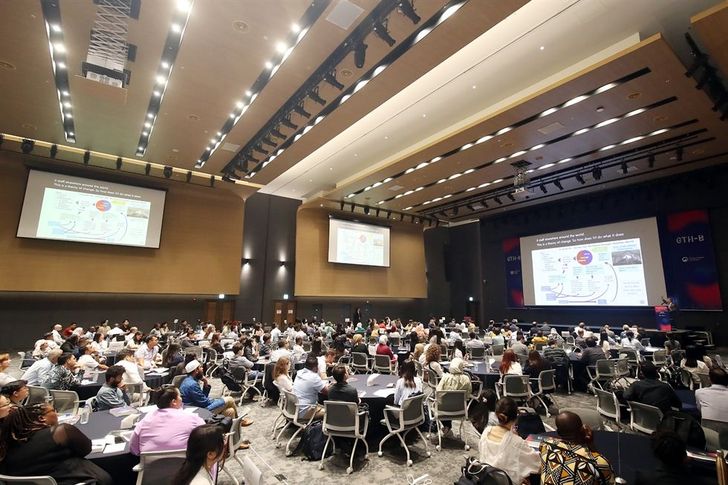
Participants of an introductory course at the Global Training Hub for Biomanufacturing attend a ceremony marking the start of the program at Seoul National University Siheung Campus in Gyeonggi Province, June 19. Courtesy of Ministry of Health and Welfare Figure
Toward that end, this year's first course kicked off on June 19 at Seoul National University Siheung Campus in Gyeonggi Province for a two-week run, bringing together 235 people from 47 countries, including Korea.
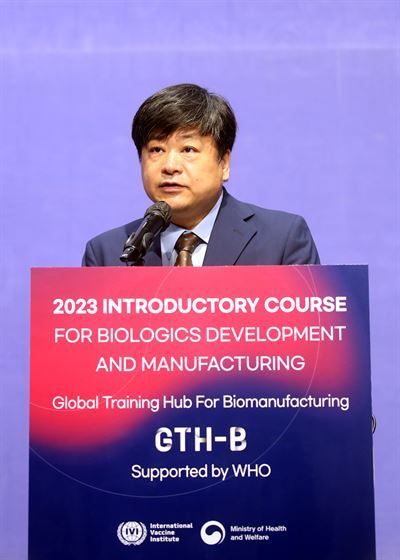
Hwang Seung-hyeon, director general of Global Vaccine Hub Office at the Ministry of Health and Welfare, gives a speech during a ceremony marking the start of an introductory course at the Global Training Hub for Biomanufacturing at Seoul National University Siheung Campus in Gyeonggi Province, June 19. Courtesy of Ministry of Health and Welfare
During a ceremony marking the start of the course, Hwang Seung-hyeon, director general of the Global Vaccine Hub Office at the Ministry of Health and Welfare, said, “I hope this education will contribute to improving production capabilities of vaccine and biologics. Korea will spare no efforts to establish a dedicated global bio campus, expanding field courses and cooperating with international organizations to nurture vaccine manufacturing workers.”
Jerome Kim, director general of the International Vaccine Institute (IAI), also said the global training hub will offer high-quality education by utilizing Korea's production infrastructure and the IAI's training capability, in order to contribute to resolving inequalities in vaccine distribution.
The ongoing course offers basic education necessary for vaccine and biologics development, such as immunology, vaccine technology, clinical development, product development, vaccine production and human resources management.
The course, supervised by the IVI, is comprised of lectures from experts both in and outside Korea, case studies as well as on-site visits to manufacturing facilities.
Some programs are offered online to provide convenience to participants.
Since January, the ministry had worked with the WHO and the IVI to recruit trainees in a bid to give opportunities to more people around the world. As a result, 205 people from 47 low- and middle-income countries and 30 people from Korea were recruited.
The participants work for a variety of institutions, including companies, government offices and research centers. After completing the course, they are expected to be assigned to vaccine manufacturing operations in their home countries or play an important role in research, education and distribution there.
Kim Da-som, a specialist at the Regulatory Affairs Team of LG Chem, Korea's leading petrochemical firm, said she decided to participate in this course to develop her understanding of vaccine development.
“In particular, I expect to exchange up-to-date information with other industry personnel from a wide variety of backgrounds,” she said.
Hend Elsayed, a vaccine and biological product quality supervisor at the Egyptian Drug Authority, said she participated in the course to improve her basic knowledge of vaccines and learn about new developments in the industry.
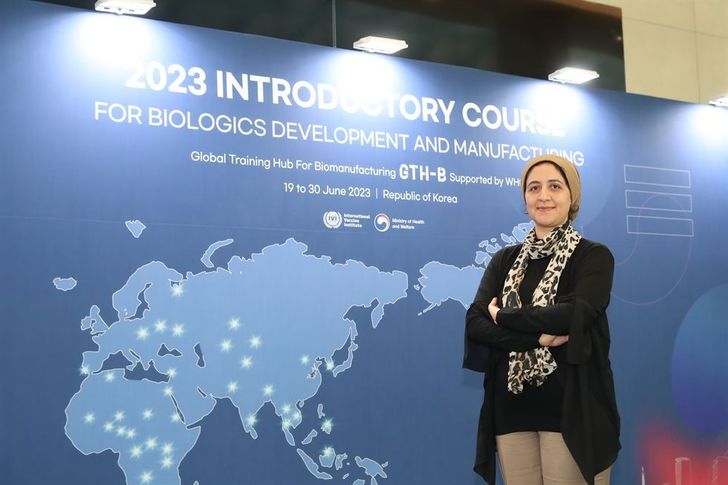
Hend Elsayed, vaccine and biological product quality supervisor at the Egyptian Drug Authority, who participates in the introductory course of the Global Training Hub for Biomanufacturing, poses at Seoul National University Siheung Campus in Gyeonggi Province, June 19. Courtesy of Ministry of Health and Welfare
“I want to meet and network with people, share our knowledge about vaccines and learn what is new. An offline course like this is much more effective than online courses because networking with fellow scientists from around the world is also included,” she said.
“Once I finish the course, I will go back to my country and give a demonstration to my colleagues in the lab about what I learned here. Next time, I hope to participate in the course again together with my colleagues and learn and experience the course together.”
Junior Senoo, biomedical scientist at the science department of the Navrongo Health Research Centre in Ghana, said he hopes to learn the entire vaccine manufacturing process, as his company is involved in many clinical trials, but he and his colleagues do not really get to appreciate what happens in the different processes that happen earlier.
“Another interesting topic for me is vaccine hesitancy. Vaccine hesitancy is very low in Ghana but I heard that it is increasing globally so I would like to learn more about the issue,” he said.
“We have seasonal presentations and seminars at my company where we share knowledge, so after completing the course, I will share what I learned here with my colleagues through internal seminars.”
Senoo added that he also hopes to contribute his knowledge to the National Vaccine Institute that Ghana launched in 2021.
The Korean government aims to solidify the foundation of GTH-B and will make every effort to provide high-level training as a global leader in biohealth by increasing essential trainings to strengthen biomanufacturing capacity in low- and middle-income countries.
In addition, cooperation with international organizations such as WHO, various governments, and non-governmental organizations (NGOs) will be further expanded to improve the status of the hub and provide training programs that meet global demands.
For this goal, the government signed a memorandum of understanding with the WHO on the sidelines of the 76th World Health Assembly in May, and also plans to create new educational programs in cooperation with the Asian Development Bank and the Inter-American Development Bank.