Gov't seeks to apply stricter health insurance criteria on foreigners

gettyimagebank
Chinese nationals reap highest benefits among foreign residents
By Lee Hyo-jin
The government plans to apply stricter standards on National Health Insurance Service (NHIS) coverage of foreign residents' dependents, hoping to control expenditures by the public health insurance system.
The Ministry of Health and Welfare said Wednesday that it is looking into applying tougher measures to screen health insurance coverage of foreign residents' dependents. One of the options under discussion is obligating them to continuously reside in Korea for at least six months in order to become eligible for the state healthcare program.
At present, salaried workers of foreign nationality wishing to apply for NHIS coverage are required to live in Korea for at least six months to sign up for the program through their employers and pay monthly premiums.
But their dependents ― spouse, children or immediate family members ― are not subject to such requirements and thus are eligible to sign up regardless of their duration of stay here, as long as they meet certain criteria such as income and assets.
Health authorities have been grappling with a rise in so-called free riders among foreign nationals who apparently have exploited the system. In some cases, family members who were living abroad were signed up as dependents and came to Korea only when they get ill to receive healthcare benefits.
According to the National Assembly Research Service, NHIS coverage of foreigners' medical fees rose from W923 billion in 2019 to W954 billion in 2020.
In particular, among the foreign residents, Chinese nationals reaped the most benefits, according to NHIS data. Between 2017 and 2020, their reimbursement-to-premium ratio exceeded 100 percent, meaning that the group in total received more benefits than the amount they paid.
“The need to tighten eligibility standards for dependents of foreign subscribers has been rising. So we are reviewing various options. And one of them is to require family members to continuously live here for six months to become an eligible dependent,” a health ministry official told The Korea Times.
The official, however, did not specify an exact timeline for the implementation of the new measure, saying that details have yet to be fixed. She noted that children could be exempt from the new policy as they are assumed to be living with their parents in Korea.
“But before finalizing the plan, we would have to see if the revised bills are passed by the National Assembly,” she said.
Currently, there are two revised bills to the Health Insurance Act aimed at preventing the possible exploitation of the healthcare system by foreign subscribers. One of the bills was proposed by Rep. Joo Ho-young and the other by Rep. Song Eon-seog, both from the ruling People Power Party.
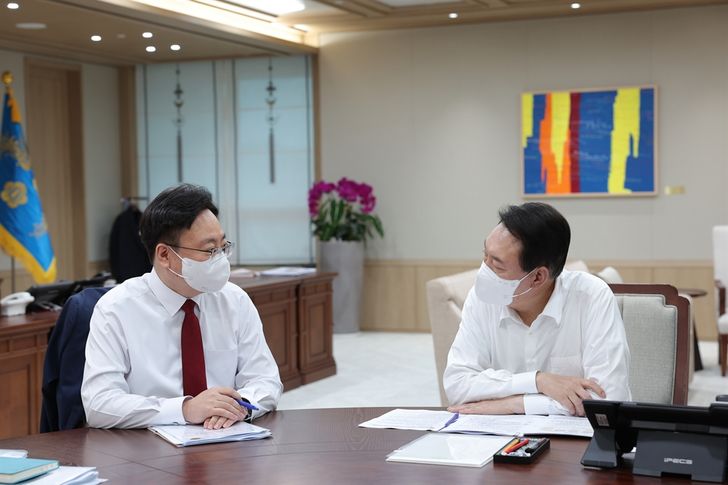
President Yoon Suk-yeol receives a policy briefing from Vice Health Minister Cho Kyoo-hong at the presidential office in Seoul, Aug. 19. Courtesy of presidential office
The plan was also included in the health ministry's policy briefing to President Yoon Suk-yeol, Aug. 19, where Vice Minister Cho Kyoo-hong presented a reform plan to restructure health insurance expenditures.
The policy aligns with Yoon's campaign pledge to apply tougher standards to screen foreigners benefiting from the state-run healthcare system.
During the presidential campaign in February, Yoon vowed to rectify the issue, saying that foreigners have been “putting their spoons on tables prepared for Korean citizens.”
He cited NHIS data which showed that eight out of 10 foreigners who are covered by the public health insurance system were Chinese, with six of them being their dependents. A dependent who was reimbursed by the NHIS the most received about 3.3 billion won, while having paid only 10 percent of their medical bills.