Experts warn of new COVID-19 wave this fall

A COVID-19 screening center near Seoul Station is empty, Thursday, as the country sees a steady decline in new infections. Yonhap
By Lee Hyo-jin
Local experts have warned that Korea may see another wave of COVID-19 infections this fall, during which as many as 2,700 fatalities could occur, depending on how many among the population have received a second booster shot.
They described the current situation as a “hyper-endemic,” which means that the coronavirus is persistent at high levels, and urged caution over the possible emergence of a new variant.
During a conference hosted by the Korea Disease Control and Prevention Agency (KDCA), Wednesday, Jeong Eun-ok, a professor of mathematics at Konkuk University, projected that a new wave may hit the country as early as November or early next year, due to weakened immunity among the population.
The professor predicted the wave would cause, roughly 700 to as many as 2,700 fatalities, depending on how many people receive a fourth injection of the vaccine. In the worst-case scenario, where most of the population is not inoculated with the second booster shot, the next wave would lead to nearly 3,000 deaths, she said.
The government has rolled out a second booster shot to people aged 60 and over from Monday, but only 10 percent of the eligible recipients have made a reservation, as many people are growing tired of repeated vaccinations.
“Tackling vaccine hesitancy, as well as maintaining a stable virus situation through non-pharmaceutical interventions such as social distancing measures, are important variables,” she said.
Jung Jae-hun, a professor of preventive medicine at Gachon Medical University, warned that the BA.2 subvariant of Omicron may soon take over as the dominant strain in the country this fall.
The BA.2 subvariant, also known as Stealth Omicron, has been increasing its presence here, with the detection rate rising to 41 percent as of Monday, up 15-percentage points from the previous week.
Jung advised that the country should be prepared for the new wave by renewing its vaccination plan, securing a sufficient amount of oral treatments and thoroughly reviewing when to remove mandatory mask rules.
The warnings from experts over a possible new wave coincide with the government's adoption of a pandemic exit plan in preparation for a post-Omicron era, where the coronavirus is treated like an endemic disease.
Korea seems to have passed the crest of the Omicron-driven wave, with daily infections steadily declining to below 100,000.
The country reported 90,867 daily new cases for Wednesday, raising the cumulative total to 16,674,045, according to the KDCA. This is the first time in nine weeks that new infections fell below the 100,000-benchmark on a Wednesday.
Will government lift face mask rule in May?
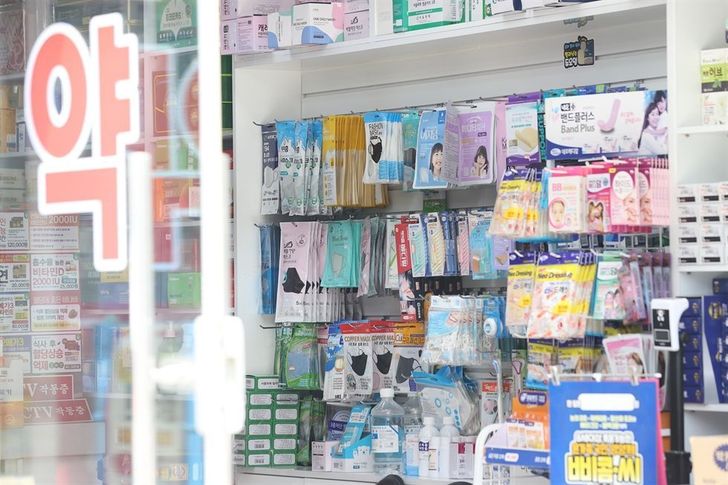
Face masks are displayed in a pharmacy in Jongno District, Seoul, Wednesday. Yonhap
While the government is mulling over whether to lift the mandatory wearing of face masks outdoors in early May, the transition committee of President-elect Yoon Suk-yeol is calling for a prudent approach on the mask mandate.
Interior Safety Minister Jeon Hae-cheol said Wednesday that the government will review lifting the mask mandate in early May through discussions with experts and an assessment of the current virus situation.
Later in the day, the presidential transition team called for prudence on revising the measures, as it may lead to an explosive increase in infections now that almost all COVID-19 restrictions have been lifted.
“It is not wise to lift all antivirus curbs as if the coronavirus does not exist. We are still seeing some 100,000 new infections and a hundred deaths per day. Many medical experts are worried that relaxing measures all at once would lower public awareness and worsen the virus situation,” said Shin Yong-hyun, a spokesperson for the transition team.