Traditional Korean medicine practitioners excluded from pandemic response scheme

gettyimagesbank
By Lee Hyo-jin
Despite their willingness to participate in the battle against COVID-19, traditional Korean medicine practitioners are struggling to find their place in the pandemic response scheme, which is dominated by their Western medicine counterparts.
They have been urging the government to recognize traditional Korean medicine as an official treatment method, and are demanding that traditional Korean medicine hospitals be included in the list of clinics offering rapid antigen tests.
Their demands, however, haven't been met by the health authorities.
Since December of last year, the Association of Korean Medicine (AKOM), which represents about 27,000 practitioners nationwide, has been offering traditional Korean medicine to COVID-19 patients undergoing home treatment, people suffering from side effects after vaccination, as well as those experiencing long-term symptoms of COVID-19 (long COVID).
Through non-face-to-face consultations with a doctor, patients are prescribed with treatments based on individual diagnoses, after which the medicines are delivered to their homes.
“We have treated more than 4,000 patients over the last four months, an impressive outcome which reflects the popularity and credibility of traditional Korean medicine,” Moon Young-choon, a senior official at the AKOM, told The Korea Times.
“We are having difficulties in meeting the soaring demand, as we are rapidly running out of resources without any financial support from the government.”
He said that none of the COVID-19 patients who have been treated with traditional Korean medicine have fallen into critical condition or were hospitalized, which proves the effectiveness of the medicine.
“Western and traditional Korean medicine treatments for COVID-19 seem very different from each other, but basically, they use the same approach; they both have antiviral effects and relieve coronavirus symptoms such as fever and cough.” he said.
“But what is different from Western medicine, is that traditional Korean medicine does not contain substances that may pose potential risks. I don't see why COVID-19 patients should be prescribed with a bunch of pills that may lead to side effects for some.”
Moon explained that among the four countries worldwide where traditional East Asian medicine is widely used ― Korea, China, Japan and Taiwan ― Korea is the only country where it is not officially recognized as a treatment option for COVID-19.
“Later this month, we will submit data analyzed over the last four months to the health ministry, and make an official request to include traditional Korean medicine in the government's treatment scheme,” he said.
“Traditional Korean medicine doctors haven't been able to play an active role in the public health crisis, as the country's medical services are dominated by doctors of Western medicine,” he added.
'Traditional Korean medicine practitioners excluded from testing scheme'
In addition to treatment, traditional Korean medicine practitioners have been excluded from the country's COVID-19 testing scheme, which has been expanded to local clinics since February.
Currently, people can receive rapid antigen tests (RAT) at over 9,500 medical institutions including general hospitals and local clinics nationwide at the cost of 5,000 won.
On March 14, the government decided to accept RAT results conducted by medical professionals for official diagnoses of COVID-19, without the need to take an additional PCR test. Since then, many local clinics have been flooding with people, forcing people to wait in lines for several hours to receive the tests.
The AKOM issued a statement, Monday, calling on the Ministry of Health and Welfare to give them the authority to conduct rapid antigen tests as well, but the ministry denied their request.
“The role of doctors conducting rapid antigen tests is not limited to administering the tests, but they should also prescribe medicines and treat the patients if necessary. We are not considering including traditional Korean medicine clinics in the testing scheme,” said ministry spokesman Son Young-rae during a briefing, Tuesday.
The traditional Korean medicine practitioners viewed this decision as “utterly absurd and unfair.”
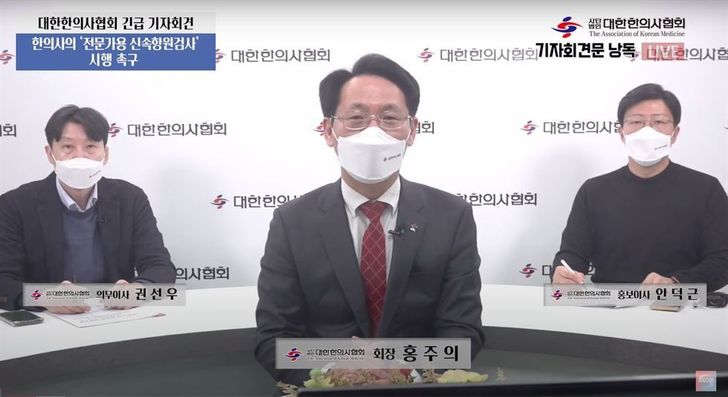
Hong Joo-eui, the president of the Association of Korean Medicine speaks during an online press conference, Tuesday, calling on the government to give traditional Korean medicine practitioners the authority to conduct rapid antigen tests. Screenshot from YouTube
“It is our due responsibility, as licensed medical workers, to participate in COVID-19 response activities and treat patients,” said Hong Joo-eui, the president of the AKOM, during an online press conference held on Tuesday.
Hong also refuted the claims of some western doctors that traditional Korean medicine practitioners are not qualified to conduct RATs, as they did not receive education in anatomy.
“Students at traditional Korean medicine colleges cover basic anatomy, physiology and pathology and undergo necessary training,” he said, explaining that the doctors are qualified to perform nasal swabs using testing kits designed for professionals.
He also argued that the government has no clear reason to exclude traditional Korean medicine practitioners when it has given Western doctors the authority to conduct the tests regardless of their specializations.
Doctors who are authorized to administer the tests are not limited to otolaryngologists, but also includes physicians of other specializations such as pediatricians, dermatologists, orthopedic doctors and internal medicine doctors.