'Less lethal' Omicron leads to record-high deaths, critical cases

People wait in lines to receive a COVID-19 test at a screening center near Seoul Station, Monday. Yonhap
Critical cases hit all-time high of 1,158
By Lee Hyo-jin
Korea is grappling with record-high deaths and critical cases due to the sheer volume of new infections fueled by the fast-spreading Omicron variant, although the variant has been found to be less lethal than previous variants of the coronavirus.
According to the Korea Disease Control and Prevention Agency (KDCA), the country reported 309,790 new infections for Sunday, raising the aggregated total to 6,866,222.
The number of patients in severe condition in total came to 1,158, breaking the previous record of 1,151 set in the midst of the Delta wave on Dec. 29, 2021.
The KDCA added 200 COVID-19-related fatalities for Sunday, down from Saturday's 251. Daily new deaths hit a record high on Friday at 269.
Health ministry data showed that 60 percent of hospital beds reserved for severely ill COVID-19 patients were occupied as of last week, up by 10 percent points from the previous week.
Although the Omicron variant is known to be three to four times less lethal than the Delta variant, with a current fatality rate of 0.15 percent, the highly transmissible variant is leading to larger overall volumes of deaths and critical cases than its predecessor.
Since the Omicron variant was first identified in Korea in early December, a total of 5,032 fatalities were reported as of Sunday, accounting for nearly half of the 10,595 total deaths the country has seen in the last two years of the pandemic.
But the worst is yet to come, according to medical experts, who view that the country will be seeing its deadliest days of the pandemic in the coming weeks.
“Starting from late March to early April, daily new deaths will soar to 300 and reach as many as 400. This means that the virus will take the lives of about 10,000 to 15,000 people in this short period. The warm spring month of April could be the cruelest month for some people,” Kim Tark, an infectious disease specialist at Soonchunhyang University Medical Center in Bucheon, wrote on Facebook.
Jung Jae-hun, a professor of preventive medicine at Gachon Medical University, called on the government to secure sufficient hospital beds in preparation for a further surge of seriously ill patients.
“The worst situation of the current Omicron wave will begin from late March and continue through early April, when the number of critical patients is expected to peak. Whether the government will be able to save the precious lives of the patients will depend on the effective management of hospital beds,” he said.
Vaccinations expanded to children aged 11 and under
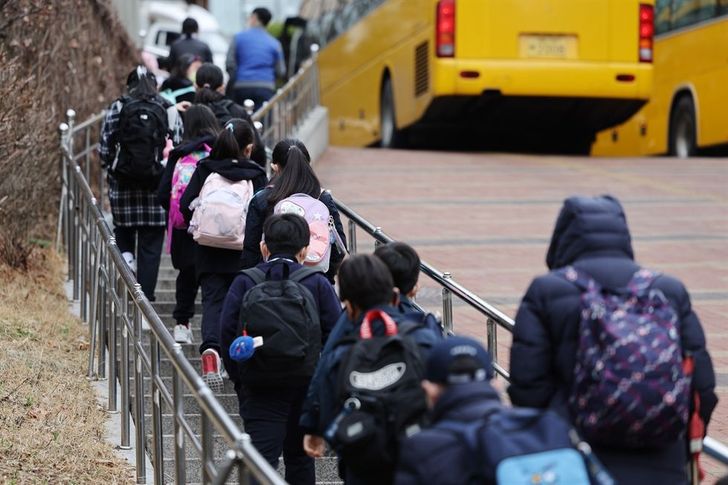
Students of an elementary school in Seoul head to classes, Monday. Under eased quarantine measures, starting Monday, students with a cohabiting family member who has tested positive for the virus are allowed to attend classes without having to self-isolate. Yonhap
Meanwhile, the KDCA unveiled its plan to administer COVID-19 vaccines to children aged between 5 and 11 ― or those born between 2010 and 2017 ― in the wake of mounting infections among young children.
Earlier on Feb. 23, the Ministry of Food and Drug Safety approved the use of Pfizer's Comirnaty vaccine for children of that age group.
Starting March 31, the two-dose regimen vaccine will be offered with an eight-week interval, while the gap may be shortened to three weeks for those with weak immune systems. Reservations will be available through the KDCA website from March 24.
Health authorities said teenagers and younger children have been linked to a rising number of infections in recent weeks, a worrisome development, as many schools have reopened for the spring semester.
But it remains to be seen how many of these eligible children will actually line up for the shot, as many parents have been reluctant to vaccinate their children due to concerns over potential side effects.