Local governments seek rebound in medical tourism

A dermatologist treats patients from Mongolia at a medical center in Daegu, in this April 23, 2019 photo. Courtesy of Daegu Metropolitan City
By Bahk Eun-ji
The COVID-19 pandemic, which has lasted for almost two years, has impacted local governments' efforts to promote medical tourism. Foreign patients come here to receive treatment at local medical institutions, during which they are also free to go sightseeing, shopping and experience Korean culture, and many programs are offered by public and private agencies to offer support at various stages of their stay.
But medical tourists have been unable to visit the country due to travel restrictions and fears of infection during travel. Unless they need to get urgent treatment available only in Korea, many who planned to travel here for medical purposes have delayed their plans because a large ratio of medical tourists used to come for health checkups or cosmetic surgeries.
According to data from the Korea Health Industry Development Institute, the number of medical tourists visiting Korea last year was 117,069, down 76.5 percent from 2019's 497,464.
By region, Seoul experienced a 79.2 percent decrease in the number of medical tourists; Incheon, 78.8 percent; Gyeonggi Province, 66.6 percent; Busan, 74.5 percent; and Daegu, 83.1 percent.
This year's total number, which hasn't been tallied yet, is expected to be even lower than last year's.
As medical tourism is a high value-added industry, with medical tourists spending 10 times more money than ordinary tourists, local authorities are struggling to come up with new ideas to revive the industry and attract patients from abroad, planning ahead for after the pandemic is brought under control.
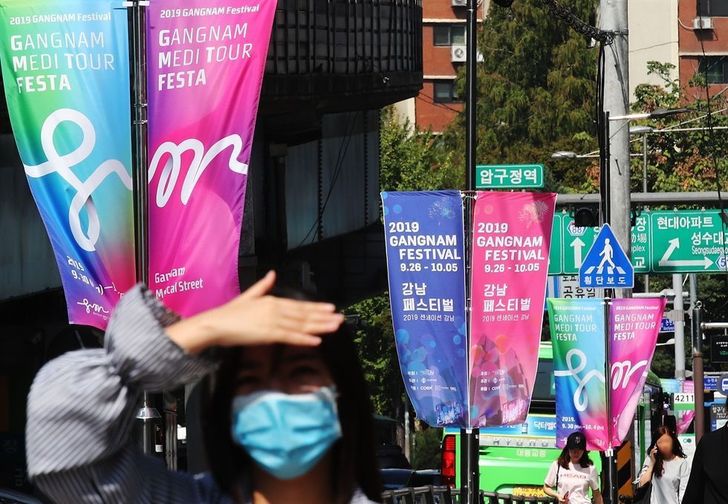
Banners promoting a medial tourism fair are displayed along street near Apgujeong Station in Gangnam District in this Sept. 30, 2019 photo. Yonhap
Incheon Metropolitan City plans to adopt ICT-based telemedicine and counseling for patients from Mongolia, Russia and member nations of the Commonwealth of Independent States (CIS).
It also plans to actively appeal to foreign nationals in Korea through various familiarization tours and medical fairs, targeting those working in foreign companies and international organizations, members of multicultural families, pilots and flight attendants and U.S. Forces Korea service members and their families.
“We plans to expand the system that provides pre- and post-services, from their entry to departure, offer interpretation services and cover self-quarantine expenses,” said an official of the Incheon city government's culture and tourism bureau.
“In addition, we will discover five new wellness tourism companies and organize a consultative body to promote joint projects.”
For North Chungcheong Provincial Government, it announced a five-year plan last month to revitalize medical tourism by 2025.
The scheme contains programs linking medical treatment and the region's tourist attractions, offering health checkups, plastic surgery, skin treatments, dental treatment and traditional medicine to VIPs who have influence in promoting these experiences in their home countries, as well as humanitarian medical service volunteer work for people in low-income brackets in medically vulnerable countries.
Two districts in Daegu were designated as Daegu Global Medical Special Zones by the Ministry of SMEs and Startups in November.
Six business operators in Suseong District and Jung District, where hospitals and medical institutions are clustered, will come up with special projects to attract foreign patients.
In accordance with the special zone designation, the city will spend 15.9 billion won ($13.4 million) by 2025 to take another leap forward in the medical tourism industry.
Busan Metropolitan City said it will focus on regular and online overseas promotional marketing through social media.
In particular, it plans to strategically support hospitals' overseas marketing and help them open telemedicine centers.
“It is time to seek various paths to promote medical tourism as the travel industry is expected to pick up to a certain level next year following the increase in the global vaccination rate,” an official of the Busan city government said.
“We are struggling to come up with measures so that attracting overseas patients can lead to revitalization of the local economy.”