Concerns rise over increasing mass rallies

Members of the Our Republican Party march on the street in Gwanghwamun area in central Seoul, Saturday. Yonhap
By Kim Rahn
Mass demonstrations and rallies are now being allowed with the government's “return to normalcy” plan that has eased social distancing regulations against COVID-19, raising concerns over the possible spread of the coronavirus among participants.
On Saturday, thousands of people took to the streets in downtown Seoul in demonstrations organized by more than 20 civic groups. They marched on the streets around the Gwanghwamun area, causing traffic jams in central Seoul.
Most of the organizers reported to the police that their rallies would have 499 participants ― in line with the government's “Living with COVID-19” plan that allows up to 99 people to participate in a rally and up to 499 when including 400 fully vaccinated people.
The police said they checked the demonstrators' vaccine certificates and did limit the numbers to 499 per rally, but could not prevent more people from joining in the middle of street marches.
More rallies are planned following the easing of social distancing rules. The National Police Agency said that it had received 8,489 notifications for rallies to be held across the country in October ― when mass gatherings were banned ― but had received 5,319 in just five days from Nov. 1 to 5. Those planning to hold demonstrations are obliged to make prior notifications to the police although they don't need to be granted permission, according to relevant laws.
The Korean Confederation of Trade Unions (KCTU), one of the nation's two largest umbrella unions, said it would hold mass demonstrations at four locations in Seoul, Nov. 13, the 51st anniversary of the death of Chun Tae-il, a labor activist who self-immolated in 1970 to raise awareness on the poor working conditions of garment factory workers.
It said 10,000 members would participate, with 2,500 at each location, adding they will hold more rallies, Nov. 17 and Dec. 2.
But the police and Seoul Metropolitan Government concluded the planned demonstrations were illegal due to the larger number of participants than allowed, saying they would not allow the rallies to take place.
“We already notified the KCTU that we are not allowing the reported rallies. So if they hold them, it will be illegal,” Seoul Metropolitan Police Agency Commissioner Choi Kwan-ho said in a regular press briefing, Monday.
Leaders of the KCTU have already come under police investigation for violating social distancing rules in a previous demonstration, Oct. 20, when some 16,000 union members gathered in areas near Seodaemun Station in central Seoul despite police declaring a ban on the protest.
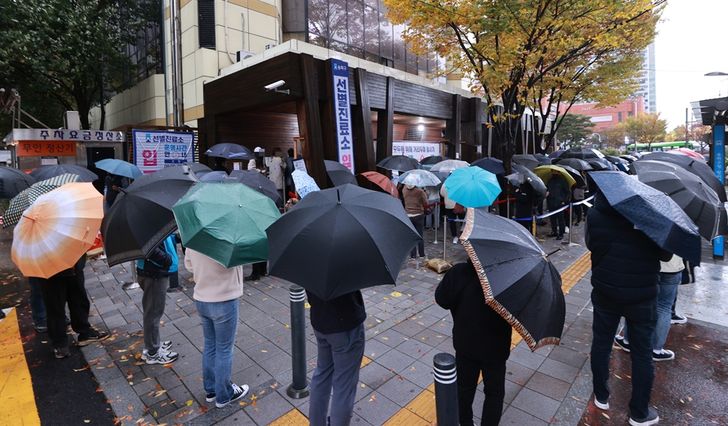
People wait in a long queue to get COVID-19 tests at a testing center in Songpa District, Seoul, Monday. Yonhap
Such mass gatherings are raising concerns over the further spread of COVID-19, as the nation is already seeing an increase in infections accompanying the eased social distancing rules.
Health experts said there are chances of the virus spreading at such mass gatherings even if the participants wear masks.
“People chant slogans and talk with each other, and some could eat together, so there is enough possibility for demonstrations to become hotbeds for infections,” said Chon Eun-mi, a professor of respiratory medicine at Ewha Womans University Mokdong Hospital.