Concerns growing over consistent rise in COVID-related deaths

People enjoy a sunny day at Gyeongbok Palace in central Seoul, Sunday, marking the first weekend since the government implemented its “Living with COVID-19” plan, Nov. 1. Yonhap
Death toll rises among elderly patients and unvaccinated
By Jun Ji-hye
Concerns are growing over a consistent increase in the number of deaths related to COVID-19 amid the prolonged fourth wave of the pandemic that began in early July.
According to the Korea Disease Control and Prevention Agency (KDCA), Sunday, the average daily number of COVID-19-realted deaths stood at 17.4 this month, nearly nine times higher than 1.96 tallied in June just before the fourth wave of the pandemic began.
On Nov. 3, the death toll rose to a 10-month high of 24, and on Nov. 4, 20 more virus patients died.
In general, when the death toll increases, the number of critically ill patients decreases. But this time, the number of such patients has also risen from 365 on Nov. 3 to 382 on Nov. 4.
Health authorities are bracing for a continued increase in the number of critically ill patients and deaths, as the government's shift in its virus management policy to the “Living with COVID-19” scheme, which took effect on Nov. 1, could lead to a more explosive increase in infections.
Both the authorities and medical experts believe that the resurgence of infections would be inevitable under the government's policy shift, aimed at achieving a “return to normalcy” through a gradual phasing out of many coronavirus-related restrictions.
The government has already eased key social distancing measures, lifting the limitations on operating hours for restaurants, cafes and movie theaters, and easing private gathering bans.
The government said the daily caseload could increase to between 7,000 and 10,000 soon, up from the current 2,000-range, vowing to preemptively enhance medical capabilities in preparation for “emergency situations.”
“The government issued an administrative order to secure more intensive care unit beds in the Seoul metropolitan area in preparation for a possible spike in daily COVID-19 cases,” Second Vice Minister of Health and Welfare Ryu Geun-hyuk said during a government meeting on COVID-19 responses, Friday. “We will secure sufficient hospital beds so we can respond to a possible emergency situation in which the country's daily infections reach 10,000.”
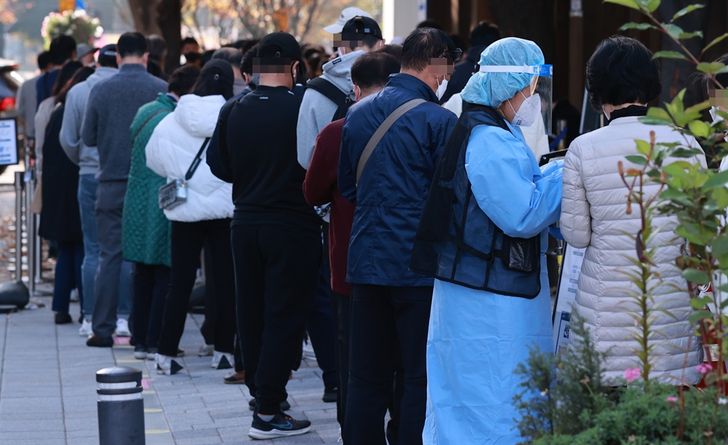
Residents wait in long lines to go through COVID-19 testing at a public health center in Seoul's Songpa District, Sunday. Yonhap
The authorities are raising concerns especially over increasing deaths among elderly patients and those who have yet to be vaccinated.
According to the KDCA, all of the 24 deaths, reported on Nov. 3, were patients over the age of 60, and among them, only six were fully vaccinated.
“The risk of becoming critically ill or dying increases when patients are elderly, have yet to be vaccinated or have underlying diseases,” Kim Ki-nam, a senior KDCA official, said. “We once again stress the need to get vaccinated against COVID-19.”
The authorities are also paying keen attention to the increasing ratio of teenage patients, as their vaccination rates are still low compared to the total. Teenagers began receiving vaccine shots last month, while the country's vaccination program began in February.
The fatality rate for teenage patients is comparatively low, but their infections could spread to local communities and to elderly residents, the authorities said.
“We need to increase the vaccination rate for teenagers at the earliest possible date to prevent further infection clusters in local communities,” Sohn Young-rae, a spokesman for the Ministry of Health and Welfare, said.