Couples decry strict social distancing rules on weddings

A screen installed on a truck shows a message of protest by soon-to-be married couples against the government's social distancing rules, in front of Seoul City Hall, Aug. 19. Yonhap
Limit on number of guests mars once-in-a-lifetime event
By Bahk Eun-ji
A wedding is one of the most important life events for an individual and their family. Soon-to-be-married couples are usually busy planning their wedding ceremony while delivering the happy news to their relatives and friends but, these days, such joy is gone and planning a wedding has become a huge headache for couples as the protracted COVID-19 pandemic and resultant social distancing rules have forced them to give up most of their plans.
A major hurdle is the limit on the number of guests that may attend the ceremony.
Under the national Level 3 and Level 4 social distancing regulations, the maximum number of guests at a wedding ceremony has been set at 49, excluding the bride, groom and their parents.
Even before the four-tier system was introduced in July, Seoul and the surrounding metropolitan area, where the largest percentage of infections has taken place, had been under the same restriction of less than 50 people.
Those planning to marry say the distancing rule is excessively stricter for wedding venues than other multi-use facilities where a large number of people gather: For places of worship, up to 99 people are allowed; for a concert hall, up to 2,000; and for department stores or discount stores, there is no limit.
“For a wedding ceremony with 49 people, family members and close relatives account for the majority and only one or two friends can be invited,” said Lee Jee-ahn, a 35-year-old office worker living in Incheon, who has already postponed her wedding twice since last year.
“A wedding is a once-in-a-lifetime event, and who would want to have such a big ceremony in such a shabby way?” she asked.
Besides being unable to invite as many guests as they want, would-be married couples also face financial losses because most wedding venues require a non-refundable deposit for a minimum number of guests, and the minimum numbers are usually between 100 and 200 ― meaning couples must pay for 200 guests even though they are only permitted to invite up to 49 guests.
Jung Hyun-seok, 39, an office worker living in Songpa District in Seoul, said he plans to file a lawsuit against a wedding hall operator. Jung and his fiancee paid a deposit to cover meals for 100 people before the strict distancing rules were applied. When the couple asked for a refund for the 51 guests excluded by the policy, the operator refused.
“The cost of feeding each guest is between 40,000 won ($34) and 50,000 won per person, but they want us to pay for the additional 51 people, which amounts to at least 20 million won,” Jung said.
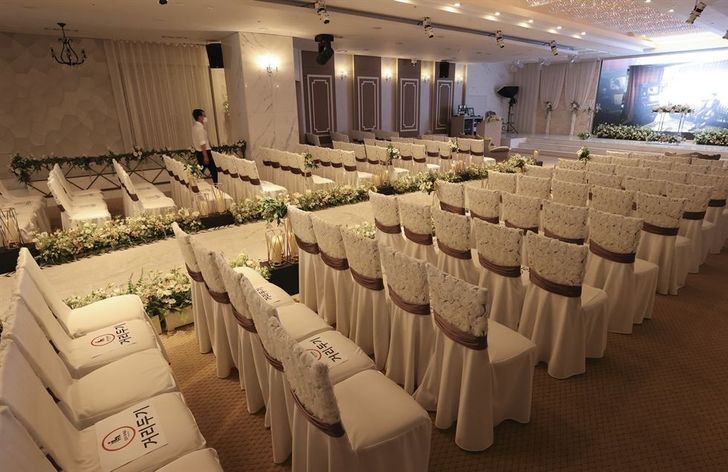
Chairs are placed at a wedding hall in Seoul, Sunday, allowing people to sit together in accordance with the government's social distancing measures. Yonhap
In response, to-be-married couples that have become angered over the planning issues have organized an association to collectively demand the government revise the social distancing rules.
There are already around 1,500 brides- and grooms-to-be participating in the group chat.
Members of the association staged one-person demonstrations in front of Seoul City Hall and the health ministry in Sejong City from Thursday to Monday, with trucks with large screens displaying their criticism against the social distancing measures and their demands.
Lee said she contributed some money to the association for the demonstration.
“Since my wedding ceremony has been continuously postponed, my fiance and I have had continuous conflicts with the wedding hall operator. If the wedding is eventually ruined, the government should provide compensation .”
Conflicts over wedding expenses between couples and wedding venue operators have been ongoing since last year.
According to the Korea Consumer Agency and the Korea National Council of Consumer Organization, the number of complaints they received regarding wedding services in July was 542, up by 211 percent from 172 in June before the current distancing rules had been introduced. For August, 240 cases were already reported within the first 10 days of the month.
Even those working in the wedding hall business are saying that the government's quarantine rules are unreasonable. They say they cannot even cover fixed expenses such as rent, electricity, and labor cost with the money for only 49 guests.
“It is better to suspend the business if we can be paid only for 49 people. When the Level 4 rule began to be applied, we asked the government twice to shut down our business forcibly like gyms or other facilities because then we can at least receive government disaster relief funds for damaged businesses,” an official of the association of wedding hall business operators.
“The government refused, saying they can't stop people having weddings. But operating our businesses in this way causes damage to us, too,” he said.