Tightened curfew, vaccine incentives draw controversy

People stand in line to receive coronavirus tests at a testing center in Gangnam District, Seoul, Friday. Yonhap
Gov't extends current social distancing measures for 2 more weeks
By Lee Hyo-jin
The government's decision to extend the current social distancing measures has drawn controversy, as many believe that such measures will not help curb the virus spread while only driving more self-employed up against the wall.
Along with the extension, the government also tightened the curfew on eateries and cafes, and expanded incentives offered to people who have been fully vaccinated for the coronavirus.
Small business owners criticized the strengthened limit on operating hours as excessive, while medical experts viewed that the “vaccine incentives” would have limited effects on boosting consumption.
As the current social distancing measures expire Sunday, the Ministry of Health and Welfare announced Friday to extend the current rules ― Level 4 in the greater Seoul area and Level 3 in other parts of the country ― for another two weeks through Sept. 5.
In addition, eateries and cafes in regions under Level 4 will be required to close at 9 p.m., an hour earlier than the current 10 p.m., amid an increasing number of infections linked to the facilities.
The government, however, has partially eased the gathering ban on groups of more than two people after 6 p.m. Under the new rules, up to four people are allowed to gather at eateries and cafes if the group includes two fully vaccinated individuals.
The health ministry noted that the new rules apply only to eateries and cafes, not to other facilities such as indoor gyms and singing rooms.
It also explained that the eased gathering ban is aimed at boosting consumption in a bid to relieve the financial woes of small business owners, while giving more freedom to the vaccinated, considering the deepening public fatigue from prolonged restrictions.
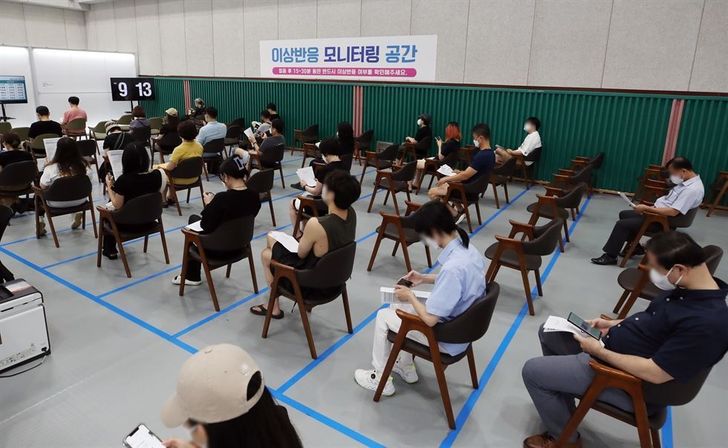
People are observed for possible side effects after receiving a COVID-19 vaccine at a vaccination center in Dongjak District, Seoul, Friday. Yonhap
The business owners, however, denounced the extension of the strongest distancing measures and the tightened curfew. Arguing that the “excessive” rules will only worsen the financial struggles of the self-employed, they called on the government to reshape its social distancing policies as the current ones are proving to be ineffective in curbing the virus spread.
“The business owners who have adhered to the government's antivirus rules over the last 18 months are now drowning in debt,” said a coalition of the self-employed across the country through a statement.
“Limiting the operation hours to 9 p.m. is a decision completely ignoring the self-employed,” it said, announcing plans to organize a drive-thru rally in protest against the measures.
Meanwhile, medical experts believed that the new rules would have limited effects on either curbing the virus spread or boosting consumption to help owners of eateries and cafes.
“Considering that only some 20 percent of the population, most of whom are the elderly population are fully vaccinated, the incentives being given to vaccinated people may not directly lead to more gatherings in the evenings,” said Kim Woo-joo, an infectious disease specialist at Korea University Guro Hospital.
Due to the sluggish vaccine rollout, a vast majority of the younger population who are more socially active haven't received the vaccine yet, he said.
“Also, shortening the business hours of eateries and cafes in the evening will have little effect on preventing infections there, as the bigger problem now is the gatherings in the daytime,” Kim added.
Despite the stringent social distancing measures, which have been in place for over a month, the coronavirus is showing no signs of abating. The country added 2,052 new infections for Thursday, including 2,001 local transmissions, raising the aggregated total to 232,859, according to the Korea Disease Control and Prevention Agency.