Is a 'living with COVID-19' strategy feasible in Korea?

People stand in line to receive a coronavirus test at a temporary testing center near Seoul Station, Aug. 17. Yonhap
Gov't may begin discussion on new strategy in late September
By Lee Hyo-jin
The current fourth wave of infections that is sweeping the country is proving to be tougher and longer than previous ones. The strongest social distancing measures, which have been in place for several weeks, have been failing to curb the virus spread.
The prolonged restrictions, including a ceiling on the number of people in private gatherings and a nighttime curfew on eateries and cafes, have significantly limited people's freedom while also causing heavy financial damage on the self-employed.
Against this backdrop, discussions have emerged that the government should reshape its quarantine policy to allow more freedom for the public, in preparation of the possibility that the country might have simply to live with the coronavirus going forward.
Some countries have already adopted “living with COVID-19” strategies. The United Kingdom has recently lifted the legal requirement to wear a face mask, eased rules on private gatherings and self-isolation measures, while Singapore is set to make a transition to a new COVID-19 protocol, under which the restrictions there are significantly eased.
Local medical experts expressed mixed views about whether such a strategy could be adopted in Korea.
Some say that the government should begin to prepare for the “new normal,” where the coronavirus becomes an endemic, while others warn against the introduction of more relaxed measures, citing the country's current low vaccination rate.
Kim Yoon, a professor of health policy and management at Seoul National University, insisted that Korea should reform its current top-down social distancing policies to more sustainable ones, considering the decrease in the fatality rate.
“The average fatality rate of COVID-19 patients was previously 0.98 percent, but in line with the vaccine rollout, the figure fell to 0.18 percent last month, similar to that of the seasonal flu. We might look for possible ways to control the coronavirus similar to the flu,” Kim said.
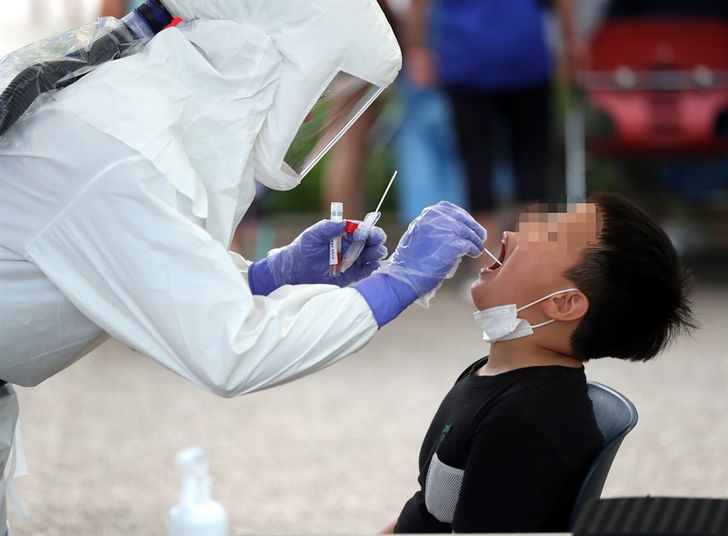
A boy receives a coronavirus test at a testing center in Incheon, Aug. 19. Yonhap
He also insisted that the stringent social distancing measures aimed at bringing down the number of daily infections have been putting an excessive socio-economic burden especially on small business owners and marginalized groups, such as the elderly and disabled people.
“The government should stop counting the number of daily new infections, as this figure should not be the threshold for determining the level of the social distancing measures. Instead, quarantine resources should be poured into strengthening Korea's medical capacity for treating critically ill COVID-19 patients.”
Other medical experts, on the other hand, believe that such discussions are premature in Korea, where the rate of fully vaccinated people is relatively low compared to those of other countries. They also believe that it is risky to consider COVID-19 to be similar to other vaccine-preventable or milder diseases, like the flu.
Chon Eun-mi, a professor of respiratory medicine at Ewha Womans University Mokdong Hospital, said, “The current level of social distancing measures should be maintained at least until the end of this year, considering the fact that a treatment for COVID-19 has not yet been developed, and some 80 percent of the population is not fully vaccinated in Korea.”
Kim Woo-joo, an infectious disease specialist at Korea University Guro Hospital, contrasted the situation in Korea with that of Singapore. “The virus situation is very different in Singapore than in Korea. Singapore is a small city-state, and its vaccination rate is higher than 70 percent,” he said.
“Also, in order to manage the coronavirus like the seasonal flu, the commercial use of COVID-19 (drug) treatments would have to be available,” he added.
The Ministry of Health and Welfare, for its part, said that the possibility of introducing a new quarantine model is not off the table, but stressed that the country should focus on curbing the current virus spread for now.
“Our immediate goal is to bring the fourth wave of infections under control, while proceeding with a swift vaccine rollout. We will discuss possible changes in the social distancing policy in the long term, through discussions with experts and monitoring the situations in other countries,” said Sohn Young-rae, a spokesperson of the health ministry, during a COVID-19 response briefing, Aug. 13.
Another ministry official added, Aug. 20, that the government may start discussing “living with COVID-19” strategy in late September or early October when more than 70 percent of the population is expected to receive at least their first shots of the vaccine.