Accelerated plan to fully vaccinate 70% of public by Oct. faces skepticism

A person goes through COVID-testing at a temporary testing center in front of Seoul Station, Monday. Yonhap
Young Koreans reluctant to get COVID jabs; supply still unstable
By Jun Ji-hye
President Moon Jae-in's assurance that 70 percent of South Korean people will have been fully vaccinated by October is facing public skepticism, as the supply of COVID-19 vaccines is still unstable and the participation rate of young people in the vaccination program has been lower than expected.
President Moon made the comment, Sunday, during a ceremony to mark the nation's liberation from Japan's 1910-45 colonial rule.
The government originally set the goal of having 70 percent of the entire population vaccinated by November to achieve herd immunity by that time.
Moon's comments meant that the government will move up the timing of achieving such a goal by one month, despite the unstable global vaccines supply due to production problems at pharmaceutical companies, and moves by some countries including the United States to offer booster shots to their people amid yet another wave of infections led by the highly contagious Delta variant of the coronavirus.
Given that these issues are beyond the government's ability to control, skeptics say Moon's projection was too optimistic.
According to the Korea Disease Control and Prevention Agency (KDCA), 43.6 percent of the entire population here had received at least their first shot as of Saturday, with the rate of people fully vaccinated reaching 19 percent.
To fully vaccinate 70 percent of the population ― or 36 million people ― some 39.9 million doses should be additionally administered, meaning that the government needs about an additional 29 million doses.
The goal could be achieved if the vaccines were delivered in accordance with the government's initial plan for August and September, as it earlier said it would receive 18.6 million doses by August and 42 million doses by September.
But the exact timing of delivery is still uncertain, as seen in the case of Moderna.
The U.S. pharmaceutical firm notified Seoul, Aug. 9, that it would supply less than half of the 8.5 million doses it was contracted to for August, due to problems at its labs related to production.
This led the government to readjust the gap between the first and second doses of mRNA vaccines ― Pfizer and Moderna ― from the current four weeks to six weeks.
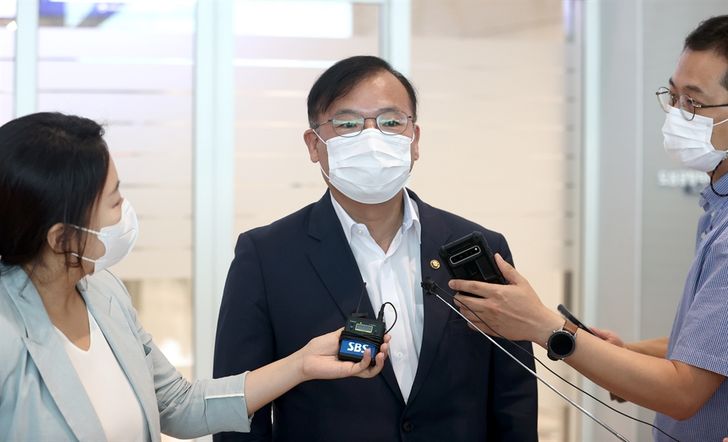
Vice Health Minister Kang Do-tae speaks to reporters before departing for the United States from Incheon International Airport, Friday, to meet with Moderna officials to discuss ways to resolve a delayed supply of vaccines from the U.S. pharmaceutical firm. Yonhap
In addition, Novavax has delayed its timeline for seeking U.S. authorization for its vaccine, raising uncertainty over whether Korea can introduce the firm's product within the fourth quarter.
The government's goal is also likely to hit a snag due to lower-than-expected participation of young people in the vaccination program.
The government is planning to administer vaccines to about 17 million people aged between 18 and 49 between Aug. 26 and Sept. 30, but the reservation rate came to only 60.4 percent as of 6 p.m. Saturday, falling short of the government's expectation of 70 percent.
“Some young people appear to be reluctant to get the vaccine shots,” said Chun Eun-mi, a professor of respiratory medicine at Ewha Womans University Mokdong Hospital. “This could be a setback in achieving the government's goal of fully vaccinating 70 percent of the population. Vaccine incentives are necessary now more than ever.”
Regarding this issue, Sohn Young-rae, a senior official from the Ministry of Health and Welfare, said, “We expect the reservation rate to increase as the reservation period has yet to be finished.”
Meanwhile, a government delegation led by Vice Health Minister Kang Do-tae, which visited the United States last week to meet with Moderna officials to discuss ways to resolve a delayed supply of vaccines, plans to announce the results of the discussion, Tuesday.
According to the KDCA, 1,556 COVID-19 cases, including 1,493 local infections, were reported, Sunday.