Pregnant women anxious over COVID-19 vaccinations

gettyimagesbank
Gov't to announce vaccination guidelines for pregnant women this month
By Jun Ji-hye
Pregnant women here are expressing anxiety over COVID-19 vaccinations, as the Korean government has yet to establish clear guidelines for them, at a time when new daily virus cases have remained above 1,000 for more than a month, with the spread of the highly contagious Delta variant of the coronavirus.
They are categorized as a high-risk group for COVID-19, as they can become seriously ill more easily once infected with the virus, compared to the general public, according to medical experts. Infected pregnant women also face a greater risk of premature deliveries and babies with low birth weights.
Choosing to get a vaccine is also not an easy option for them. Some pregnant women are raising fears over the vaccinations, due to the possibility of abnormal reactions after inoculation, and the fact that there is insufficient data about COVID-19 vaccinations and pregnancy.
“I dread being infected with the coronavirus. But at the same time, I feel scared about receiving the shots as well, even if the government decides to administer vaccines to us,” said a 39-year-old pregnant woman living in Seoul's Jungnang District.
“Every pregnant woman is very careful about their food and medicine due to concerns that they could adversely affect their baby. I think that data on the effects of COVID-19 vaccines on pregnant woman and babies is still insufficient. When I consulted with my doctor, he did not give a clear answer, either. I am uncertain about what to do.”
The government began vaccine reservations for about 17 million young adults and middle-aged people between the ages of 18 and 49 on Monday evening, lasting through Aug. 18, based on the last digit of a person's date of birth. Inoculations are scheduled to begin Aug. 26 through Sept. 30. Pregnant women, however, were excluded from this series of reservations.
The administration has postponed any announcement about vaccinating pregnant women since January, when it drew up its detailed vaccine rollout plans, citing the lack of relevant data and experience from in and outside the country.
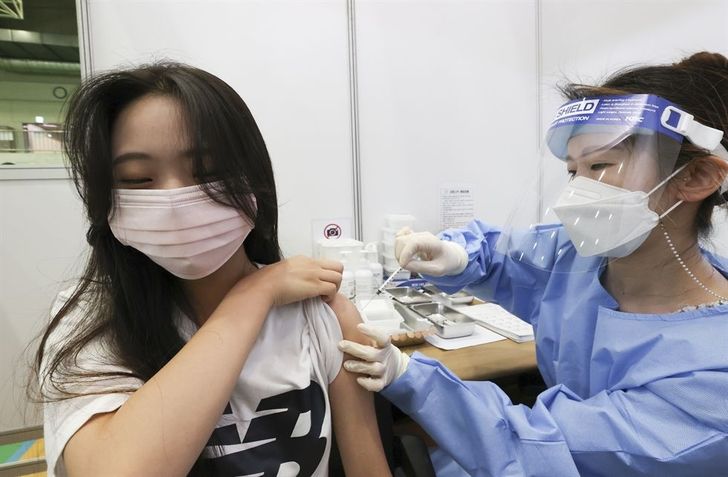
A high school senior receives her COVID-19 vaccine shot at a vaccination center in Nowon, Seoul, Monday. Yonhap
But concerns have been growing amid few signs of a slowdown of infections.
According to data submitted by the Korea Disease Control and Prevention Agency (KDCA) to Rep. Kim Mi-ae of the conservative main opposition People Power Party, a total of 323 pregnant women tested positive for the virus from Jan. 1 to July 17. Among them, 46 tested positive in July when the fourth wave of the pandemic began in Korea.
“A considerable number of pregnant women have tested positive for the virus, but there have been no particular countermeasures,” Rep. Kim said. “The health authorities should actively review cases in other countries such as the United States and the United Kingdom, as well as consult with medical experts.”
As worries are mounting, the KDCA said that consultation with the Korean Society of Obstetrics and Gynecology is currently underway to analyze the effects and risks that COVID-19 vaccinations could cause to pregnant women.
“We are analyzing cases outside the country. We will make a decision after gathering various opinions from experts,” Bae Gyeong-taek, a senior official from the KDCA, said during a media briefing.
The Korean Society of Obstetrics and Gynecology has already expressed its position that the government should advise pregnant women to receive vaccine shots.
The KDCA is expected to announce its decision on vaccinations of pregnant women as well as of children within this month.
Policies regarding vaccinations of pregnant women still differ from country to country, although the World Health Organization and the U.S. Centers for Disease Control and Prevention have advised pregnant women to receive the shots.